
Delaware lawmakers return to session to consider policies on property reassessments, education, health care
Some of the issues Delaware lawmakers plan to address include property reassessments, rising health care costs and education funding.

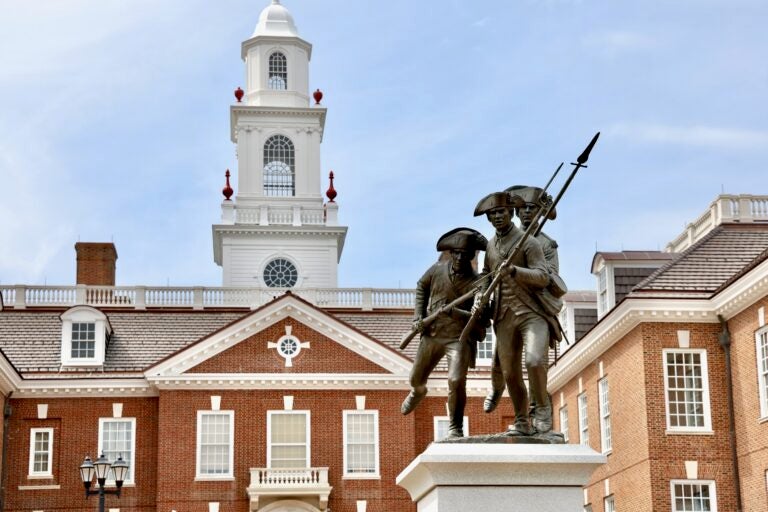
Legislative Hall in Dover, Delaware (Emma Lee/WHYY)
What are journalists missing from the state of Delaware? What would you most like WHYY News to cover? Let us know.
Delaware lawmakers return to Legislative Hall in Dover on Tuesday, picking up where they left off at the end of June. Lawmakers have frequented Dover after the end of session more often this year than in years past. They entered into a couple of special sessions to deal with high property tax bills and protecting corporate tax revenue from federal tax code changes and held a series of hearings on property reassessments.
Changes likely to how property reassessments are done
State lawmakers are likely to introduce more bills designed to make the property tax reassessment process go more smoothly in the future. They could also consider school district-related changes, such as changing how the school referendum system works. Districts are allowed to call for a referendum vote to raise additional revenue for expenses. State law also allows districts to realize a 10% increase after reassessments.
Legislators passed a package of bills in an August 2025 special session aimed at addressing the anger of New Castle County residents, who denounced increases of thousands of dollars in county and school taxes in some cases after property values were reassessed for the first time in decades.
More bills this year could be inspired by the series of hearings held last fall. Those could include whether school districts and local governments would be allowed to continue using split rates and how properties are classified.
House Bill 242, signed into law last year, allowed school districts to issue split rates for commercial and residential properties, similar to what New Castle County and the city of Wilmington did. The new law, which only applied to the 2025-2026 tax year, touched off a lawsuit brought by apartment landlords and other trade associations challenging its constitutionality. The state’s Chancery Court and the Delaware Supreme Court rulings upheld the law.
A special joint legislative committee also held a series of hearings focused on the property reassessment process, listening to counties, school districts and businesses.
“From the beginning, our committee has made it a priority to hear from as many voices as possible so that we can craft solutions grounded not in theory, but in lived truth,” said House Majority Leader Kerri Evelyn Harris in a statement.
Related Content

Avelo denies it ever had a contract to help deport immigrants. But flight tracker data shows it operated deportation flights.
5 months ago
Education could see a major overhaul this session
Lawmakers could consider legislation this year that would dramatically revamp the state’s new school funding formula and consolidate New Castle County school districts into a single county district.
Delaware’s school funding formula was created in the 1940s. Its resource-based model converts the number of children in each building into units, which determines how much money a district receives to pay for teachers, paraprofessionals, other expenses and “equalization.” In the current system, student characteristics dictate how units are generated, which are limited to grade level and special education needs.
The Public Education Funding Commission is moving to create a hybrid of that system where operational and opportunity funding would be allocated per student. The opportunity funding would be weighted toward high-needs children, such as those who are low-income and multilanguage learners. The commission’s current timeline calls for submitting legislation for consideration between March and May.
The Redding Consortium, a state group created in 2019 and tasked with redrawing school district lines serving Wilmington and northern New Castle County, voted in December to consolidate Northern New Castle school districts into one single school district for the county.
The Redding Consortium plans to spend the early part of 2026 developing a detailed plan that it will send to the State Board of Education for approval. Once the board signs off, it goes to state lawmakers for their approval.
Some elected officials and community activists remain concerned that the county district plan, at an estimated cost of $20 million, would be a politically heavy lift in the General Assembly. Brandywine School District leaders have publicly opposed redistricting.
Redding Consortium co-chair state Sen. Elizabeth “Tizzy” Lockman, D-Wilmington, said last month she’s confident lawmakers will approve this model.
“We wouldn’t be doing this if I didn’t,” she said. “I know the people there, and I believe that they want the best, not just for their constituents, but for our state. So I’m gonna say ‘yes.’”
Lawmakers could vote on a plan before session ends on June 30.
Related Content

Delaware bill would decriminalize smoking marijuana in public
Smoking marijuana in public can lead to a criminal charge and up to five days in prison. The proposal would make it a civil violation subject to a fine.
5 months ago
Listen 1:57Health care costs still rising while legislation weakens hospital review board
Delaware lawmakers will also consider a measure this session that would reduce the powers of the Diamond State Hospital Cost Review Board, which lawmakers created in 2024 to rein in health care spending. The board is charged with ensuring that hospitals align their price increases with annual health care cost growth benchmarks set by the state.
The bill, sponsored by Senate Majority Leader Bryan Townsend, would codify a settlement agreement reached last fall by the state and ChristianaCare Health System. Under the legislation, the board will not prospectively approve future budgets. Reporting salary data would be limited to officers, directors, key employees and only the highest-compensated employees. The bill would also give hospitals more time to comply with the state spending benchmark by not requiring performance improvement plans until 2027.
Delaware Healthcare Association President and CEO Brian Frazee said the compromise still ensures transparency and accountability in hospital finances.
“It holds hospitals accountable to the healthcare spending benchmark,” he said. “Including a $500,000 accountability penalty for hospitals that fail to comply. The board can also require hospitals to initiate a benchmark compliance plan for failure to meet the benchmark.”
Although the state legislature might settle the role of the hospital review board early on in session, Delawareans are still expected to pay more this year for health care.
The Delaware Financial and Economic Advisory Council capped the 2026 Healthcare Spending benchmark at 4.9% at its December meeting. But Frazee said national projections show that health care inflation is likely to rise about 9%. Director of Health and Social Services Christen Linke Young said hospitals would not be penalized for exceeding the guideline.
Delaware last saw a 9.1% increase in total health care expenditures from 2022 to 2023 that hit nearly $11 billion, according to the 2023 Calendar Year Benchmark Trend Report released last year by the Delaware Department of Health and Social Services.
Lawmakers will meet for nine days this month before taking a break for the Joint Finance Committee to go over Gov. Matt Meyer’s proposed budget, which he’ll present later this month. After that break, they’ll next be back in regular session in March.

Get daily updates from WHYY News!
WHYY is your source for fact-based, in-depth journalism and information. As a nonprofit organization, we rely on financial support from readers like you. Please give today.
Part of the series


Mike Houghton was a former Delaware Economic and Financial Advisory Council chairman and longtime member before being fired Wednesday.
2 months ago
“What we wanted to highlight at the State of the Union was that, a year later, things are not better,” said Democratic Sen. Lisa Blunt Rochester.
3 months ago

Watch: Del. Gov. Matt Meyer outlines policy priorities in State of the State
Meyer will present his priorities for 2026 as he delivers his second annual State of the State address to the General Assembly in Dover.
4 months ago