

Philly is unlocking $400M for housing. Here’s what that means for renters and homeowners
Mayor Parker's H.O.M.E. plan is entering a critical new phase. Advocates hope it helps the city's most vulnerable residents.
Listen 6:00
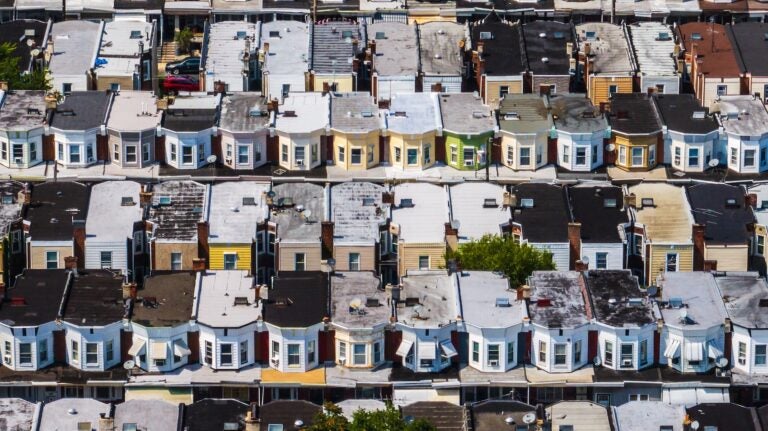
West Philadelphia rowhouses. (Kimberly Paynter/WHYY)
Have a question about Philly’s neighborhoods or the systems that shape them? PlanPhilly reporters want to hear from you! Ask us a question or send us a story idea you think we should cover.
In the coming days, Mayor Cherelle Parker’s administration will issue $400 million in bonds to fund the first phase of the Housing Opportunities Made Easy initiative, a multifaceted plan centered on building and repairing 30,000 homes in Philadelphia.
The milestone comes more than a year after Parker formally launched the effort — also known as H.O.M.E. — in response to the city’s housing crisis, marking a moment advocates hope will usher in meaningful change for thousands of cost-burdened residents.
“Through hard work, creativity, and key public-private partnerships, the Mayor and our housing team have brought Year One of HOME to the launching pad. The HOME bond funds coming in means that the rocket fuel is here and we can take off,” said Angela Brooks, the city’s chief housing and urban development officer, in a statement.
The money, exactly half of the total borrowing, will flow to dozens of programs aimed at expanding and preserving the city’s housing supply — to make homes more accessible and affordable amid a tight market with limited mobility.
And there will be a significant marketing campaign to spread the word about these resources, part of a historic investment in housing.
Here’s what else to know:
Related Content
The investments are meant to bolster the mayor’s plan to create and preserve 30,000 housing units amid an affordable housing crisis.
3 weeks ago
Listen 0:59Funding for renters and homeowners
The first annual budget for H.O.M.E. calls for $277 million in spending for nearly 30 programs, many of which already exist.
Broadly speaking, the funding will be available to renters and homeowners within a range of household income levels, but each program has its own eligibility requirements.
Collectively, the budget will serve households earning up to 120% of the area median income, or $143,300 a year for a family of four.
The wide range reflects Parker’s overarching vision for tackling the city’s housing crisis. Since the start, her administration has said the goal is to have a comprehensive strategy that fosters self-sufficiency and minimizes class contempt.
“We’re thinking about all Philadelphians across the spectrum,” said Tiffany Thurman, the mayor’s chief of staff, during a legislative hearing last May.
Notably, two of the city’s most in-demand housing programs — the Basic Systems Repair Program and the Adaptive Modifications Program — will prioritize the city’s lowest-income households, meaning the vast majority of the funding during the first year will go to those residents, including those with permanent physical disabilities.
The funding approach was codified through amendments to the annual budget in a major win for progressives, who pushed hard for the changes amid strong opposition from Parker.
“I’m glad we came back together today to continue our review of this important legislation. And I’m also glad that we kept our focus on the true face of Philadelphia’s housing crisis. Because for the H.O.M.E. plan to work, it must start by helping those who are most burdened in today’s housing market, including many of our public servants,” said City Councilmember Jamie Gauthier, chair of the housing committee, after a critical vote in December.
The federal government considers a household cost-burdened if it spends more than 30% of its income on housing. In Philadelphia, more than 250,000 households — roughly 40% — are cost-burdened, according to new research from the Philadelphia Coalition for Affordable Communities.
Related Content
West Philly tenants are racing to save 925 affordable rentals to prevent mass displacement
The subsidized units are among 12% of properties in the city that could lose their affordability restrictions over the next decade.
2 weeks ago
Listen 1:03Transforming city-owned land
For now, there aren’t a lot of concrete details when it comes to what the administration has planned for the first year of H.O.M.E.
More generally, the administration wants to use the first bond issuance to keep existing programs funded and going strong. The list includes the Basic Systems Repair Program, as well as Turn the Key, which Parker has vowed to put “on steroids” under the initiative. The building program is aimed at minting first-time homeowners, especially city workers.
“The prime concentration there is to make sure that we don’t lose the momentum,” said Jessie Lawrence, who directs the city’s Department of Planning and Development.
The administration will also focus on getting more public parcels ready for redevelopment. That primarily involves fast-tracking the disposal of 1,000 city-owned parcels.
City Council passed legislation in January containing language meant to streamline the approvals process for these parcels — so they can be sold to developers more quickly. This will be accomplished by creating a preapproved list of properties that will not require new legislation to be introduced by a district council member, who typically have final say on land-use decisions in the communities they serve through the tradition of councilmanic prerogative.
During the first year of H.O.M.E., Lawrence said the goal is to operationalize that process and get these parcels in the pipeline for disposition and redevelopment.
“Being able to say that our special disposition plan came to fruition, mobilized and actually achieved the goals that we were looking for,” he said.
It’s unclear how many of these projects will be under construction during the first phase of H.O.M.E. — or how many units the administration expects to add to its running total.
Overall, the plan calls for the construction of 13,500 new homes and the preservation of 16,500 more, a split housing experts say is achievable.
During the first two years of Parker’s term, 3,525 new units were built and 8,593 were preserved under H.O.M.E., according to data the administration shared with WHYY News.
“I’d stay tuned,” Lawrence said, “because we got some things in the works that are really going to allow us to be able to point to these numbers much more sophisticatedly than we can right now. There’ll be some dashboards available that will really allow us to kind of speak to some targets in an itemized way.”
Related Content
Philly City Council’s big housing push: What changed for renters, homeowners and developers in 2025
The mayor’s housing plan took center stage, but lawmakers also made it easier for certain renters to move and made life easier for affordable housing developers.
3 months ago
Setting expectations for H.O.M.E.
Housing experts say it will likely take time for the plan’s new programs to produce new homes.
Even if everything were in place right now, it would still take at least 18 months to complete a traditional residential development. And building anything right now remains challenging, in part because it’s more difficult to get construction loans and material costs are still elevated.
“All of those are really important endeavors to pursue. However, they’re going to take more time to actually come into effect and to essentially have an impact on the market,” said Vincent Reina, founder and faculty director of the Housing Initiative at Penn.
That means, realistically, housing production under H.O.M.E. may lag behind the initiative’s preservation goals. And it’s entirely possible that more new units will be built after Parker’s term ends than during it.
The primary election for Philadelphia’s next mayor is next May.
That said, it’s significant that the mayor and City Council are effectively on the “same page” about the administration’s housing goals, said John Kromer, who served as the city’s housing director under former Mayor Ed Rendell.
He said that should prove to be a “huge time saver,” along with using flexible bond proceeds, which are not subject to the regulatory requirements that come with federal funding. Those requirements must be documented to remain compliant, which can slow down productivity.
“We’re starting on the high ground,” Kromer said.
In the short term, the city is positioned to repair a number of existing homes — work that helps protect homeowners from displacement and preserve neighborhood identities.
Reina said the administration could also line up projects to receive gap funding through the plan’s new housing production program. Those dollars are meant to move developments across the finish line so construction can start.
“There are definitely real opportunities there, with concerted planning efforts on the city side, to ensure that those gains aren’t all just further down the road,” said Reina. “There is the opportunity for people to really tangibly see the impact of these investments pretty quickly.”
Related Content

Could Philly’s Logan Triangle transform into a hub for modular homes? Mayor Parker hopes so
For decades, the site — 35 acres of grassy lots where 1,000 rowhomes once stood — has sat empty. Parker’s proposal could change that, but residents are wary.
2 months ago
Listen 4:35Legislation to expand city’s housing supply
On the policy side, the administration will look to Council to pass additional legislation intended to increase the city’s housing supply.
Lawmakers are currently weighing a bill that would expand an existing law meant to encourage residential development in and around SEPTA stations. The proposal, which also seeks to boost ridership, has yet to be formally introduced.
City Council is also expected to consider legislation for a new property tax abatement program aimed at incentivizing developers to convert large, underutilized properties into housing. The program, recently authorized by state law, would exempt these projects from paying property taxes for up to 20 years.
The benefit would apply to any “industrial, commercial or other business property, or property used for government purposes, including a school” that is located in a “deteriorating area.”
“This … tool that we all were able to get through Harrisburg together is going to be a massive, massive opportunity to change the calculus fundamentally to take projects that could have been impossible and bring them into the realm of possibility. To revitalize our downtown, to revitalize our forgotten neighborhoods, to revitalize our waterfront and to revitalize our entire city,” state Sen. Joe Picozzi, R-Philadelphia, told reporters during a November news conference at City Hall.
Parker has said her administration is crafting legislation to send to Council early this year.
Lastly, the administration is asking lawmakers to include at least $10 million in the next budget to support her push to make Philadelphia a hub for modular home manufacturing. The mayor would like to bring up to five factories into the city to help with the production of new homes.
The budget would go toward site preparation, utilities and infrastructure improvements that “support the development of underutilized assets that could be candidates for this type of facility,” according to a spokesperson.
There is some debate over the feasibility of the mayor’s plan. While Pennsylvania is a national leader in modular home manufacturing, critics say bringing these facilities to Philadelphia presents a variety of environmental and regulatory hurdles.
“There is really a good opportunity to explore partnerships with modular housing businesses elsewhere in Pennsylvania by inviting them to consider producing components at their existing locations,” Kromer said.

Get daily updates from WHYY News!
WHYY is your source for fact-based, in-depth journalism and information. As a nonprofit organization, we rely on financial support from readers like you. Please give today.
Brought to you by PlanPhilly

PlanPhilly
In-depth, original reporting on housing, transportation, and development.
Philly landlords escalate fight over legislation aimed at protecting city renters
A motion filed Monday seeks to add new allegations to a rare lawsuit that alleges a City Council committee violated state law.
4 days ago
Listen 1:05
Bills to protect Philadelphia renters are poised for passage following landlord lawsuit
The bills are part of the Safe Healthy Homes Act, a legislative package that has drawn considerable opposition from independent landlords.
5 days ago
Listen 1:00
A vacant Philadelphia factory on Broad Street may be adapted for affordable senior apartments
The five-story property in Philly’s Spring Garden section belongs to the Philadelphia Corporation for Aging and has sat empty for years.
1 week ago