

Pennsylvania lawmakers push for new clean up law, a year after Upper Makefield pipeline leak
The legislation comes as Mt. Eyre residents continue to grapple with the Sunoco pipeline leak that contaminated six wells with jet fuel.
Listen 1:13
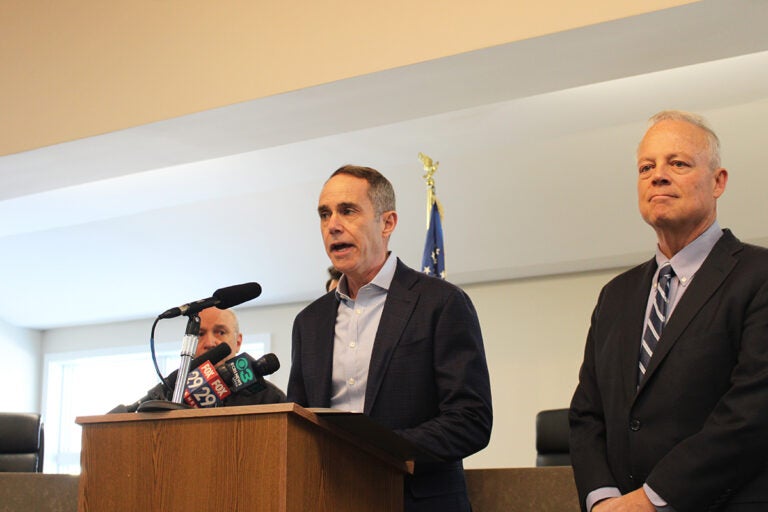
State Sen. Steve Santarsiero, left, and state Rep. Perry Warren, right, announce the Pennsylvania Environmental Cleanup and Responsibility Act in Upper Makefield Township, one year after a Sunoco pipeline leak was discovered in the area. (Emily Neil/WHYY)
From Delco to Chesco and Montco to Bucks, what about life in Philly’s suburbs do you want WHYY News to cover? Let us know!
State Sen. Steve Santarsiero and state Rep. Perry Warren announced the Pennsylvania Environmental Cleanup and Responsibility Act on Friday, a year after a Sunoco pipeline leak contaminated at least six private drinking wells in the Mt. Eyre neighborhood in Upper Makefield Township.
”We need to make sure the Pennsylvania law makes cleanup mandatory, that the state can act immediately to protect residents and the environment and that the polluter, not the taxpayer, winds up paying for all these efforts,” Santarsiero told residents and other elected officials at the Upper Makefield Township Municipal Building.
The bill’s framework, modeled on New Jersey’s Spill Act, includes the following provisions:
- Ensures that response to hazardous substance spills will be addressed immediately, and mandates that containment, investigation and cleanup by the polluter
- Guarantees residential protection and requires cleanup to standards suitable for unrestricted residential use, including the protection of drinking water, soil and air quality
- Creates enforceable timelines
- Gives more power to the state Department of Environmental Protection to act decisively, including taking over cleanup when polluters do not comply
- Ensures that responsible parties pay for cleanup through joint-and-several liability
- Strengthens funding and accountability, and funnels penalties and recoveries into a Hazardous Sites Cleanup Fund to support response efforts
- Requires DEP to establish a public information portal so residents can track cleanup progress, learn about risks and get updates on recover
Lawmakers aim to introduce the legislation by the end of February.
“Everyone in government is helping here, and yet we are constrained by the lack of comprehensive environmental cleanup responsibility law here in Pennsylvania,” Warren said, noting the bill will “give teeth” to regulators, the DEP and the state legislative and executive branches.
State law addressing hazardous spills includes the Hazardous Sites Cleanup Act, designed for cleanups and landfills and industrial facilities, Santarsiero said. The Act II remediation process falls under the Department of Environmental Protection and is what Energy Transfer, Sunoco’s parent company, is currently following.
Act II is “largely voluntary,” Santarsiero said, and lacks statutory deadlines for investigation or remediation.
“DEP lacks explicit authority to take over a cleanup immediately and recover costs later, and residents can be left waiting while responsibility and remediation plans are debated, which is exactly what has been happening over the last 12 months,” he added.
Residents’ “frustration has grown” as they continue to press for answers from Energy Transfer, said Ben Weldon, chair of the Upper Makefield Township Board of Supervisors.
Less than a quarter of the jet fuel leaked has been recovered, he said, and the company has scaled back testing and refused to maintain filters for some residents.
Related Content
Why billions of gallons of raw sewage keep ending up in Philadelphia waterways
With a new analysis showing where the pollution is going, environmental advocates call on public officials to do more to stop it.
4 months ago
Residents still don’t know how much fuel leaked, how far it spread, what chemicals were in the pipeline, how long the leak was occurring before detection and why recovery is slow, Weldon said.
“Sunoco has been able to delay, deflect and avoid accountability, in large part because the agencies overseeing this process are constrained by existing laws that must change,” Weldon said.
Energy Transfer did not immediately respond to a request for comment.
Last year, the company created a website with resources for impacted community members and has hosted a series of public meetings.
Mt. Eyre residents are ‘living in limbo’
Kristine Wojnovich said she and her family first reported the smell of jet fuel in their water in September 2023 to pipeline operator Energy Transfer. Water sampling did not show any contamination. Wojnovich reported it again in January 2025, and the leak was identified by Energy Transfer on Jan. 31, 2025.
“On behalf of our neighborhood task force and our whole community, many, many who could not be here today, but wish they could have been, we greatly appreciate any legislation that will accelerate the speed of which pipeline leaks are identified, and legislation that requires the spill to be completely cleaned up, completely, restoring the contaminated environment to its original state,” Wojnovich said Friday.
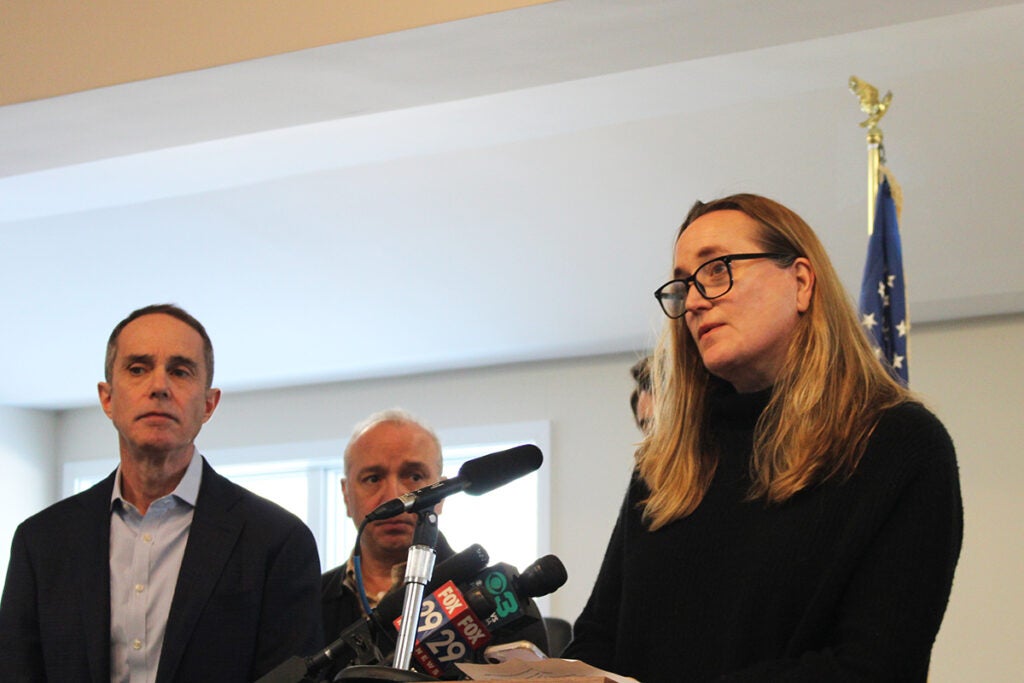
Ruth Kuenzig and Melissa Tenzer are neighbors who live adjacent to Wojnovich’s property. They described how constant digging and visits from Energy Transfer’s technicians to recover the leaked jet fuel and monitor the pipeline have upended life in the once quiet neighborhood.
“The cleanup act has not been quick enough for my liking,” Tenzer said. “I cannot believe, and [I] feel emotional coming a year later, that we’re still in this position, and we don’t have any answers.”
They told WHYY News that they continue to use bottled drinking water. Energy Transfer reimbursed them for filtration systems, but they are still fearful of how contaminants in their tap water could impact them and their family members.
“We’re not fully contaminated, but it’s still higher than the normal standards of the drinking water that is a privilege and the law and the right of human citizens to be able to have clean water, to shower, to drink,” Tenzer said.
Tenzer said she also uses bottled water for cooking and washing her face, although she uses tap water for showering.
Tenzer, who has lived in her house for more than 24 years, said she wanted to “move out immediately” when she first learned of the leak, and was “really nervous and scared and very upset all the time.”
But she said she loves the neighborhood, her house and the surrounding nature, including the parks and canal where she walks her dog every day. She added that her 21-year-old daughter, who is away at college, also “loves the house and its stability in her life.”
Tenzer’s concerns about health impacts of contaminated water remain, especially for her daughter and stepdaughter. She said she and other impacted residents are “living in limbo” as cleanup continues.
“I worry about if something happens, I’ll never forgive myself for not moving, and that’s a burden I have to live with, in making that decision to go or to stay,” she said.
Related Content
The remnants of Hurricane Ida caused millions of dollars in damage to homes and led to the deaths of four people in Bucks and Montgomery counties.
2 months ago
Listen 1:17Fitzpatrick pushes federal reforms while Pa. attorney general investigates
U.S. Rep. Brian Fitzpatrick introduced the bipartisan Wojnovich Pipeline Safety Act in November, named for Kristine Wojnovich and her family. The bill calls for a new program to replace or upgrade high-risk hazardous liquid lines, and includes provisions to expand public transparency around pipeline leaks, among other reforms.
In a letter sent Friday to the Pipeline and Hazardous Materials Safety Administration, the federal agency investigating the leak, Fitzpatrick pressed for the status of the agency’s full report and other actions.
A preliminary investigation by the administration found the leak had been going on for at least 16 months before it was identified.
Newly-elected Bucks County District Attorney Joe Khan, whose campaign highlighted the Upper Makefield pipeline leak, said Friday that his office is supporting Pennsylvania Attorney General Dave Sunday in the investigation.
“This is an all hands on deck matter,” Khan said. “There are civil, there are criminal, there are statutory fixes that we need to put in place, but I am here to tell you that the District Attorney’s Office is committed to that work and to making sure that we keep Bucks County safe.”
Khan said he and his chief of staff are working to create a plan of action in the next 120 days to determine how the Bucks DA’s Office can protect residents’ environmental rights in the future.
Several residents filed a lawsuit against Energy Transfer in March.
As the legislative process continues, Santarsiero said, he and other elected officials will continue to work with the DEP to “hold Sunoco accountable.”
“Sunoco is a company that has shown here and so many other places in our state alone, as well as elsewhere in the country, that it is not always acting in good faith, and it is not always a company that can be relied upon and do the right thing, unless they are forced to do that and are held accountable, and we will continue to work toward that,” he said.

Get daily updates from WHYY News!
WHYY is your source for fact-based, in-depth journalism and information. As a nonprofit organization, we rely on financial support from readers like you. Please give today.
Among those fighting for the seat: two former Republicans and a scientist backing universal health care.
2 months ago
Listen 1:10
Bucks County commissioners approve 8% property tax increase
The increase amounts to roughly $6 a month for residential property owners.
3 months ago
Listen 0:45
Philly suburbs record highest off-year voter turnout since 2011
Voters in Bucks, Chester, Delaware and Montgomery counties showed up in droves, despite there being no big-ticket federal race.
4 months ago