

Trump said data centers should build their own power source, but offers few details
President Trump said in his annual State of the Union address that he made deals with data centers to tamp down electricity costs for consumers. But there are few details.
Listen 1:02
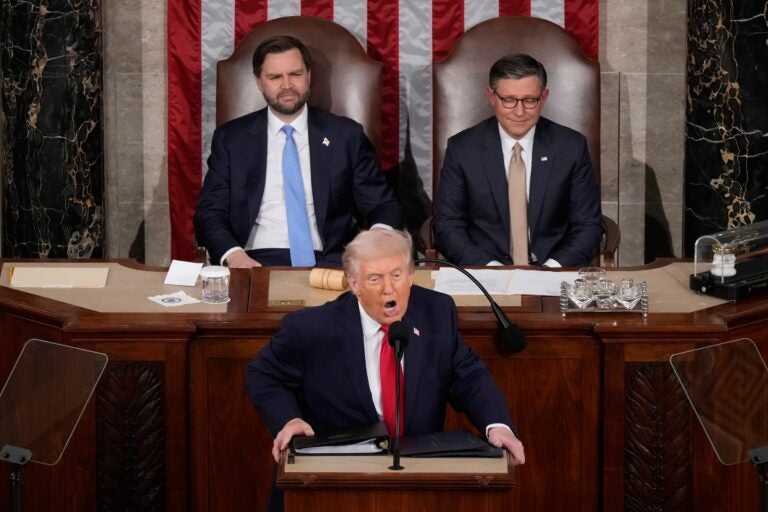
President Donald Trump delivers the State of the Union address to a joint session of Congress in the House chamber at the U.S. Capitol in Washington, Tuesday, Feb. 24, 2026, as Vice President JD Vance and House Speaker Mike Johnson of La., listen. (AP Photo/Mark Schiefelbein)
From Philly and the Pa. suburbs to South Jersey and Delaware, what would you like WHYY News to cover? Let us know!
As power-hungry data centers that serve the growth in artificial intelligence continue to draw the ire of electricity customers, regulators and lawmakers across the Philadelphia region, President Donald Trump said during his State of the Union address Tuesday evening that he’d made deals with tech companies to tamp down on rising electric bills.
“Many Americans are also concerned that energy demand from AI data centers could unfairly drive up their electric utility bills,” Trump told Congress. “Tonight, I’m pleased to announce that I have negotiated the new ratepayer protection pledge. You know what that is? We’re telling the major tech companies that they have the obligation to provide for their own power needs. They can build their own power plants as part of their factory, so that no one’s prices will go up and, in many cases, prices of electricity will go down for the community, and very substantially.”
Without giving details of the agreements, Trump called it a “unique strategy” that would have tech companies that operate data centers build their own power plants.
A major factor in rising electricity rates is due to the shrinking gap between supply and demand, with the surge in demand stemming from the amount of energy it takes to power artificial intelligence.
But it’s unclear how this will work.
“The president provided an unenforceable corporate commitment that has no details, and can’t possibly be implemented in any meaningful way,” said Ari Peskoe, director of the Harvard Electricity Law Initiative.
Peskoe said the president cannot unilaterally change how data centers get their energy, which is primarily through contracts with utilities.
“Those contracts are regulated by state utility regulators and federal regulators,” he said. “And any change in how these data centers pay for energy has to go through those regulatory processes.”
The region’s grid operator, PJM Interconnection, said data centers have led to a narrowing gap between supply and demand, which has led to increasing costs. The amount of energy required by new and proposed data centers also risks future blackouts.
Related Content

How much water do data centers use? One in Delaware City could use up to 20 million gallons a year
A proposed data center in New Castle County would use tens of millions of gallons of water every year.
2 months ago
Listen 1:03Peskoe said while data centers have generated opposition, the focus should also be on the utilities that build the infrastructure to serve them.
“The data centers now in development will consume as much electricity as a large U.S. city,” he said. “And so to provide energy to these facilities, utilities are building billions of dollars of transmission infrastructure, [including] new power lines to bring energy to these facilities. And the utilities spread the cost of those power lines to everyone.”
The costs of that infrastructure gets passed on to the average ratepayer, Pescoe said.
“They’re [utilities are] the ones that hold all the cards here and can initiate reforms regardless of any pledge by the companies or statements by the president,” he said.
In a recent budget address, Pennsylvania Gov. Josh Shapiro also said he wants to see data centers generate their own power. Shapiro promised speedier permits if they abide by “strict transparency standards and direct community engagement,” along with environmental protection and water conservation.
In a statement, Data Center Coalition President Josh Levi said the industry is “ready to do its part” to develop the facilities responsibly.
“Data centers are the backbone of modern life — powering telehealth visits, digital classrooms, banking systems, air travel, financial institutions, and online commerce,” Levi said. “Data centers are also critical to sustaining America’s leadership in artificial intelligence, strengthening national security, and driving long-term economic growth – while supporting millions of jobs across the U.S. and generating hundreds of billions of dollars in tax revenue.”
“The data center industry continues to work closely with the Administration, Congress, and other federal and state policymakers to ensure the data centers continue to pay their own energy costs, while also enabling the U.S. to remain the world’s epicenter of innovation, technological leadership, and digital resilience.”
Meanwhile, Pennsylvania, New Jersey and Delaware state lawmakers have proposed consumer protections from rising electricity rates due to data center energy use.

Get daily updates from WHYY News!
WHYY is your source for fact-based, in-depth journalism and information. As a nonprofit organization, we rely on financial support from readers like you. Please give today.
Part of the series
Philly-area MACH2 hydrogen hub spared in latest round of Trump administration clean energy cuts
The Department of Energy slashed more than $7.5 billion for clean energy projects in 16 Democratic-led states, yet Pennsylvania's "green" hydrogen hubs survive, for now.
6 months ago
Listen 1:17
The House budget bill Rep. Brian Fitzpatrick voted for would be a “disaster” for business, solar installers say.
10 months ago
Listen 2:23
How a Trump victory could stall offshore wind expansion
Trump said he would stop offshore wind on “day one” should he win the election. The wind industry worries about delays to permits and proponents worry about jobs.
1 year ago
Listen 5:56