PECO’s profits skyrocket almost 50% after 2025 rate hikes
Critics say investor-owned utilities, which enjoy a monopoly, earn too much at the expense of ratepayers. PECO says the increased rates fund needed infrastructure upgrades.
Listen 1:15
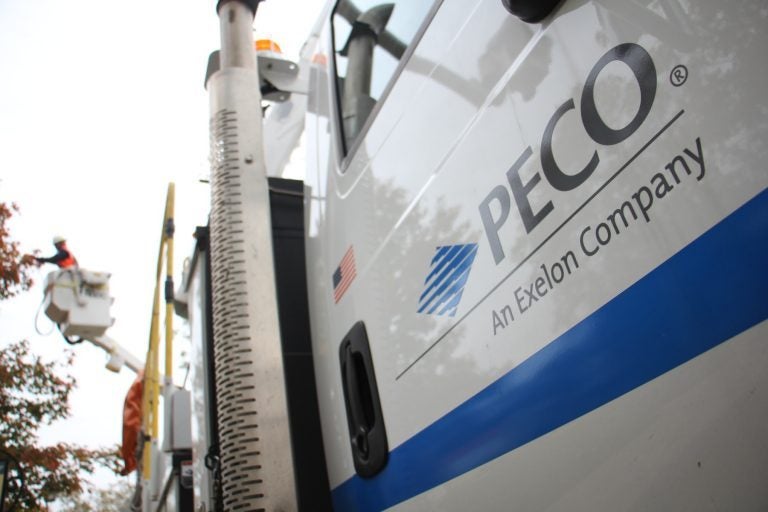
A PECO truck is seen in a file photo. (Emma Lee/WHYY)
This story is part of the WHYY News Climate Desk, bringing you news and solutions for our changing region.
From the Poconos to the Jersey Shore to the mouth of the Delaware Bay, what do you want to know about climate change? What would you like us to cover? Get in touch.
PECO’s net income shot up 47.7% to $814 million in 2025 over the previous year, according to earning reports announced earlier this month by its parent company Exelon.
Exelon, a publicly traded company that owns six utilities, including PECO, Atlantic City Electric and Delmarva Power and Light, attributed its overall 12.5% increase in net income for 2025 in part to PECO’s gas and electricity rate hikes approved by the Pennsylvania Public Utility Commission at the end of 2024. This comes as Pennsylvania Gov. Josh Shapiro criticized utility profits in his annual budget address earlier this month.
PECO’s rate hikes included a 10% increase that kicked in for electricity ratepayers in January 2025. The Philadelphia-based company also provides natural gas to suburban customers, who endured a 12.5% increase as part of the same rate hike case in 2025.
“These earnings that they’re delivering to shareholders is money that is coming from all of us,” said Alex Bomstein, executive director of the Clean Air Council. “You have the many contributing to the profits of the few here at a time when the many are in a lot of pain.”
Jeanne Jones, Exelon’s chief financial officer, said in a statement that the company’s “financial performance in 2025 exceeded expectations, with full-year adjusted operating earnings of $2.77 per share, sustaining a 100% track record of annual outperformance as a standalone utility.”
“With a $41.3 billion four-year capital plan and 7.9% rate base growth, we are well-positioned to deliver annualized earnings growth near the top end of 5% to 7% through 2029,” her statement reads.
Soon after the earnings report announcement on Feb. 12, Exelon’s stock price jumped 5.5% from $45.92 per share to $48.48 the next day.
PECO’s net profits, which rose from $551 million in 2024 to $814 million in 2025, come at a time when affordability issues are squeezing consumers. While calling for reforms, Gov. Josh Shapiro blasted these types of profits to the General Assembly during his annual budget address.
“Our utility companies in Pennsylvania, well, they make billions of dollars every year. While at the same time, they’ve increased the cost for consumers with too little public accountability or transparency. That’s going to change,” Shapiro said in front of the General Assembly.
How do gas and electric utilities make a profit in Pennsylvania?
Investor-owned utilities that provide gas and electricity make their profits on infrastructure upgrades, not the supply of gas and electricity, so the more they build, the more profit they can make. Because utilities enjoy a monopoly when it comes to the distribution of gas and electricity, any increase in distribution rates must be approved by regulators, which in Pennsylvania is the Public Utility Commission.
In recent testimony before the Pennsylvania House of Representatives’ Energy Committee, Mark Ellis, who spent 30 years as an executive in the utility sector and is now a senior fellow for utilities at the American Economic Liberties Project, said the state delivers on average a 12.8% “return on equity” to shareholders, the highest profit margins in the country. He said it costs Pennsylvania gas and electric ratepayers about $2 billion a year.
“This is not a one-time event,” Ellis explained to the committee in his presentation. “It is an ongoing transfer of wealth from customers to shareholders year after year and growing.”
The infrastructure upgrades and expansions that are the source of profit for investor-owned utilities often include new poles, pipelines, wires or substations that provide safety and reliable service. These are financed through a combination of debt and equity, or funds contributed by their shareholders. The shareholders expect a return on that investment.
Related Content
Philadelphia utility bills surged in 2025, and more increases are coming in 2026. Here’s why
Philadelphians’ electric, gas and water bills all increased in 2025. Together, the typical household is paying around $30 more per month.
3 months ago
‘How much of a reward should shareholders get for financing’ gas and electric infrastructure upgrades?
Consumer advocates say those returns on investment, referred to as ROE, or return on equity, are too high and are the source of a growing affordability crisis for the average customer. This is especially the case now, when consumers are facing the double-whammy of rising supply charges and increased distribution rates.
“My office has long championed lower returns on equity,” said Darryl Lawrence, Pennsylvania’s Consumer Advocate, who leads the state agency tasked with representing the interests of all ratepayers. “We just don’t see our regulated utilities as being high risk endeavors that should support returns on equity in the high 10s or 11% range. We think that is just beyond the pale and it just adds to affordability issues for average ratepayers.”
Lawrence said his office thinks return on equity should be less, between about 8.5% and 9.5%.
“That is one of the most fought-over items in every rate case,” Lawrence said. “How much of a reward should shareholders get for financing whatever projects need to be financed?”
But according to a report issued by the Public Utility Commission, PECO earned 10.59% return on equity in the second quarter of 2025 for electricity, and 10.19% during the same period for its gas services.
“This is crazy,” Ellis said, adding that the models used by regulators and utilities to determine those rates of return push profits much higher than if those companies were operating within competitive markets, rather than as monopolies. “A first-year MBA student could look at it and just say, ‘This is crazy,’ or somebody from Wall Street would look at it and say, ‘This is crazy,’ or an academic researcher would look at it and say, ‘This is crazy.’”
Related Content
Why Gov. Shapiro wants to scrutinize electric utility profits
Gov. Josh Shapiro has a plan to scrutinize utility profits. Investor-owned utilities say it's important to invest in infrastructure that keeps the lights on.
1 month ago
Listen 5:35What factors into rising electric bills?
One important distinction about electric and gas bills is that they’re split in two — about half of each bill is made up of supply costs, and the other half is distribution charges. While the companies do not make profits off of the wholesale cost of electricity generation, or the supply costs of natural gas, the distribution charges on gas and electric bills are not simply the one-time fee, but are linked to the amount used, and will rise with higher usage.
That usage is weather dependent. While Exelon’s earnings report referred to “favorable weather” in PECO’s territory as a factor in its 12.5% net profits, it did not work out to be so favorable for ratepayers. The winter of 2025 was colder than 2024, leading to increased gas usage while the summer was much hotter than the previous year, causing an increase in electricity usage.
PECO spokeswoman Candice Womer said in an email that the difference in weather between 2024 and 2025 was “the driving factor in making the year‑over‑year increase appear larger.”
Separate and apart from the regulated distribution charges, wholesale supply costs are also rising in part because of a shrinking gap between supply and demand caused by retiring power plants and the rise in energy-hungry data centers. This is happening in a large, 13-state footprint that encompasses the electric grid operated by PJM Interconnection, which includes Pennsylvania, New Jersey and Delaware. So if large data centers are drawing from the grid in Virginia, for example, and older coal and natural gas plants are closing in Ohio, it impacts ratepayers in the entire PJM region.
In addition to the rate hikes, all electricity customers are also paying more due to PJM capacity auctions, something that PECO has no control over. In June 2025, PECO customers saw an additional 10% increase due to rising capacity costs.
‘Too little public accountability or transparency’ regarding utility rates
When companies like PECO seek to raise distribution rates, they enter into a legal procedure known as a ratemaking case. The complex litigation includes scores of documents with financial information that many describe as opaque and confusing for the average person to understand. All cases include a public advocate to argue for lower rate hikes; in Pennsylvania that’s the Office of Consumer Advocate. Others, like labor unions, industry coalitions, business groups, environmentalists and nonprofits representing low-income customers, often participate. All parties use expert witnesses to argue for or against the original request.
Rarely do the cases end up litigated as a civil court case before the Public Utility Commission. Ellis said more than 90% enter into a settlement agreement, in which the financial information used to arrive at a specific conclusion is not public. Shapiro referred to these in his budget address as “black box settlements,” which he said should end.
“In order to reach a settlement, parties will only agree to the actual revenue number, not what each and every part of that number is,” Consumer Advocate Darryl Lawrence wrote in an email. “That is a ‘black box’ settlement, and what the Governor does not like is the fact that no ROE is explicitly stated.”
If the case were litigated, Lawrence wrote, “the PUC must decide each and every revenue issue and also decide on an ROE number.”
Lawrence added that settlements can result in consumer-friendly policies such as phased-in rate hikes or rate freezes, which the Public Utility Commission cannot order through litigation.
PECO’s most recent 2024 rate case was a settlement, which provides the public with an amount of revenue earned rather than an explicit return on equity, according to the PUC’s Hagen-Frederiksen. The Public Utility Commission approved a settlement that awarded PECO $354 million in revenue, which was less than the original request of $464 million for electricity distribution. For its suburban gas division, the utility and the parties settled on $78 million in revenue, 36% less than the company’s original ask of $111 million.
As part of the settlement, PECO agreed to make it easier for low-income customers to receive financial assistance and increased funds for weatherization.
While there is no authorized return on investment in the settlement, the Public Utility Commission does make quarterly reports that include ROEs. The most recent commission report for the second quarter of 2025, which reflects 12 months prior, shows returns higher than 10% for PECO’s electric and gas divisions.
Another PECO distribution rate increase occurred in January of this year, as the second phase of the utility’s 2024 commission-approved rate hike. As a result, the typical monthly residential bill rose an additional 2.8%, from $156.01 in December 2025 to $160.37 in January 2026.
Related Content

The lawsuit filed against PECO and the company operating the Bristol Health and Rehabilitation Center says both companies failed to evacuate residents, staff and visitors.
2 months ago
Listen 1:05A ‘perverse’ and ‘broken’ system rewards more spending on utility infrastructure
PECO argues for rate hikes by pointing to investments that shore up aging infrastructure in order to maintain reliability, especially during extreme weather events like the winter storm that dumped more than 9 inches of snow, capped with ice, across the region at the end of January.
“Rate cases also ensure we recover the costs of investments needed to maintain and strengthen the grid through just and reasonable energy delivery rates,” Womer said in an email. “PECO’s energy delivery rates and return on equity (ROE) are approved by regulators and apply only to the delivery portion of the bill.”
But it’s that type of approval by state regulators nationwide that has some calling for reform.
“These ROEs are too high and it’s just kind of screaming in everybody’s face,” Ellis said.
As part of his role at the American Economic Liberties Project, Ellis now provides expert testimony in ratemaking cases advocating for affordability. Previously, he worked for ExxonMobile, McKinsey & Company and then for Sempra, a large energy company where he managed the cost of capital for their infrastructure projects. He’s also a managing partner with Market Clear, a company that is working to create an alternative solution for what he calls “utility profiteering.”
Ellis said the modeling that results in specific return on equity for monopoly utilities is a “perverse” system because it rewards spending more money, which is provided by ratepayers.
During a rate case, utilities will tell regulators the amount needed to spend on new and existing infrastructure and point to safety issues and reliability, he said. But determining what is actually required for safety is difficult. While Ellis did not participate as an expert in the 2024 PECO rate case, he said regulators, in general, do not ask enough questions to determine how much of a profit should be made from these upgrades.
“It’s supposed to be the actual cost of capital. Like, what is the profit that [the company] would obtain if they were subject to competition?” Ellis said. “That’s the underlying principle going back 100 years. But for whatever reason, regulators set the profit much higher than the actual market-based cost of capital.”
Ellis said the opaque nature of these rate cases makes it hard for the public to follow. Additionally, he said regulators are easily confused by these complex cases because they lack expertise.
“So when a utility comes in and says, ‘I need to spend X amount of dollars for reliability or safety,’ it’s very hard for a regulator to say, ‘No, you’re overspending on safety.’ So you just have this kind of broken system,” Ellis said. “And these experts that [utility companies] hire have developed this whole parallel universe. I call it utility land finance.” Ellis explained that a company that faces market competition does not have an incentive to spend more, but rather figure out how to spend less to make a profit.
He added that regardless of whether a settled case agrees to a specific return on equity for shareholders, the company knows, in their own calculations, an ROE.
A spokesperson for Edison Electric Institute, an investor-owned electric utility trade group, defended the regulatory ratemaking process as transparent, and said the burden of proof for infrastructure upgrades is on the utilities.
“Public utility commissions conduct open, transparent rate reviews to determine which costs regulated electric companies may recover,” wrote Dani Marx, the institute’s spokesperson, in an email. “In these proceedings, electric companies bear the burden of proving that requested costs are prudent and necessary to meet customer needs. Commission staff and intervenors may review, challenge, and seek additional evidence as part of the process. Commissions then decide cases based on the evidentiary record.”
A spokesperson for the Public Utility Commission said the 2024 rate case process for both PECO’s electric and gas utilities was fair and resulted in less than the company’s original request.
“These settlements were reached by a broad group of parties representing consumer, small business, and public interests, and were supported by a fully developed record,” said Public Utility Commission spokesman Nils Hagen-Frederiksen. “In both cases, the approved outcomes reflected substantial reductions from the utilities’ original requests.”
Shapiro said he wants the commission to better examine a utility’s books and make financial details of their rate-hike requests more transparent. He asked lawmakers to pass legislation that provides guidelines for the regulator and places limits on utility profits.
“We need to have a hard conversation about the amount of profit utilities and their investors can make on the backs of hardworking Pennsylvanians,” Shapiro said in his address to the General Assembly. “S&P Global Ratings currently ranks Pennsylvania as one of the top four states in the country for utilities to make a profit.”
“We grant these utilities a monopoly — and in exchange, they have a legal responsibility to keep their costs just and reasonable,” Shapiro said. “They shouldn’t get one dollar more than what they need to meet their customers’ needs.”
Related Content

Politicians, energy providers, Big Tech and climate activists are talking about data centers. Here’s what to know.
1 month ago
What does PECO say?
In an emailed statement, a spokesperson for PECO stressed the difference between rising supply costs, which it has no control over, and the distribution rates that are approved by state regulators. They also emphasized the need for safe and reliable infrastructure, especially during extreme weather.
“Supply costs on the average residential bill have increased by as much as 80 percent or more over the past several years, meaning customers are paying more for less as supply has not kept pace with demand,” PECO spokesperson Candice Womer wrote. “At the same time, PECO continues to make significant, ongoing investments in the local energy grid because safe and reliable service is essential and expected. These investments – covering infrastructure, maintenance, storm response, and the tools and systems customers rely on – ensure we can meet customer expectations today and build a stronger, more resilient grid for tomorrow.”
In response to affordability issues, PECO points to its Customer Relief Fund, which in 2025 has allocated $10 million to customers with one-time $750 grants for their bills. Exelon recently announced an additional $2.5 million for PECO customers.
The $12.5 million total Customer Relief fund is 1.5% of PECO’s 2025 net profit.

Get daily updates from WHYY News!
WHYY is your source for fact-based, in-depth journalism and information. As a nonprofit organization, we rely on financial support from readers like you. Please give today.
Part of the series

Pa. wants to reduce vehicle collisions with animals using wildlife corridors
Across the U.S. between 1 and 2 million large animals are involved in vehicle collisions each year, according to the Federal Highway Administration.
4 days ago
Listen 1:06
Trump said data centers should build their own power source, but offers few details
President Trump said in his annual State of the Union address that he made deals with data centers to tamp down electricity costs for consumers. But there are few details.
2 weeks ago
Listen 1:02
How much water do data centers use? One in Delaware City could use up to 20 million gallons a year
A proposed data center in New Castle County would use tens of millions of gallons of water every year.
1 month ago
Listen 1:03