
Delaware Gov. Meyer promises to cap budget growth in State of the State speech
Meyer said he wants to create more statewide affordable housing and railed about high energy prices.
Listen 1:13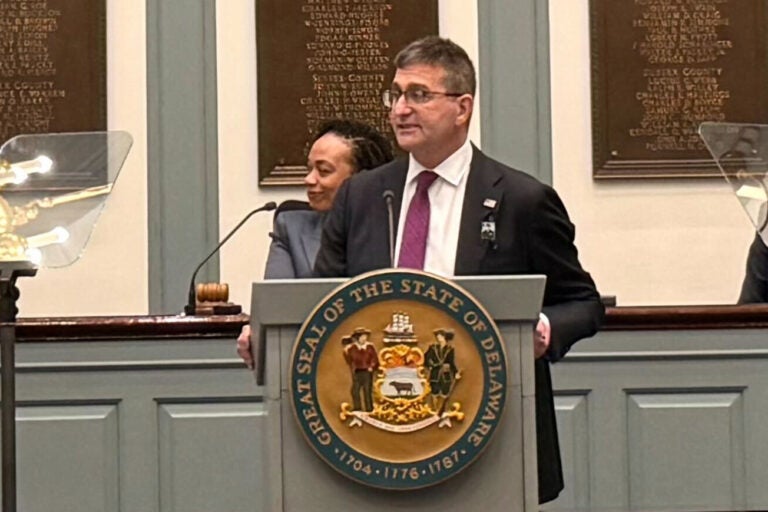
Gov. Matt Meyer delivers his State of the State address, outlining priorities on education, health care, housing, and other key issues facing Delaware.(Johnny Pérez-González/WHYY)
Delaware Gov. Matt Meyer is promising to constrain spending growth in the next state budget to less than 5%.
Meyer announced his intention to cap spending in Thursday’s State of the State speech in front of a joint session of the General Assembly in Dover. In his remarks, he highlighted several other priorities for this legislative session that focused on affordability and government efficiency.
“Over the past year, we have faced challenges, tragedy and unprecedented uncertainty, but I am here to report to you that despite this, the state of our state is strong,” he said.
State budget growth has risen year-over-year
The General Assembly’s 2026 budget was about $6.5 billion, a 7.3% increase from the prior year. That operating budget for fiscal year 2025 totaled $6.1 billion, which was a 9.3% increase from the previous year’s budget.
Speaking to reporters after the speech, Meyer said he will give more details about how he plans to reduce the growth of spending in his budget speech on Jan. 29.
“Of course, that’s only one side of the ledger,” he said. “You’re going to also hear about the revenue side next week. You’re going to see a smaller gap between revenues the state’s taking in and expenditures and our projected budget than you’ve seen in years.”
Republican House Minority Whip Jeff Spiegelman, who represents Clayton, said he welcomed Meyer’s pledge to hold back on spending growth, something he and other Republican lawmakers have complained about for years.
“We’ve been calling for that for 14 years,” he said. “Just in the last six years, we’ve grown 50%. So for him to keep budgetary growth under 5% — I mean, that’s still above inflation — but that would be great.”
The governor did not mention any efforts to reform the state’s personal income tax brackets, which he made a priority last year. State lawmakers did not take action on that.
Under the state’s current income tax system, Delawareans making more than $60,000 a year pay a 6.6% tax rate on earnings above $60,000, which is the state’s top rate. Meyer proposed last year making the new brackets with increased tax rates for income over $125,000, $250,000 and $500,000. However, he struggled to get buy-in from key legislators, including House Speaker Melissa “Mimi” Brown.
The governor said after the speech that he still supports changing personal income tax brackets.
State Rep. Madinah Wilson-Anton, D-Newark, said she was disappointed he didn’t highlight the issue in his speech.
“He did talk about the corporate franchise, which is a big part of our revenue stream, but income tax bracket reform is long overdue, and there was a lot of drama about that last year, so interesting that that wasn’t mentioned today,” she said.
Related Content

Delaware to recoup more than $300M over 3 years after law on tax decoupling takes effect
Delaware’s corporate tax revenue was at risk due to federal tax provisions passed in the “one big, beautiful bill.”
3 months ago
Listen 0:59Meyer calls out Delmarva Power on rising utility costs
Meyer also took Delmarva Power to task for its latest rate increase request. The utility, which serves 344,000 residential and nonresidential customers in the state, is asking the Delaware Public Service Commission for an overall revenue increase in electric base rates totaling $67.8 million, with an actual impact of $44.6 million to bills. That would amount to a 4.13% increase, or about $6.42 on an average residential customer’s bill, starting in July, subject to approval by the commission.
Meyer said he is urging the commission to reject the company’s rate hike requests.
“Rate increases far beyond inflation are unacceptable,” he said. “Delmarva’s out-of-state shareholders should not take advantage of Delaware’s families working to make ends meet. We must hold monopolies accountable.”
Delmarva Power said in a statement that it understands the concerns with rising energy costs and affordability.
“We agree that something needs to be done, but we cannot allow our customers to be left in the dark due to underinvestment in the energy delivery system,” spokesperson Matt Ford said.
Major education changes could be on the horizon
The governor urged lawmakers to approve a new school funding formula this year. The House and Senate education committees held a hearing this week so the Public Education Funding Commission could give an update on the creation of a hybrid formula that keeps the foundation of the state’s current unit-based system while adding simplicity and flexibility.
House Minority Leader Timothy Dukes, R-Laurel, said he would love to see the formula overhauled.
“I represent the lowest-funded district in the state, the school district of Delmar,” he said. “Kids in Delmar are just as important as kids at the beach or kids in Kent [County] or kids in New Castle [County]. Kids, wherever they are, they all deserve the same opportunity.”
The Redding Consortium, a state group created in 2019 and tasked with redrawing lines for the school districts currently serving the city of Wilmington and northern New Castle County, voted last month to move forward to implement Meyer’s preferred choice of creating a single county district at a potential cost of $20 million.
“Combining districts alone will not deliver more equitable educational opportunity,” Meyer said. “But done right, this could be a major leap forward for equal opportunity in our communities.”
Related Content
Lack of energy supply and continuing price hikes for gas and electricity this year have frustrated Delawareans over ability to afford higher utility bills.
2 months ago
Listen 1:02Housing remains great challenge
Meyer said that Delaware needs 20,000 more affordable housing units statewide. He announced an initiative to build more housing faster, proposing to streamline the permitting process, cut red tape and make the process more efficient.
“We need to be focused on smart growth that fills the housing needs of our working families while also protecting the environment,” he said.
State lawmakers from both parties said they welcomed the governor’s focus on housing affordability, while emphasizing the need to balance growth with land preservation.
Budget chief state Sen. Trey Paradee, D-Kent, said zoning reform and coordination with county governments is critical to addressing the housing shortage.
“We have to look at some of our zoning issues,” Paradee said. “I was really happy to hear him talk about preserving open space, but at the same time we need to be working with our county governments and allow high-density housing where it’s appropriate.”
Dukes also praised Meyer’s commitment to streamlining housing development.
“I say to the governor, ‘amen,’” he said. “We support you on that. We will do, as a caucus, whatever we can to help that get done.”
Dukes said expanding housing should not come at the expense of farmland and open space.
“The problem is not the land,” he said. “There’s plenty of land to build. The problem is honestly, as the governor said, getting through the red tape.”
Meyer will follow up his State of the State address next week when he presents more of his spending priorities to lawmakers in his budget address. Lawmakers will spend the next six weeks going through that proposal.

Get daily updates from WHYY News!
WHYY is your source for fact-based, in-depth journalism and information. As a nonprofit organization, we rely on financial support from readers like you. Please give today.

Delaware Supreme Court upholds controversial overhaul of state corporate law
The revamp of Delaware’s corporate code was sparked by Elon Musk’s "DExit" from the state after an Chancery Court decision not in his favor.
5 days ago
Listen 0:43
Meyer’s recommended budget would "modernize" business formation fees and raise cigarette taxes to add state revenue.
1 month ago
GOP leaders criticized Murphy on taxes, spending, energy policy and his COVID-19 response, and expressed hope for Mikie Sherrill's success.
2 months ago
Listen 1:05