

Lawmakers visit Delco’s William Penn School District to celebrate increased education budget
State lawmakers cited student gains and a landmark court ruling on equity that sided with the district.
Listen 1:08
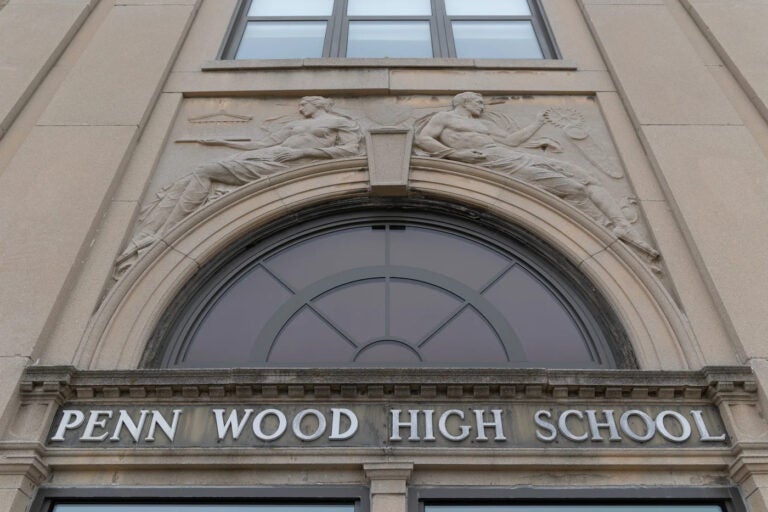
File - Penn Wood High School, in the William Penn School District (Kimberly Paynter/WHYY)
From Philly and the Pa. suburbs to South Jersey and Delaware, what would you like WHYY News to cover? Let us know!
With the next state budget proposal just weeks away, Democratic lawmakers and school officials gathered Tuesday at Penn Wood Ninth Grade Academy to tout millions in new education funding flowing to the William Penn School District.
House Speaker Joanna McClinton, whose district includes part of the school district, framed the moment as the result of years of advocacy following a 2023 Commonwealth Court ruling that declared Pennsylvania’s school funding system unconstitutional.
“We have all been on the front line fighting for change, fighting for investment because we believe you’re the future,” she said, addressing students and educators. “If you base [funding] only on the value of someone’s home and what they pay in taxes, it is not fair.”
Principal Rob Curry opened the event by highlighting improvements at the school.
“Over the past two years, the Ninth Grade Academy has made significant academic growth,” Curry said. “Our building-level score increased from 56 in the 2022-23 school year to 95 in the 2024-25 school year, nearly doubling in just two years.”
The site of the press conference was highly symbolic: William Penn School District led the legal fight that led to the landmark decision. The lawsuit argued that the state failed to provide a “thorough and efficient” education, creating vast inequities between wealthy and low-wealth districts, and violating equal protection by disproportionately harming students of color and low-income students. The Greater Johnstown, Lancaster, Panther Valley, Shenandoah Valley and Wilkes-Barre Area school districts joined the suit.
Since then, Gov. Josh Shapiro has proposed significant increases to the education budget, including a record $1 billion in February 2024 for the budget cycle that followed the decision. Shapiro’s 2025 budget proposal included another significant increase.
Under the current state budget, William Penn School District received $80 million in funding, including more than $57 million for basic and special education and Ready to Learn grants — roughly $10 million more than the previous year.
William Penn Superintendent Eric Becoats accredited the funding increase for expedient and significant gains in his district’s recent performance, noting that eight of William Penn’s 11 elementary schools “met or exceeded growth expectations” in math and English.
“Three out of every four William Penn teachers met or exceeded growth expectations in both subjects,” he said. “Nearly 90% of our Algebra 1 teachers and almost 80% of our English language arts teachers met or exceeded growth expectations” on the Pennsylvania System of School Assessment.
“Growth like that does not happen by accident,” he added, attributing it to better staffing and other academic resources.
Related Content
Pa. budget: What’s in store for public schools?
Lawmakers passed a $50.1 billion 2025-26 state budget, providing $665 million for public schools, $175 million in cyber charter reforms and expanded student support programs.
5 months ago
Despite those successes, the last two years have posed challenges for William Penn and other underprivileged districts. Early last year, the school still faced a $9 million deficit, partly because some of the new state funds were diverted to school construction projects rather than teachers and other academic resources.
In the fall, the district was forced to cut extracurricular activities while also facing other resource deficiencies, many of which stemmed from the five-month-long budget impasse that was partly caused by the debate over the education budget.
“Delays in the state budget affected the start of activities and clubs that matter to students like me,” Maurion Miller, a senior at Penn Wood High School and a third-generation William Penn student, told the lawmakers. “Consistent and full funding matters, not just in the classroom but in everything that helps us grow.”
Becoats called for a more stable system that would maintain current levels without an annual fight for funding. He said long-term capital funding is needed to move beyond temporary fixes.
“Our students need stability, not stopgaps,” he said.
State Rep. Jordan Harris, chair of the House Appropriations Committee, agreed and said that he and his colleagues are working on a capital funding plan.
“Fair funding is not a one-time fix,” he said. “It’s our ongoing responsibility, and it’s something that is extremely important to what we’re doing.”
Shapiro will give his next budget address on Feb. 3, and education funding is expected to again take center stage.

Get daily updates from WHYY News!
WHYY is your source for fact-based, in-depth journalism and information. As a nonprofit organization, we rely on financial support from readers like you. Please give today.
Part of the series

Students and advocates call for expansion, not elimination, of 5 West Philly schools
A West Philadelphia rally called for the consolidation of five schools set to be closed under the school district's plan.
2 weeks ago
Philadelphia School District proposes $225 million in budget cuts. Here’s what it means
The cuts, proposed to go into effect 2026-27 school year, begin the process of eliminating a $300 million deficit.
3 weeks ago

Students and community advocates told the school board Thursday that shuttering schools affects more than numbers.
3 weeks ago
Listen 1:10