New financing is available for Philly-area homeowners seeking to install rooftop solar
The federal residential rooftop solar tax credits expire at the end of this year. But Philly-area homeowners have another affordable option through leasing.
Listen 1:11
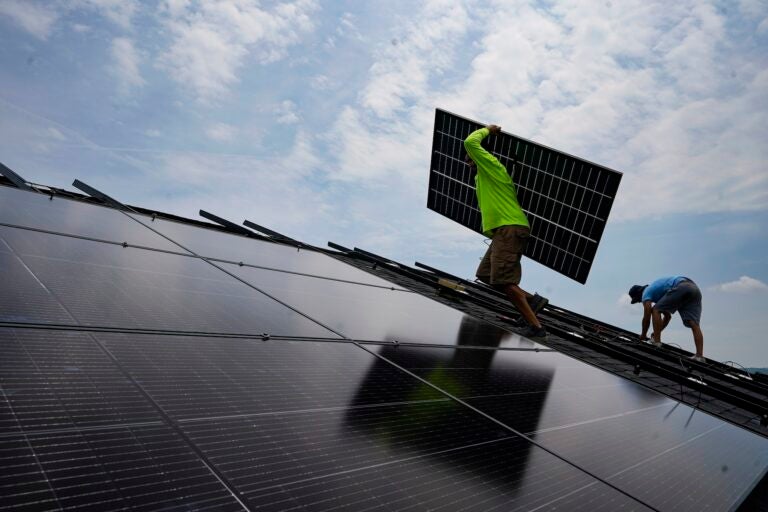
A crew installs a solar array on the roof of a home in Frankfort, Ky., in 2023. (Michael Conroy/AP)
This story is part of the WHYY News Climate Desk, bringing you news and solutions for our changing region.
From the Poconos to the Jersey Shore to the mouth of the Delaware Bay, what do you want to know about climate change? What would you like us to cover? Get in touch.
Although the residential solar tax credits expire at the end of this month, solar installers and financers are pointing to another affordable option – leasing.
“The underlying economics of solar is still really strong despite federal policy changes that we’ve seen come down over the past year,” said Maryrose Myrtetus, executive director of the Philadelphia Green Capital Corporation. “Because of the expiration of that tax credit, there’s actually been a bigger push for leasing.”
The 30% tax credit for residential solar installations that expires at the end of 2025, applied to homeowners who paid the upfront costs and owned their solar panels. But the commercial solar tax credit, which provides leasing opportunities for homeowners, remains until the end of 2027. The financing for leasing works since third parties own the installation, and pass on all or part of their 30% tax credit to the customer.
“So the third party is still able to monetize the investment tax credit,” Myrtetus said. “The tax credit value is baked into the pricing of the lease.”
Still, some solar companies have already succumbed to the tax credit rollbacks. PosiGen, a major installer of solar panels on homes in Philadelphia, went bankrupt this year — citing the loss of tax credits.
The Philadelphia Green Capital Corporation specializes in financing clean energy projects and works directly with the Philadelphia Energy Authority to bankroll Solarize Greater Philadelphia, which has helped install solar panels on about 4,000 homes in Philadelphia since 2017.
With a new $3.2 million investment from Candide Group’s Afterglow Climate Justice Fund, PGCC will partner with the Capital Good Fund’s Pennsylvania BRIGHT solar leasing program to expand the number of residential solar leases in southeast Pennsylvania.
The Capital Good Fund is a nonprofit lender that has programs in Pennsylvania, Georgia and Nevada that provides residential solar leases to households with gross annual incomes of less than $165,000. The Pennsylvania BRIGHT program provides leases with no money down and no credit score minimums.
“It really is accessible so that lower income people can take part in the savings that solar provides,” said Anika Wistar-Jones, executive vice president of America BRIGHT at the Capital Good Fund. “It’s not reserved just for the richer people who are able to do solar.”
Wistar-Jones said rooftop residential solar not only helps save money on electricity bills, but also helps tackle climate change.
“I think that’s the thing that I love most about solar is that it’s the intersection between wanting to do good for the world and wanting to do good for your pocketbook,” she said.
Related Content

As Trump administration moves away from solar energy, Philly doubles down with new Abes Run deal
The 20-year contract locks in a fixed price meant to insulate the city from rising costs. But the price is higher than what the city initially sought.
7 months ago
Listen 1:02How rooftop solar leasing can work for Pennsylvania homeowners
Pittsburgh resident Mark Gorman agrees, and said he’s very happy with the leasing option he’s taken advantage of through the Pennsylvania BRIGHT program, which paid for the installation and continues to provide long-term maintenance.
“I think by putting up panels like this and, and touting their benefits, the people living in these communities who are switching to solar are leading the way for the rest of society,” Gorman said. “Right now, we’re not getting a lot of leadership out of Washington, D.C., and Harrisburg on this issue, so I think it’s up to us to start leading instead.”
Gorman has 12 panels on a two-story brick house that he says provides enough power to sell it back to the grid. He pays about $13 a month to Duquesne Light for infrastructure, and $155 a month for leasing the solar panels and a battery that stores energy for emergencies. Last April, he said he was able to have electricity during a wind storm while his neighbors experienced power outages. If it’s a snowy or cloudy day, he will draw power from the grid.
He says his monthly payments are equal to or in some cases a bit higher than what he would have paid if he did not have solar, which he attributes to the battery system. The lease agreements have a 2% increase each year, which is lower than recent rate hikes for electricity in the state. After seven years, Gorman will have the option to buy the solar panels, or continue the lease.
Average monthly payments for participants in the Pennsylvania BRIGHT program are $88, which is less than the typical utility bill, according to the Capital Good Fund spokesperson Julia Scully. Scully said the solar leases save most households about $30 a month, or 15%.
Wistar-Jones said they work to make sure 25-year leasing agreements will save homeowners money on their electric bills over time.
“Solar as an energy source is the cheapest form of electricity or energy that humans have ever invented, and it’s an extremely affordable way of making power,” Wistar-Jones said. “And, as electricity bills rise, solar is going to become more and more important for people to take control of their bills.”
If a customer ends up selling their house, the lease would transfer to the buyer who would continue the lease payments, or pay off the system “at a significant discount,” said Scully.
Wister-Jones said that despite the end of the residential tax credits this year, and the phasing out of the commercial tax credits at the end of 2027, she’s bullish on solar.
“I feel very confident that solar is going to be a good deal for people, and create real savings even without the tax credit and so the most important thing for us at Capital Good Fund and Pennsylvania BRIGHT, is to make sure that that benefit is evenly distributed to everyone in the state, and especially the people who are really hurting on electricity bills,” she said.
At the end of the 25-year lease, Wistar-Jones said homeowners have the option to take ownership of the array or have Pennsylvania BRIGHT replace the panels.
Solarize Greater Philadelphia worked with Pennsylvania BRIGHT last year, which installed arrays on 17 homes in the city and 70 statewide. This funding will expand the program to about another 150 households across Pennsylvania.
“The nuance is that one tax credit ends, but another tax credit remains, and it’s not just big, mega scale solar farms, but can be someone’s Philly row home that benefits,” Myrtetus said.

Get daily updates from WHYY News!
WHYY is your source for fact-based, in-depth journalism and information. As a nonprofit organization, we rely on financial support from readers like you. Please give today.
Part of the series
What you can do about your rising electric bills in Pennsylvania
The National Consumer Law center said that about a quarter of all U.S. households sacrificed food and medicine to pay for their energy bills in 2024.
3 months ago
Listen 6:08
The tax credits help offset the cost of upgrades such as heat pumps, windows and insulation. They expire at the end of December.
10 months ago

Close to a dozen residents of the flood-prone neighborhood met with members of Congress Tuesday.
1 year ago
Listen 1:10