

Scrap metal safety bills advance through N.J. Assembly committee
The bills would require facilities like the EMR scrapyard in Camden to take fire safety precautions and come under new state regulation.
Listen 1:11
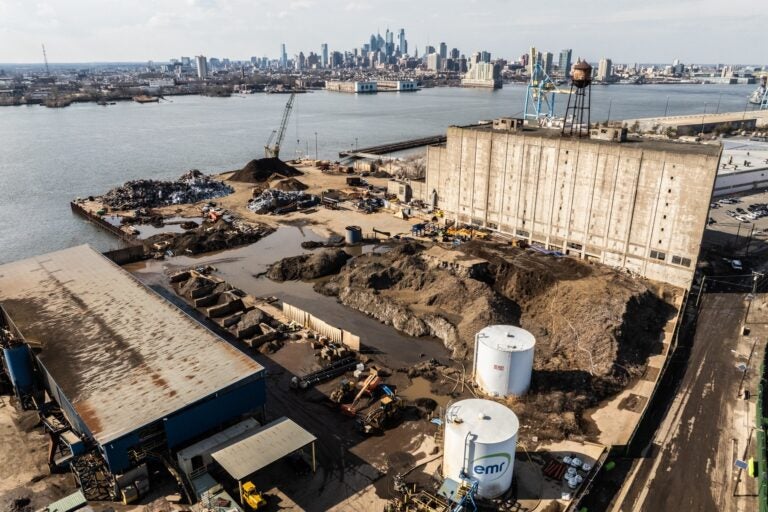
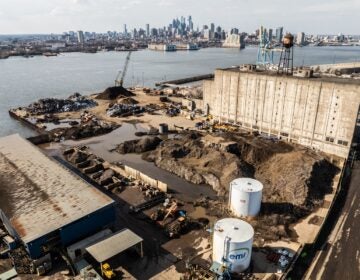
EMR Recycling in Camden, N.J., had a massive junkyard fire caused by a lithium-ion battery. (Kimberly Paynter/WHYY)
From Philly and the Pa. suburbs to South Jersey and Delaware, what would you like WHYY News to cover? Let us know!
New Jersey lawmakers are considering legislation that would impose more safety requirements and state oversight on facilities like EMR’s scrap metal recycling facility in Camden.
The New Jersey General Assembly Environment and Solid Waste committee voted Monday to release two bills, A2401 and A2406, sponsored by Assemblyman William Moen Jr., a Democrat representing Camden. The first would require scrap metal companies to install remotely operated fire suppression systems and take other steps to prevent fires. The second would require the New Jersey Department of Environmental Protection to regulate scrapyards as recycling facilities.
“Camden is not a dumping ground,” said Gary Frazier, a community activist who lives in Camden and wants to see scrap metal businesses like EMR’s held accountable for fires and pollution. “We are tired of that.”
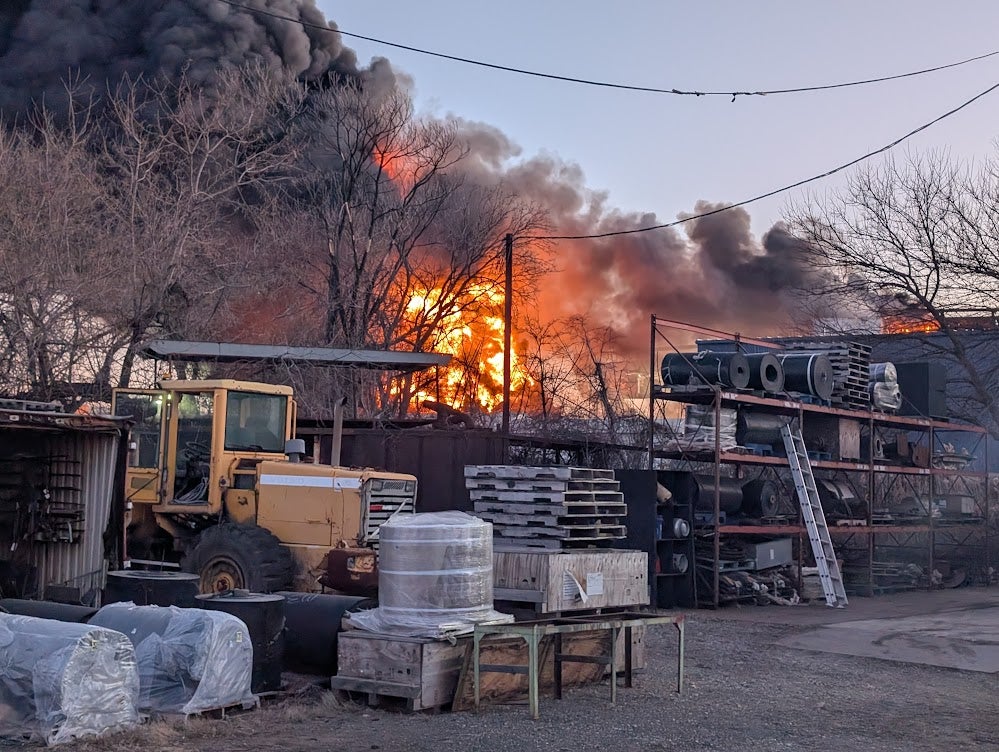
Multiple fires at Camden scrap metal recycler
In February 2025, a massive fire at a scrap metal recycling facility in South Camden owned by EMR caused roughly 100 nearby residents to evacuate their homes. The fire came close to knocking out power at a nearby sewage treatment plant and causing millions of gallons of raw sewage to back up into basements of homes across the county. Nearby residents reported coughs, headaches and trouble sleeping after the fire. EMR said the fire was sparked by a lithium ion battery improperly sent to its scrapyard.
In August, EMR signed a memorandum of understanding with the city of Camden, promising to install an enhanced fire suppression system, ramp up inspection of materials entering its property and reimburse the city for equipment damaged during the February 2025 fire. EMR also agreed to vacate a facility on South Sixth Street and consolidate operations at its facility on Ferry Avenue where the fire occurred.
The company also promised to contribute $1 million to an “essential needs” fund for residents of Camden’s Waterfront South neighborhood, managed by the Community Foundation of South Jersey.
Then in January, New Jersey’s attorney general sued EMR, claiming that 12 fires occurred at the company’s Camden facility over the last five years.
The state’s lawsuit alleged that EMR created a high risk of fires at its facilities and failed to take corrective action. The state wants the company to take numerous safety precautions, hire an outside consultant to evaluate its operations and submit quarterly reports to the state.
“Basically, if there’s a fire in the Camden city area at this point, we assume that EMR is behind it,” said Kate Delany, president of the South Jersey Progressive Democrats, during Monday’s hearing. “They have shown again and again to be pretty reckless with the pollutants that they’re spewing into our air.”
Following the suit, another fire occurred at EMR’s Camden facility last month.
Then last week, a barge owned by EMR caught fire in the Delaware Bay, sending black plumes of smoke into the air.
Related Content
Scrap metal fire on Delaware River barge now under control, officials say
Piles of scrap metal burned for more than 24 hours in the Delaware Bay. The barge is owned by the Camden scrapyard EMR, which will be taking the cargo.
1 month ago
Listen 0:59EMR supports scrapyard safety bill
In addition to installing remotely operated fire suppression systems, Moen’s first bill would require scrap metal businesses to limit the height of material piles to 55 feet, install heat detection equipment to catch fires early and develop a publicly available fire safety plan.
Joe Balzano, EMR USA’s CEO, said in a written statement that the company supports Moen’s bill that would require fire suppression safety measures at scrapyards.
“EMR is supportive of the Assemblyman’s measures to ensure all similarly situated scrapyards are required to have these enhanced safety measures,” Balzano said. “The prevalence of lithium batteries remain a persistent source of fire hazards, and the implementation of heat detectors and fire suppression systems will significantly help mitigate these risks.”
Delany and Frazier said they support the intent of the bill, but want to see the new safety requirements kick in faster.
“Demanding remote fire suppression is the right move,” Frazier said. “But giving corporate polluters 60 months to install it while our families suffer today is an insult to every family in the state of New Jersey.”
The original version of the bill would have given scrap metal businesses five years to install remotely operated fire suppression systems. An amended version circulated during Monday’s committee hearing would give smaller scrap metal businesses up to four years to comply and larger businesses two years to comply.
Related Content
New Jersey sues Camden scrapyard operator EMR over neighborhood impact
Attorney General Matt Platkin filed the suit nearly a year after a major blaze at the Camden scrapyard.
3 months ago
Listen 0:58Bill would put metal scrapyards under more state regulation
Last year, Shawn LaTourette, then-commissioner of DEP, told residents the state’s environmental agency has limited oversight over scrap metal recyclers like EMR. Moen’s second bill, which would result in scrapyards being regulated by the state as recycling facilities, says the burden of regulating scrap metal facilities has fallen to municipalities, “with the unintended effect of inconsistent operational and environmental controls placed on these facilities throughout the State.”
Taylor McFarland, conservation program manager of the Sierra Club’s New Jersey chapter, said the bill would close a regulatory loophole and give DEP the “authority and enforcement teeth” needed to protect residents.
“[The bill] is a common solution to a public health crisis,” McFarland said. “It ensures that the scrap metal industry is accountable to its neighbors and that the recycling process is truly clean and safe.”
Frank Brill, speaking on behalf of the Recycled Materials Association, opposed both bills during the committee hearing and said he is working with Moen on amendments to the first bill. He said the bills would create more costs and bureaucracy for small scrap businesses, which he said perform a vital service recycling scrap metal and should not be lumped in with solid waste disposal businesses.
“It’s just going to bring all those scrapyards and metal shredders under the DEP, which no one in their right mind would want to be,” Brill said. “It’s just going to involve more expense, more paper handling, inspections — all kinds of things that are going to slow down and hurt these businesses. They don’t deserve this.”
EMR’s Balzano did not specify the company’s stance on Moen’s second bill.
Last session, similar bills passed the Assembly but not the state Senate.
The bills will need to be voted on before the full General Assembly, pass the state Senate and be signed by Gov. Mikie Sherrill before they could become law.
Correction: An earlier version of this story identified Taylor McFarland by her previous job title. McFarland is conservation program manager of the Sierra Club’s New Jersey chapter.

Get daily updates from WHYY News!
WHYY is your source for fact-based, in-depth journalism and information. As a nonprofit organization, we rely on financial support from readers like you. Please give today.
Part of the series

N.J. General Assembly passes bill requiring scrap metal facilities to improve fire safety measures
The bill would require scrap metal facilities to install heat detection equipment that could identify fires early, as well as develop fire safety plans.
1 month ago
Listen 1:12
A top GOP leader says a priority this year is affordability. He believes it’s unhealthy for the state to be dominated by one party.
3 months ago
Listen 1:11
A New Jersey Senate committee has approved a bill to create emergency registries, to let older adults sign up for assistance during a crisis in the county where they live.
11 months ago
Listen 0:59