

N.J. General Assembly passes bill requiring scrap metal facilities to improve fire safety measures
The bill would require scrap metal facilities to install heat detection equipment that could identify fires early, as well as develop fire safety plans.

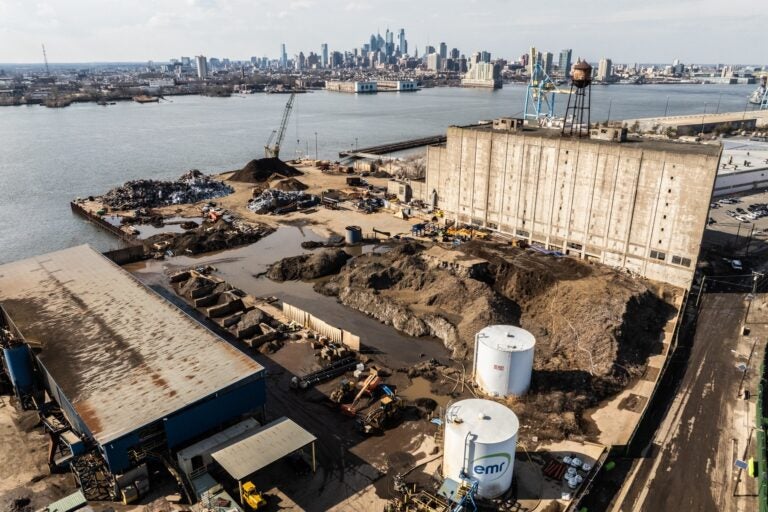
EMR Recycling in Camden, N.J., had a massive junkyard fire caused by a lithium-ion battery. (Kimberly Paynter/WHYY)
From Philly and the Pa. suburbs to South Jersey and Delaware, what would you like WHYY News to cover? Let us know!
A bill that would require scrap metal recycling facilities like EMR in Camden to expand fire safety precautions passed New Jersey’s General Assembly on Monday.
The bill, A2401, would require facilities to install heat detection equipment that could identify fires early, develop fire safety plans and limit the height of material piles to 55 feet. Facilities over a certain size would also need to install fire suppression systems that could be operated remotely.
“There’ve been a number of scrap metal fires that have occurred over the last five to 10 years,” said Assemblyman Bill Moen, a Democrat representing Camden who sponsored the bill. “We have an opportunity as a state to really have an impact on limiting those fires from happening.”
New Jersey’s Department of Environmental Protection estimates that around 440 scrap metal facilities operate in the state.
EMR’s scrap metal recycling facility in Camden has had several fires in recent years, including one in February 2025 that caused around 100 nearby residents to evacuate their homes. The company agreed to install an enhanced fire suppression system under a memorandum of understanding with the city of Camden last year.
Joe Balzano, EMR USA’s CEO, said in a written statement last week that the company supports Moen’s bill.
“EMR is supportive of the Assemblyman’s measures to ensure all similarly situated scrapyards are required to have these enhanced safety measures,” Balzano said. “The prevalence of lithium batteries remain a persistent source of fire hazards, and the implementation of heat detectors and fire suppression systems will significantly help mitigate these risks.”
Related Content
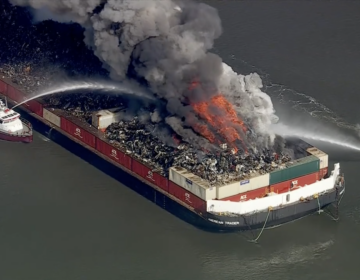
Scrap metal fire on Delaware River barge now under control, officials say
Piles of scrap metal burned for more than 24 hours in the Delaware Bay. The barge is owned by the Camden scrapyard EMR, which will be taking the cargo.
2 weeks ago
Listen 0:59Environmental, progressive and community advocates pushed Moen to shorten the compliance timeline outlined in the bill. Moen amended the bill last week to give scrap metal facilities between one and four years to comply with the bill depending on their size, down from a five-year timeline in the original bill.
The Recycled Materials Association, a trade group representing businesses including metal recyclers, opposes the bill. Frank Brill, a lobbyist working for the group, said it would hurt small businesses.
“There are scores of small scrapyards in the state, and putting them through all the expense of all this technology and equipment and record keeping and all the rest of it is just not right,” Brill said during a meeting of the Assembly Environment and Solid Waste Committee last week. “It’s not fair, and it’s hurting an industry which, quite frankly, is one of the major contributors to recycling tonnage in this state.”
Moen said Monday that the changes made to the bill before last week’s committee hearing addressed the Recycled Materials Association’s criticism, by limiting the requirement for remotely operated fire suppression systems to larger facilities. He said large scrap metal facilities, like the one owned by EMR in Camden, should be able to afford these systems.
“We’re going to expect that they’re taking steps to invest in their facilities at a certain level that probably … is manageable for them in terms of the revenue that they’re making each year operating in the state,” Moen said.
“I’ve heard from industry and from Mr. Brill that these bills are inconvenient and bad for business,” he added. “I’d welcome them to come to the Waterfront South community in the city of Camden, look the residents in their eyes and tell them that this is inconvenient and bad for business.”
The bill would need to pass the state Senate and be signed by Gov. Mikie Sherrill before it could become law. A similar version passed the Assembly last year, but did not make it through the state Senate.
Several other bills that would impact the scrap metal industry are pending before the New Jersey Legislature. These include another bill sponsored by Moen that would require the state Department of Environmental Protection to regulate scrap metal facilities as recycling facilities, giving the agency greater oversight over the facilities.
A bill introduced to the state Senate would require scrap metal recyclers to obtain permits to store the nonmetallic waste left over when cars are shredded, also known as auto fluff, and include this material in the definition of hazardous waste under the state’s Solid Waste Management Act.

Get daily updates from WHYY News!
WHYY is your source for fact-based, in-depth journalism and information. As a nonprofit organization, we rely on financial support from readers like you. Please give today.
Part of the series

Scrap metal safety bills advance through N.J. Assembly committee
The bills would require facilities like the EMR scrapyard in Camden to take fire safety precautions and come under new state regulation.
1 week ago
Listen 1:11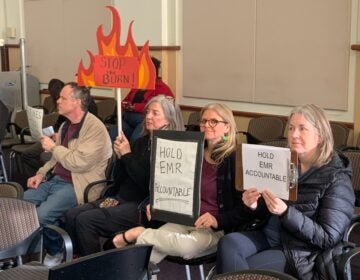
Camden City Council approves regulating lithium-ion batteries after massive EMR fire
EMR says lithium-ion batteries at their scrapyard caused a four-alarm blaze. Residents are skeptical it will hold the yard operator accountable.
12 months ago
N.J. proposes diverting $20M in Sandy funds to improve Atlantic City infrastructure
New Jersey is proposing a transfer of $20 million in federal funding to repair and replace Atlantic City infrastructure and public facilities damaged by Superstorm Sandy.
6 years ago