

Bills to protect Philadelphia renters are poised for passage following landlord lawsuit
The bills are part of the Safe Healthy Homes Act, a legislative package that has drawn considerable opposition from independent landlords.
Listen 1:00
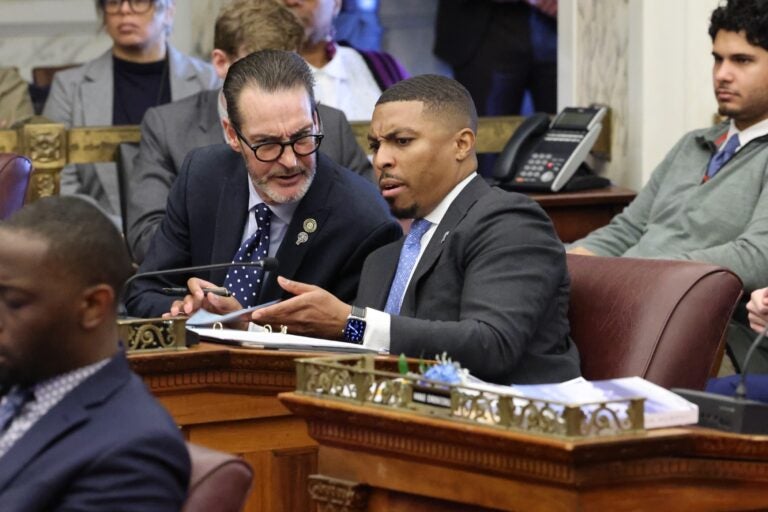
Philadelphia City Councilmember Nicolas O'Rourke with Councilmember Jim Harriity. (Emma Lee/WHYY)
Have a question about Philly’s neighborhoods or the systems that shape them? PlanPhilly reporters want to hear from you! Ask us a question or send us a story idea you think we should cover.
For the second time this month, Philadelphia lawmakers have advanced contested legislation aimed at enhancing and expanding protections for city renters.
City Council’s housing committee approved two bills Monday following a public hearing prompted by a recent court settlement between the city and two landlords.
A final vote on the legislation is now expected on April 16.
“This is about protecting tenants from landlords who refuse to follow the law … who do not take their responsibility to provide safe, healthy homes seriously,” said Councilmember Nicolas O’Rourke, who introduced the bills nearly a year ago.
The bills are part of the Safe Healthy Homes Act, a legislative package that has drawn considerable opposition from independent landlords, who argue the bills will do little to hold bad actors accountable.
Supporters say the legislation will help reduce instances of landlord retaliation and empower tenants to speak out about their dangerous living conditions, a major marker of the city’s ongoing affordable housing crisis.
If passed, the city would be authorized to create a proactive rental inspections program. Fair housing advocates say that would help protect tenants who fear retaliation if they file a formal complaint to cure code violations in their apartment or building.
The legislation would also expand “good cause” protections to all renters, regardless of the term of their lease. Currently, the law applies only to month-to-month renters and leases that run for less than a year. For these renters, landlords must provide written notice stating why they want to terminate or not renew their lease.
Advocates say the exemption has provided cover for unscrupulous landlords to use this form of eviction to retaliate against tenants with longer leases because they aren’t required to justify their decision or give renters advanced notice.
Additionally, O’Rourke’s package clarifies that renters have the right to sue for back rent if they learn their landlord illegally collected payment. Under the law, landlords must have an active rental license and a certificate of rental suitability to collect rent.
As it stands, the law is not definitive on whether a tenant can recoup rent they’ve already paid if they find their landlord is violating city law.
Related Content
A vacant Philadelphia factory on Broad Street may be adapted for affordable senior apartments
The five-story property in Philly’s Spring Garden section belongs to the Philadelphia Corporation for Aging and has sat empty for years.
5 months ago
Philadelphia landlords oppose the bills
During Monday’s hearing, tenants urged the committee to again pass legislation they say will help improve the lives of low-income residents across Philadelphia, most of whom cannot afford to move when their apartment becomes uninhabitable.
“These bills are the bare minimum for landlords to follow,” said Theresa Howell, a member of OnePA Renters United Philadelphia, which helped craft the legislation.
Landlords and property managers told lawmakers they support the bills’ intent but raised concerns about unintended consequences they said they’ll have on their businesses. Several suggested technical changes to the legislation that they say would help mitigate those concerns.
“The title of the bill is great … but the language needs work,” said Seth Floyd, a longtime landlord and realtor.
Lev Kravinsky, CEO of the Lindy Communities Company, argued the legislation will inadvertently harm law-abiding landlords facing administrative delays who are making a “good faith” effort to cure code violations at their properties. For example, he said the city’s Department of Licenses and Inspections often takes weeks to clear violations due to scheduling constraints — violations that can prevent a landlord from being able to legally collect rent.
“I urge the council members present today to hold these bills until they can be amended so as not to upend the property management industry. I truly believe that protecting tenants is not at odds with regulating property management,” said Kravinsky, who’s also the secretary for the Pennsylvania Apartment Association.
O’Rourke said the bill addresses this issue with a “safe harbor” provision meant to protect landlords against being penalized when the city is to blame.
The opposition came roughly two weeks after Floyd sued City Council’s housing committee for allegedly violating the state’s Sunshine Act during a public hearing in early March.
The measure is meant to stop public agencies, including legislative bodies, from making decisions in secret without public input. The lawsuit alleges the committee violated the law, as well as the city’s home rule charter, by deliberating and reaching a consensus on the bills behind closed doors before the hearing started.
The suit was filed and settled a day before Council was scheduled to take a final vote on the legislation. Under an agreement with the city, O’Rourke’s bills were instead sent back to committee so a new hearing — and a new vote — could take place.

Get daily updates from WHYY News!
WHYY is your source for fact-based, in-depth journalism and information. As a nonprofit organization, we rely on financial support from readers like you. Please give today.
Brought to you by PlanPhilly

PlanPhilly
In-depth, original reporting on housing, transportation, and development.
Mayor Parker vows to help preserve hundreds of subsidized rentals in the West Philly area
The announcement comes more than a year after the owner of Neighborhood Restorations told the city he planned to sell his portfolio of affordable units.
5 days ago
Listen 1:34
Why Philly’s public housing costs an average of $315,000 per unit
PHA’s $6.3 billion plan would remake its aging housing portfolio. Its per-unit estimate, which rivals the value of many Philadelphia homes, doesn’t tell the full story.
2 weeks ago
Listen 1:59
North10 is helping contractors and households pay to dispose of waste legally, diverting thousands of pounds of trash from illegal dumpsites.
2 weeks ago
Listen 0:59