
Philly’s housing market pains are expected to continue in 2026: ‘Everyone is kind of stuck’
With high home prices and mortgage rates, renters and homeowners still won’t have much mobility in the new year.

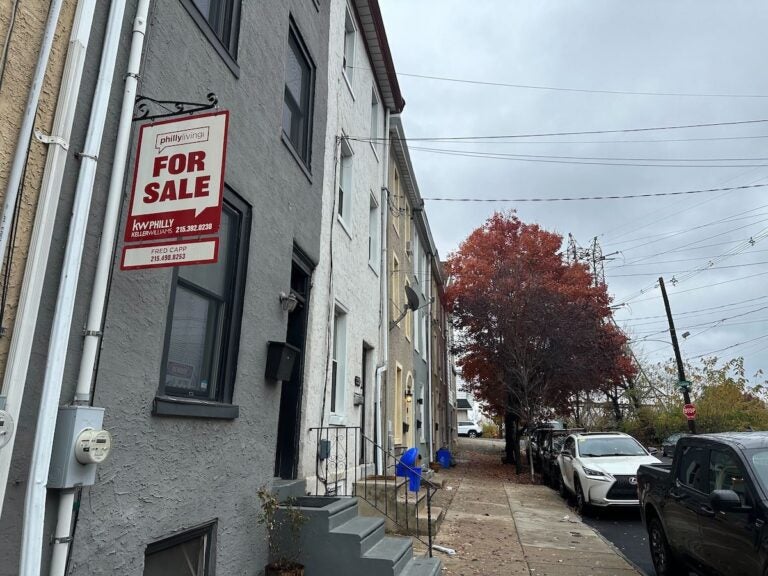
A single-family home in the East Falls neighborhood in Philadelphia in 2023. (Kristen Mosbrucker-Garza/WHYY)
Have a question about Philly’s neighborhoods or the systems that shape them? PlanPhilly reporters want to hear from you! Ask us a question or send us a story idea you think we should cover.
Philadelphia’s housing market will continue to strain renters and homeowners in 2026, according to economists.
“Everyone is kind of stuck,” said Mark Zandi, chief economist at Moody’s Analytics.
Home prices and mortgage rates remain elevated, creating a tight market with little mobility.
“That means that people are staying in their homes, whether they own or rent, for much longer than they have historically,” Zandi said.
The cost of buying a home continues to sideline renters because they’re unable to afford a down payment or mortgage. At the same time, many homeowners aren’t selling because they can’t afford to move into a new place with higher monthly payments, a predicament that is often the result of refinancing during the pandemic, when rates were much lower.
During the pandemic, mortgage rates were about half what they are today.
Economists say this logjam is unlikely to loosen in 2026, particularly for middle- and lower-income households, in part because there aren’t as many new units being built for those residents. That’s particularly problematic for low-income renters who may want to move but can’t because there aren’t any places that are safe and affordable for them.
By contrast, real estate developers are building more high-end and luxury homes. Over the last five years, the share of homes that sold for $1 million or more in the region is five times greater than it was in 2019, according to a recent report from the Lindy Institute for Urban Innovation at Drexel University.
Kevin Gillen, a senior research fellow at Lindy, said this “mini bubble” could put pressure on affordability by raising prices for first-time homebuyers as well as homeowners looking to upgrade.
“The housing market metaphorically is like a chain of dominos,” Gillen said in September. “If I jam up the domino at the very end of the chain, it can jam up the whole chain.”
Related Content
The measure is expected to pass during a second and final vote scheduled for Council's final regular meeting of the year.
3 months ago
Listen 1:09A potential silver lining is that Philly’s rental market has stabilized over the last year, meaning rents are expected to remain flat in 2026, in part because supply and demand are no longer out of balance in some of the city’s wealthier neighborhoods, including Fishtown and Northern Liberties.
That means the city’s rental market has been able to serve as a “pressure release valve” for the housing market, Gillen said.
“We’ve seen greater accessibility because we’ve got more supply. But we haven’t seen the rental market crash because of oversupply or a bubble. And we haven’t seen it crash the housing market either because suddenly everyone wants to become a renter,” he said.
“You’ve got what we call a Goldilocks situation: not too hot; not too cold,” Gillen added.
It’s unclear what impact, if any, Mayor Cherelle Parker’s signature housing plan will have on these trends, at least during the first year of the initiative.
The $2 billion plan, dubbed the Housing Opportunities Made Easy, or H.O.M.E., initiative, is rooted in creating and preserving 30,000 units of housing amid an affordable housing crisis. During the first year of the plan, about $277 million will be spent on dozens of programs designed to help renters and homeowners.
Over time, Gillen says he doesn’t expect the initiative to make Philadelphia’s housing market more affordable, but he could see it stabilizing prices, potentially reducing instances of displacement caused by rapid gentrification.
“We’ll see a reduction in price volatility, which I think everyone would agree is good. Everyone likes more certainty over future prices, right?” Gillen said.

Subscribe to PlanPhilly
WHYY is your source for fact-based, in-depth journalism and information. As a nonprofit organization, we rely on financial support from readers like you. Please give today.
Brought to you by PlanPhilly

PlanPhilly
In-depth, original reporting on housing, transportation, and development.
No new Philly anti-dumping initiatives in Parker’s third budget proposal
Parker’s $7 billion budget proposal would continue existing efforts to combat litter and illegal dumping and add funding for 125 cameras.
4 hours ago
The investments are meant to bolster the mayor’s plan to create and preserve 30,000 housing units amid an affordable housing crisis.
15 hours ago

The $2 billion plan — the Housing Opportunities Made Easy initiative — is rooted in creating and preserving 30,000 units of housing, and is backed by a massive bond.
9 months ago
Listen 1:08