
Philly City Council vote unlocks $800M for housing, shifting more aid to lowest-income residents
The legislative hurdle was cleared after intense pressure from Mayor Cherelle Parker opposing the changes to the H.O.M.E initiative's first phase.
Listen 1:06
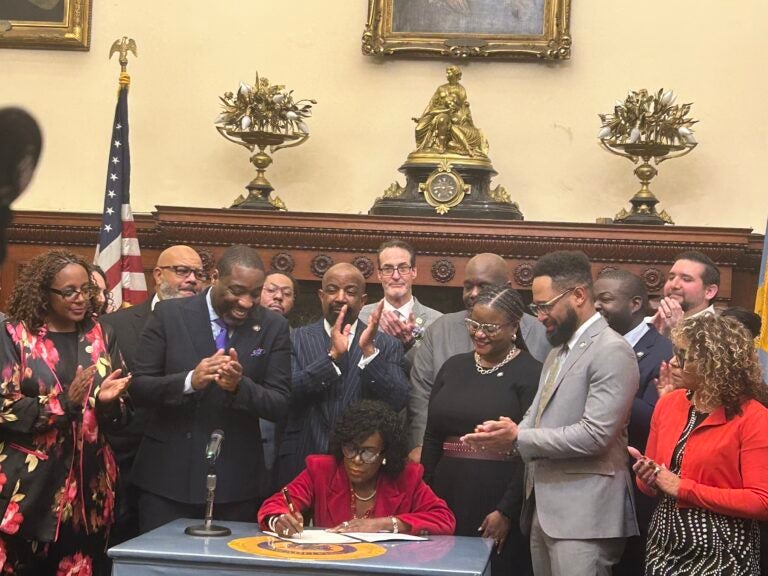
Mayor Cherelle Parker signs bond ordinance for Housing Opportunities Made Easy initiative on Thursday. (Aaron Moselle/WHYY)
Have a question about Philly’s neighborhoods or the systems that shape them? PlanPhilly reporters want to hear from you! Ask us a question or send us a story idea you think we should cover.
For the second and final time, City Council has approved a bill authorizing the city to borrow $800 million for Mayor Cherelle Parker’s signature housing plan, capping a protracted legislative process that saw lawmakers publicly spar with her administration.
Council on Thursday unanimously passed an amended version of the measure — the centerpiece of the Housing Opportunities Made Easy initiative — during the body’s first meeting of the new session.
The bill was the last legislative hurdle before borrowing could start for the $2 billion plan, commonly referred to as H.O.M.E. The multifaceted initiative is rooted in creating and preserving 30,000 housing units.
After a meeting lasting more than three hours, Council President Kenyatta Johnson called it a “win-win” for city residents.
“At the end of the day, it’s about making sure individuals become first-time homebuyers, making sure individuals have a chance to have their home prepared and making sure we address the issue of homelessness,” Johnson said.
Parker signed the legislation during a ceremony Thursday afternoon.
Related Content
New Pennsylvania loan program seeks to expand affordable rentals for at-risk populations
The $35 million initiative comes courtesy of the American Rescue Plan. The funding will be distributed by the Pennsylvania Housing Finance Agency.
2 months ago
Listen 1:07Coming together ‘with urgency and purpose’
In December, Council approved the first annual budget for the H.O.M.E. plan.
The measure calls for $277 million in spending for more than two dozen programs for renters and homeowners, many of which already exist.
The vote came amid intense pressure from the Parker administration, which strongly opposed changes made to the measure to prioritize Philadelphia’s lowest-income households. It also triggered changes to the bond bill first passed in June, requiring Council to pass the amended legislation before the funding for the plan could be unlocked.
That’s now expected to happen in late March or early April.
The updated budget measure is considered a major win for progressives. It includes increased funding for affordable housing preservation and production, a popular home repair program, and an effort to help tenants facing eviction and homelessness.
The resolution, which did not require Parker’s signature, also changed how funding will be allocated for two of the city’s most in-demand housing programs.
“The final H.O.M.E. Year One Budget represents what’s possible when lawmakers, housing experts, and community advocates come together with urgency and purpose,” Councilmembers Jaime Gauthier and Rue Landau, chair and vice-chair of Council’s housing committee, wrote in a joint statement.
Under the legislation, 90% of funding for the Basic Systems Repair Program and the Adaptive Modifications Program will go to households earning up to 60% of area median income, or about $71,640 annually for a family of four. The data point includes some areas of the Philly suburbs, as well as South Jersey and parts of Maryland.
The remaining 10% of the funding for those programs go toward households earning between 60% and 100% of the area median income, or annual incomes between about $71,640 and $119,400 for a family of four.
In the months before the vote, lawmakers had clashed with the mayor’s administration over those details, including a war of words between Johnson and Parker. Johnson said in a statement at the time that Council’s “responsibility is not to rubber stamp legislation.”
The mayor and her administration also actively lobbied lawmakers in hopes of changing the outcome. And Parker took her message on the road, spending hours one Sunday pushing her vision for H.O.M.E. at nearly a dozen churches in the city.
Since the start, the administration has been adamant that the mayor’s plan serves everyone who needs help with housing — from low-income renters to middle-income homeowners. And she vowed to never engage in policymaking that pits the “have-nots against those who have just a little.”
However, lawmakers, particularly Council’s progressive bloc, have argued the city has a duty to help its most vulnerable households first.
Following Thursday’s bill-signing ceremony, Parker told reporters she never considered the debate over the plan’s first phase to be “pugilistic.”
“We’re supposed to have that kind of exchange,” Parker said. “As long as in the end we get to ‘yes.’”

Get daily updates from WHYY News!
WHYY is your source for fact-based, in-depth journalism and information. As a nonprofit organization, we rely on financial support from readers like you. Please give today.
Brought to you by PlanPhilly

PlanPhilly
In-depth, original reporting on housing, transportation, and development.
West Philly tenants are racing to save 925 affordable rentals to prevent mass displacement
The subsidized units are among 12% of properties in the city that could lose their affordability restrictions over the next decade.
1 day ago
New Pennsylvania loan program seeks to expand affordable rentals for at-risk populations
The $35 million initiative comes courtesy of the American Rescue Plan. The funding will be distributed by the Pennsylvania Housing Finance Agency.
2 months ago
Listen 1:07
Council on track to pass bill barring Philly landlords from ‘price-fixing’ rents
The measure gives the city the ability to sue violators on behalf of tenants.
1 year ago
Listen 1:16