


South Philly’s Bellwether District has its first tenant. Here’s what to know about DrinkPAK
The canned drink manufacturer plans to create more than 170 long-term jobs at the former PES refinery site.
Listen 1:02
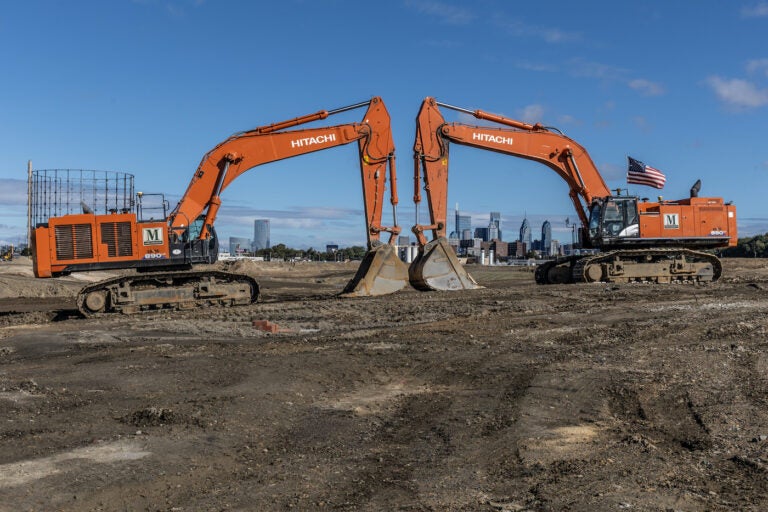
Cranes were parked to frame the Philadelphia skyline at the ceremonial groundbreaking of the Bellwether District at the former PES Refinery site in South Philadelphia on Oct. 16, 2023. (Kimberly Paynter/WHYY)
Have a question about Philly’s neighborhoods or the systems that shape them? PlanPhilly reporters want to hear from you! Ask us a question or send us a story idea you think we should cover.
A canned drink manufacturer is the first business planning to replace the former Philadelphia Energy Solutions refinery on the sprawling, largely empty tract of land that stretches along the Schuylkill River in South Philadelphia.
Developer HRP Group announced DrinkPAK as the first tenant at its site, branded The Bellwether District. DrinkPAK plans to invest $195 million and lease a custom 1.4 million-square-foot building, which it aims to start operating in early 2027.
“We’re very excited to announce the expansion to Philadelphia,” said Holly Schroeder, vice president of external affairs at DrinkPAK. “This will give us a coast-to-coast network of production facilities.”
What will the DrinkPAK plant do at The Bellwether District?
DrinkPAK’s facility, planned for the corner of 26th Street and Penrose Avenue, will mix, can, package and store beverages including energy drinks, sodas, teas and cocktails.
Beverage companies will pick up the packaged beverages using third-party logistics companies and truck them to distributors or retail outlets, Schroeder said.
The plant will have a maximum capacity of 2,600 cans per minute, able to fill a total of 3 billion cans per year, she said.
Related Content
The company has agreed to create a nonprofit to distribute at least $100,000 a year for community initiatives.
1 year ago
Listen 1:20How many jobs will DrinkPAK create?
DrinkPAK plans to create 174 long-term jobs over the next three years at its Philadelphia plant. These will include jobs mixing beverage ingredients, operating packaging equipment and working on quality control in a lab, Schroeder said.
The company plans to hire the “vast majority” of these positions locally and bring “a handful” of employees from the company’s other existing facilities, she said. Educational requirements for the new jobs will range from high school diplomas to four-year engineering degrees.
DrinkPAK receives incentives from the state
DrinkPAK received a $2 million grant from the state’s Department of Community and Economic Development meant for projects that create economic impact and jobs.
The company also plans to take advantage of a tax break for manufacturing companies that increase their taxable payroll and of reductions in certain state and local taxes available under the Keystone Opportunity Zone program.
“Those are important factors in our decision making, and we greatly appreciate the partnerships and the support that we have from the state of Pennsylvania in locating in The Bellwether District,” Schroeder said.
Gov. Josh Shapiro released a written statement praising the company’s commitment.
“My Administration competed aggressively against other states to secure this major investment from DrinkPAK – the first anchor tenant for The Bellwether District that will create tens of thousands of jobs and supercharge the economy of Southeastern Pennsylvania,” Shapiro said. “Our strategic investments in site development are helping us win major deals.”
The Bellwether District is also part of the state’s Permit Fast Track program. It has received several state environmental permits, according to the state’s website.
The latest step in a yearslong redevelopment process
Two other warehouse-style buildings are already built at The Bellwether District along 26th Street, but are not yet occupied.
Amelia Chassé Alcivar, HRP Group’s executive vice president of corporate affairs, said last month that the company was in “late-stage negotiations” with several prospective tenants, but did not specify who those tenants might be. She said she could neither confirm nor deny whether a data center could locate at the site, but said there were no plans to build a traditional power plant there, The Philadelphia Inquirer reported.
The 1,300-acre former refinery site in South and Southwest Philadelphia once housed the largest oil refinery on the East Coast. The refinery closed in 2019 after a fire and series of explosions, leaving the site contaminated from over a century of petroleum-related industrial use.
HRP Group demolished the refinery and is in the process of remediating the site, as well as redistributing soil on the site in order to raise low-lying areas out of the flood plain. The company plans to raise all buildings above the 500-year floodplain.
The company’s plans for the site include an industrial campus, where the DrinkPAK building will be located, consisting of over a dozen warehouse-style buildings near the Packer Park and Girard Estates neighborhoods.
HRP Group also plans to build a life sciences campus with smaller buildings meant to house research, development and manufacturing operations near the Grays Ferry, Point Breeze and West Passyunk neighborhoods. The first buildings in the life sciences section are planned to be completed in 2027.
Related Content

‘The stuff of nightmares’: Philly nonprofit sues EPA over deadly chemical used at refineries
Three nonprofits hope to force the federal government to regulate hydrogen fluoride more strictly. The chemical is still used at a Delaware County refinery.
8 months ago
Listen 1:25Community concerns about truck traffic and air pollution
Nearby residents and activists with the nonprofit Philly Thrive have scrutinized the redevelopment of the site, worrying it could accelerate gentrification and bring unhealthy air pollution from diesel trucks servicing the site’s businesses. They’ve also questioned whether jobs that could come from businesses locating at the life sciences campus would benefit working-class neighbors.
Shawmar Pitts, co-managing director of Philly Thrive and a resident of the Grays Ferry neighborhood, said he worries that tax breaks will erode DrinkPAK’s contribution to local revenue while the facility worsens air quality for nearby residents. He wants to see any businesses locating at The Bellwether District use electric trucks.
“We know that a huge source of the pollution is from our traffic, the highways right here,” Pitts said. “When you’re talking about distributing cans, beverages, that’s the first thing come to my mind is all the trucks that’s going to be coming in, making more pollution.”
A zoning permit issued by the city earlier this fall shows nearly 200 truck loading spaces surrounding the planned building.
Schroeder said the type of trucks transporting DrinkPAK’s cans are not within the company’s control, but if a customer were to hire a logistics company that uses electric trucks, DrinkPAK would consider providing the needed chargers. She said DrinkPAK plans to use battery-powered fork lifts inside its facility.
Last year, HRP Group signed a community benefits commitment with 16 community groups, promising to create a new nonprofit that will distribute at least $1 million over 10 years for community initiatives. Philly Thrive criticized the community benefits commitment as inadequate and did not sign on.
The total amount HRP Group will contribute to the new nonprofit’s fund depends on the company’s success leasing out its buildings.

Subscribe to PlanPhilly
WHYY is your source for fact-based, in-depth journalism and information. As a nonprofit organization, we rely on financial support from readers like you. Please give today.
Brought to you by PlanPhilly

PlanPhilly
In-depth, original reporting on housing, transportation, and development.
‘Not salvageable’: Inside William Way’s decision to build a new Center City headquarters
The nonprofit plans to demolish its longtime home on Spruce Street to make way for a new building that will also feature affordable apartments.
3 hours ago

City Council’s housing committee advanced the legislation after months of negotiations with the mayor’s administration and landlord advocates.
6 days ago
Listen 1:17
The sponsor of the proposed incineration ban pulled the bill from a vote at the last minute in January once it appeared to lack support.
6 days ago
Listen 1:08