

Swarthmore ‘charges’ student activists for disseminating literature the college calls ‘violent’ and ‘intimidating’
The literature included a scope’s crosshairs placed over a photo collage of the board of managers. A spokesperson said expulsions are rare.
Listen 1:13
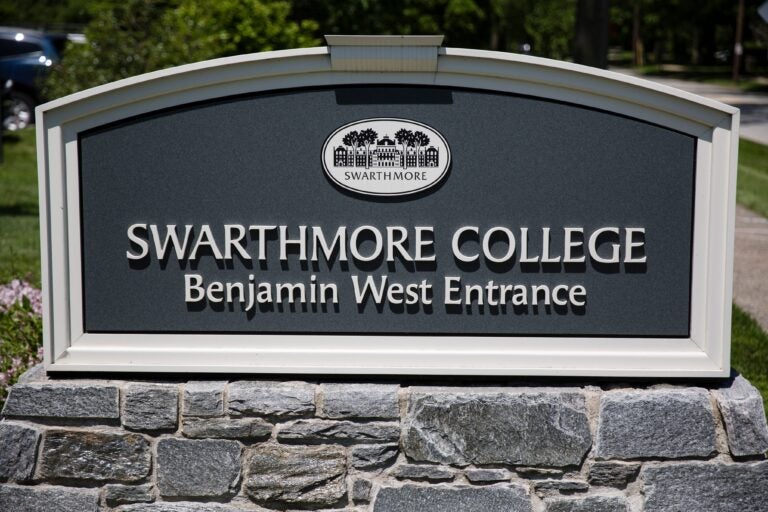
Swarthmore College in Swarthmore, Pa., Wednesday, May 15, 2019. (AP Photo/Matt Rourke)
From Philly and the Pa. suburbs to South Jersey and Delaware, what would you like WHYY News to cover? Let us know!
Eight Swarthmore students are facing possible expulsion for distributing protest materials. The materials criticize members of the college’s board of managers for ties to Israel and use imagery and rhetoric that the college administration says “threatened, intimidated, and/or promoted potential violence on campus.”
In letters sent to seven students, Erin Kaplan, associate dean and director of student conduct, identifies several “charges” that may violate the student Code of Conduct, including “bullying and intimidation,” “endangerment or affliction of physical harm” and “unauthorized use of college resources and services.” Not all of the students were “charged” with all of the violations.
Some of the letters allege that students distributed flyers “featuring threatening and intimidating imagery” and distributed pamphlets that “promoted potential violence on campus.” It cites the placement of crosshairs over a collage of photos of board members and quotes phrases such as “necessarily more violent” and that students “must put [their] bodies on the line.”
The letters say that students who are found “responsible” may see the “maximum sanction of expulsion.” An independent panel of peers, faculty and students will review and decide their cases.
One of the students told WHYY News that they were “shocked” at “the lengths to which [the college was] willing to go to repress student activists” and that the school is intentionally taking quotes “out of context in a way that is very disingenuous to their meaning.”
The pamphlet is “not calling for violent action,” said the student, who went by the pseudonym Taylor because of concerns that it could affect his case with the school. “It’s not advocating for people to make choices of violence, but rather accepting and understanding and being upfront that choices of peaceful resistance results in possible risk.”
Andy Hirsch, Swarthmore vice president for communications and marketing, explained in an email to WHYY News that, while he could not comment on “specific incidents of alleged conduct,” the college “deeply values and supports individuals’ rights to express their views and engage in peaceful protest and dissent.”
“At no point have any students faced charges for the content of their views,” Hirsch wrote. He also took exception to the characterization that students are “facing expulsion,” calling expulsion “extremely rare” and “reserved for the most extreme violations.”
Related Content

Penn, Bryn Mawr and Swarthmore back Harvard in lawsuit to defend international student enrollment
The colleges say blocking international enrollment would harm U.S. higher education and the economy.
5 months ago
What the pamphlets say
The front of one of the pieces of literature — which the students are calling a “zine” — depicts the image of a firearm scope’s crosshairs placed within a collage of 37 profile photos of members of the college’s board of managers, the institution’s governing body responsible for fiduciary oversight, strategic planning and appointing the college president.
Under the image, in large type, reads “Public enemy No. 1,” with “The Swarthmore board of managers” in smaller type.
The next page includes the large headline “Why you should hate the board” followed by text saying members have been investing in companies that “directly contradict the College’s propaganda about DEI, anti-violence, & environmentalism,” including those in the “military industrial complex, surveillance tech, fossil fuels” and “companies w/ gross human rights violations.”
The zine identifies seven board members that it accuses of profiting from ties to companies that invest in Israel, including the current chair of the board, Harold Kalkstein, and Harold Gustavo Schwed, an alumnus of Swarthmore who will take over as chair in July. The zine includes profile photos of Kalkstein and Schwed with devil’s horns and devil’s tails drawn on them.
WHYY News reached out to Kalkstein and Schwed to ask if they felt threatened or bullied by the materials but neither responded, though Hirsch confirmed that they received the requests.
Taylor said the crosshairs in the image are superimposed on an empty space in the middle of the collage, not on anyone’s face — a decision they say was deliberate.
“It’s in between different portraits [so] it’s not threatening violence on a specific individual whatsoever,” they said, adding that such imagery is regularly found in “pop culture,” such as that used by the prominent hip-hop group Public Enemy. “What [the image] is saying is that these people are against the Swarthmore community. Their interests or investments are in opposition to what the public should stand for.”
The administration also zeroed in on another pamphlet, the full text of which reads: “If we wish to change anything, to agitate anything for Palestine, we must put our bodies on the line. The loss of the Hossam Shabat Liberated Zone was just the beginning of a new chapter of our struggle — one that will be necessarily more escalated, necessarily more violent.”
“Hossam Shabat Liberated Zone” refers to the protest encampment that was forcefully taken down last year. A student and a former student were arrested along with seven individuals unaffiliated with Swarthmore.
“It’s not advocating for people to make choices of violence, but rather accepting and understanding and being up-front that choices of peaceful resistance results in possible risk,” they said.
Another student, going by the pseudonym Alex, said college officials are misrepresenting the phrases by deliberately taking them out of context.
“It’s clear that they’re just trying to weaponize the language,” Alex said. “I think that their goal here is to censor students, to crack down on free speech.”
Related Content

Philly activists mark 100th peace vigil for Gaza outside of Sen. John Fetterman’s Old City office
Protesters called on Fetterman to stop military aid to Israel and speak up in support of aid to Gaza.
9 months ago
Listen 0:52Free speech standards and the Code of Conduct
Craig Green, a law professor at Temple University and an expert on free speech, said the college administration seems to be attempting to make the case that the literature had the potential to “incite violence.”
However, “the standard for inciting violence is very high under the Constitution,” he said. “The evidence that I have seen concerning Swarthmore is not close to that line.”
That legal standard was set in the 1969 U.S. Supreme Court decision in Brandenburg v. Ohio, in which justices said such language must be likely to incite “imminent lawless action.”
“People can say things that are very hostile and very mean, as everybody knows, and none of those things rise to level incitement to violence, even if some person who’s violent might cite that in committing some act of violence,” Green explained.
He said the fact that the crosshairs did not single out an individual would “almost certainly … be interpreted as a general statement of opposition” and that the idea of students “putting their bodies on the line” is a known concept among nonviolent activism employed by Mohandas Gandhi and Martin Luther King Jr.
Green said that the “one use of the word violence I think was probably the strongest argument that I could see that the college would have, but I think it’s not very close.”
The opinion in Brandenburg specifically prohibits “the state” — the federal or local government — from infringing on free speech rights. As a private institution, Swarthmore can implement its own code of conduct that limits speech on its campus.
While the letters viewed by WHYY News specifically accuse their recipients with distribution of the literature and cite the college’s Code of Conduct, a review of the code does not reveal a specific violation for the act of distribution.
However, a section titled “Bullying and Intimidation” clearly prohibits “any electronic, written, verbal, or physical act or a series of acts (which includes, but is not limited to, e-mail, text messaging, and internet posting on web-sites or other social media) that is intended to cause – or any reasonable person should know would cause – physical or substantial emotional harm to another person or group.”
The students questioned the idea that they could have been “bullying” or “intimidating” “powerful” board members.
The section “Endangerment or Infliction of Physical Harm” refers to “Physical restraint, contact, or any other act of violence or use of physical force against any member of the community,” which includes “conduct that approaches or threatens such contact, such as grabbing, kicking, smacking, shoving, or spitting.”
Green said that, from his reading, “it’s very difficult to see anything” in “Swarthmore’s private law” — as he referred to the Code of Conduct — that rises to the level of inciting violence, as well.
“I think it’ll be very hard for them to show that,” he said.
Some of the students were also charged with a “failure to comply” with prior “directives” sent to them by the school after earlier incidents of distributing materials and “unauthorized use of college resources and services,” ostensibly for printing the materials. That section of the conduct code specifically prohibits “excessive printing through College networks, systems and equipment in violation of the College’s acceptable use and allowable printing policies.”
Related Content

Philadelphia People’s Tribunal finds Israel, U.S. guilty of war crimes and genocide in Gaza
Local jurors said they hope the tribunal’s findings will have an impact in formal international governing bodies.
12 months ago
Listen 1:42Facing discipline at a school known for activism
Swarthmore has a long history as a haven for nonviolent activism, stemming back to its Quaker origins, a reputation it promulgates. That includes its students’ roles in the 1960s fight for civil rights and the push for gay rights in the 1980s. In the 2000s, the college engaged in its own shareholder activism to push private companies to bar discrimination based on sexual orientation.
Alex said that history was the reason they chose to attend Swarthmore.
“I already knew that social justice and organizing was something that was important to me,” they said. “So I thought that the school would be aligned with those core values. But I’ve quickly come to realize that that’s not the case and that they kind of just use any sort of past student activism or anything to present themselves as an institution which welcomes this, but in reality they aren’t.”
Hirsch explained that students can opt for an independent panel of community members to adjudicate their cases. That panel is made up of students, faculty and staff members.
“It is the panel that decides, based on the facts of a given incident, whether a student is responsible for alleged misconduct, and that panel — not, for example, a single dean — issues the sanction in those cases,” he wrote in an email.
Although the school considers the charges “major,” the students might receive only a written warning, Hirsch said, if the panel finds them “responsible.”
Green argues that Swarthmore could have gone a different approach altogether.
“I think that in the modern world of free speech, what is usually the solution to hostile, intimidating, threatening speech is for other people to stand up and say, this is not acceptable,” he said. “They could absolutely condemn any set of statements that the students have made within their own free speech rights.”

Get daily updates from WHYY News!
WHYY is your source for fact-based, in-depth journalism and information. As a nonprofit organization, we rely on financial support from readers like you. Please give today.
Part of the series


Centennial School District launches summer lunch bus
Bensalem Township School District’s summer lunch program inspired Centennial’s initiative.
3 days ago
Jameson took over as president as protests over the war in Gaza led to charges of antisemitism and threats to federal research dollars.
4 weeks ago
Listen 1:16
Central Bucks School District support staff call for better wages amid contract negotiations
With their contract set to expire June 30, the Central Bucks Education Support Professional Association urged school board members to address pay and retention concerns.
1 month ago
Listen 1:07