

Racial health gaps persist in Pa., N.J. and Del. as Medicaid cuts loom, report finds
The Commonwealth Fund’s 2026 State Health Disparities Report showed health care gaps were the greatest among Hispanic residents.
Listen 1:13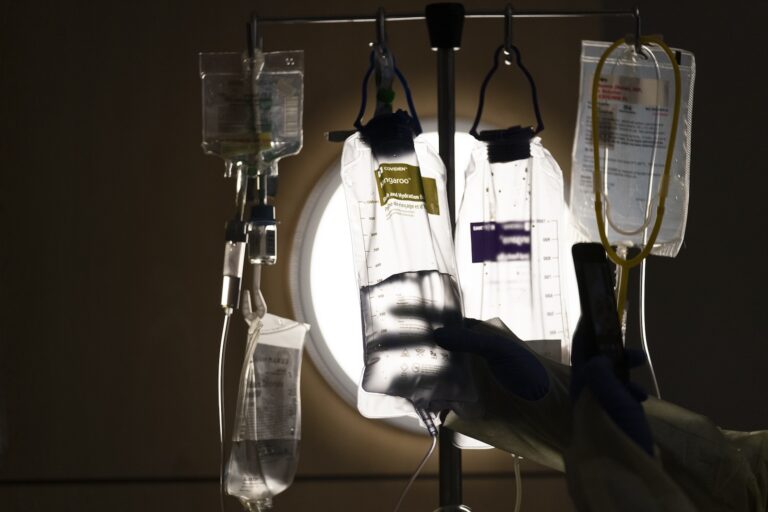
File: A nurse checks on IV fluids while talking to a patient. (AP Photo/Jae C. Hong, File)
From Philly and the Pa. suburbs to South Jersey and Delaware, what would you like WHYY News to cover? Let us know!
Disparities in health care access, outcomes and quality among people of different races and ethnicities continue to be widespread, even in states like Pennsylvania, New Jersey and Delaware, which have taken steps to reduce barriers to care in recent years.
Tri-state area Hispanic adults in particular had some of the worst experiences in the health care system in 2023 and 2024, according to the Commonwealth Fund’s 2026 State Health Disparities Report, released Wednesday.
People in this group were also most likely to report that they went without health care because of cost and affordability concerns, data show.
Researchers estimate that impending federal changes to programs like Medicaid, which provides health insurance to people with low incomes, will make it even harder for people to access and afford health services in the future.
“In other words, make the gaps that we see in this report make them probably even wider,” said David Radley, a senior scientist of health system tracking at the Commonwealth Fund.
Related Content
How a reporter began to investigate diabetes risk, and along the way, made a startling discovery about his own health.
10 months ago
Listen 13:10A snapshot of health disparities in Pennsylvania, New Jersey and Delaware
Pennsylvania
Asian Americans reported experiencing some of the best health care outcomes, access and quality in the commonwealth, followed closely by white residents.
This isn’t particularly surprising, Radley said, as these findings often correspond to income levels.
“White people and Asian Americans tend to have higher incomes on average than Black, Hispanic and Indigenous people in the country,” he said. “That really does sort of factor into underlying health risks and opportunities within the health care system.”
There continues to be a significant gap between those two racial groups and others. Hispanic and Black Pennsylvanians experienced, on average, higher rates of obesity, smoking and deaths from preventable causes.
New Jersey
About 27% of Hispanic adults were uninsured in 2023 and 2024, and 27% also reported going without health care because of potential costs.
While most older Black women in New Jersey received a recent mammogram, they were significantly more likely to die from breast cancer compared to other women in the Garden State. Delays in follow-up care, later-stage diagnoses and health insurance issues could play a role, researchers said.
Delaware
Black babies in Delaware were twice as likely to die compared to white babies, the report shows. Just over half of Black infants and toddlers had all recommended vaccines compared to 67% of Black babies nationally.
About 14% of Hispanic children and 27% of Hispanic adults in Delaware lacked health insurance, compared to 5% of white children and 6% of white adults in the state.
Related Content
Four longstanding pediatric offices will close June 30 and three others will become part of the True North Pediatrics group, based in Pennsylvania.
6 months ago
Listen 1:30Tracking racial health disparities in states as federal policy changes take effect
The report’s findings highlight the state of health care disparities following the COVID-19 pandemic, but before more recent changes to health insurance programs, including the expiration of subsidies that helped people buy coverage on Affordable Care Act marketplaces.
New restrictions on Medicaid health insurance for lawfully present immigrants and refugees will also start this October, followed by new eligibility rules and requirements for all Medicaid participants next January.
All those changes will likely affect who can access health care services going forward, across all races and ethnicities, Radley said.
“Pennsylvania is not the most diverse state, and there’s a lot of lower-income Pennsylvanians who could potentially be at risk of losing Medicaid coverage who are white,” Radley said, including those living in poorer rural areas.
Researchers hope the report’s findings can help local leaders target the biggest gaps in racial health disparities, direct resources and improve factors like housing, economic stability and food security.

Get daily updates from WHYY News!
WHYY is your source for fact-based, in-depth journalism and information. As a nonprofit organization, we rely on financial support from readers like you. Please give today.
Black women were 20% more likely than white women to get an unscheduled, unplanned C-section delivery when there were no high medical risks.
2 years ago
Listen 1:17
Philadelphia summit to focus on increasing awareness of multiple sclerosis in Black communities
An estimated 2.9 million people worldwide live with multiple sclerosis, a chronic and lifelong disease. It disproportionately affects women.
2 years ago
The short reach of long COVID care
Latinos and African Americans suffer the highest rates of long COVID. Yet health care inequality and poor outreach have resulted in clinics with mostly white patient lists.
2 years ago
Listen 9:17