
‘Plain, common sense’: Legislation to revamp Delaware’s school funding formula goes to lawmakers in May
The legislation would allow state education officials to prepare to overhaul the current funding formula. Sustaining that work could mean massive financial investment.


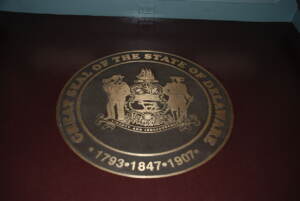
Legislative Hall in Dover, Delaware (Emma Lee/WHYY)
What are journalists missing from the state of Delaware? What would you most like WHYY News to cover? Let us know.
Delaware is taking a major step forward to overhaul Delaware’s public school funding formula that dates back to the 1940s through legislation set to be introduced next week.
Monday’s votes by the Public Education Funding Commission, chaired by Senate Education Committee state Sen. Laura Sturgeon, D-Brandywine Hundred, approved making a new hybrid formula into law.
Sturgeon and House Education Committee Chair state Rep. Kim Williams, D-Stanton, are sponsoring two bills. One is the formula revamp and the other extends the life of the commission.
Advocates of the blended funding formula approach argue it would preserve the foundation of the current unit-based system, while simplifying distribution and giving districts more flexibility in how the money is used. It would also include more weighted funding for low-income and multilingual learners.
The fiscal year 2027 cost to prepare for implementation is only $2.8 million. But the state will likely have come up with up to $200 million fiscal year 2028 to realize phase one. The numbers will be updated before phase one begins, which could increase or decrease the amount. The money would be used to hold all school districts harmless, protecting school districts from losing money if they have a lower population of disadvantaged students, while the new funding formula is put into place.
Delaware Education Secretary Cindy Marten said during Monday’s meeting that Gov. Matt Meyer has committed to putting the money into his next recommended budget to improve academic success for the state’s most disadvantaged kids.
A statement from Meyer released after Monday’s Public Education Funding Commission said fixing the system is critical to the success of all schools.
“For far too long, our students have been given a broken school funding formula that distributes resources unfairly,” he said. “My administration looks forward to working with all members of the General Assembly to get this over the finish line.”
The state was sued by education and civil rights advocates in 2018, who alleged the state was persistently underfunding low-income students, multilingual learners and children with disabilities. The parties settled in 2020.
While $200 million for fiscal year 2028 might face political headwinds, a report issued as part of the court settlement found that Delaware needed to add $600 million to $1 billion to achieve educational equity. Delaware could potentially add additional dollars spread over a period of years.
Education secretary Cindy Marten said Monday that a formula from the 1940s no longer works for today’s students.
“Delaware has the opportunity to take a major step toward a formula that’s built on a simple truth, where there’s greater need, there needs to be greater investment,” she said. “That’s not politics, that’s not ideology, it’s just plain common sense.”
Related Content

The revamped school funding formula targets more money to students with higher needs to achieve better academic outcomes.
7 months ago
Commission approves initial provisions to move to hybrid model
- weights for disadvantaged students
- a pledge to hold school districts harmless
- continuing to freeze the equalization, which is the local tax base, at fiscal 2009 levels
- consider local funding reforms
The current school funding formula only has weights for special education students. The hybrid would add them to low-income students and multilingual learners, which are currently being funded through another pot of money called Opportunity Funding. Career and technical education is also being considered for supplemental dollars.
Under the proposed hybrid model, low-income students would see $3,343 per pupil in weighted funding and multilingual students would see a $2,328 bump.
Commission member Gary Henry compared the proposed hold harmless provision, which protects wealthier school districts from losing money during the hybrid formula’s phase-in, to a similar policy in Pennsylvania and voiced concern that it would hurt their efforts to better fund at-risk students.
“We’re very aware of Pennsylvania putting this provision in without limits,” he said. “What has happened is that the funding system hasn’t achieved any greater equity, which is one of our principal values.”
But holding school districts harmless could be critical to getting enough state lawmakers to support overhauling the formula. Sturgeon told WHYY News in June 2025 that removing that provision “would not be politically viable.”
“Imagine all the legislators who happen to represent districts that would lose money,” Sturgeon said.
The phase two process currently anticipated includes tackling equalization and weights for other student groups, such as foster youth and students experiencing homelessness. It would also look at layering weights for high-need groups, including multilingual learners, low-income students and students in areas of concentrated poverty.

Get daily updates from WHYY News!
WHYY is your source for fact-based, in-depth journalism and information. As a nonprofit organization, we rely on financial support from readers like you. Please give today.
Part of the series
Thomas Herlihy raped the girl in Atlantic City in 2016 and, authorities say, sexually abused her through 2018 in Delaware.
2 months ago
Listen 2:01
El estado afirma que la escuela de cuatro años formará médicos en Delaware y ayudará a paliar la escasez de profesionales de la salud, especialmente en las comunidades rurales
2 months ago
The state says the four-year school will train doctors in Delaware and help address provider shortages, particularly in rural communities.
3 months ago
Listen 0:49