
Delaware lawmakers advance school funding overhaul amid pressure from civil rights leaders
Civil rights activists say state leaders need to give multilingual learners more resources or face immediate legal action.
Listen 1:06
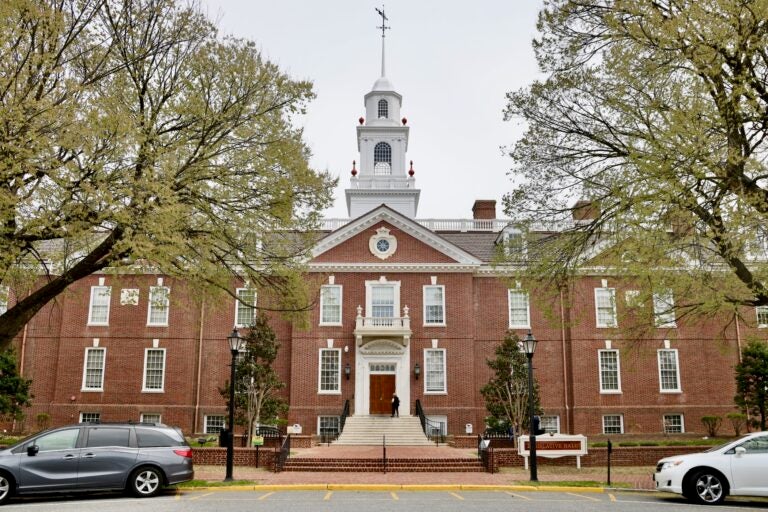
Legislative Hall in Dover, Delaware (Emma Lee/WHYY)
What are journalists missing from the state of Delaware? What would you most like WHYY News to cover? Let us know.
The legislation to begin reforms on how Delaware funds public schools cleared its first committee this week, but civil rights leaders say they are considering suing the state again if more progress isn’t made soon to provide disadvantaged students with more resources.
While this is the first major rewrite of a school funding formula created in the 1940s, The American Civil Liberties Union of Delaware sent a letter to state officials warning of potential litigation because of what it describes as years of inaction.
Delaware public and charter schools serve 142,495 students. Nearly 60% of that population are low-income, have disabilities or are multilingual learners.
The ACLU of Delaware and other education advocates sued the state in 2018, alleging that it was persistently underfunding those student groups. The parties settled in 2020.
The letter discusses the particular harms to multilingual learners, criticizing the current situation as “unacceptable and unconstitutional.”
ACLU of Delaware Educational Equity Fellow Oluwatobi Omotoso said the group is focused on the alleged constitutional violations suffered by multilingual learners because it provides an equal protection basis to file a lawsuit.
“[For] multilanguage learner students, it’s a really urgent problem,” Omotoso said. “There are students not getting education and aging out of being part of the Delaware public school system without knowing how to speak English, without learning basic mathematics, English, science, or anything.”
National test scores from 2024 show that overall student academic performance remained below prepandemic levels and the national average. But the ACLU of Delaware said in its letter that academic outcomes of multilingual learners are significantly worse than the average student, reflecting a “severely underfunded learning environment.”
A 2023 report issued as part of the court settlement by the American Institutes of Research found that Delaware needed to add $600 million to $1 billion to public schools to achieve educational equity for disadvantaged students.
Since then, civil rights and other groups have watched as state leaders grappled with the political and logistical implications of the legal action from more than a half a dozen years ago.
But the ACLU’s missive to the state complains that little has been accomplished since the AIR report was issued three years ago.
“The state has not even remotely met its ambitious goals to improve educational achievement in Delaware schools,” the letter said. “Despite the steadfast efforts of teachers, many young people do not receive an effective education due to lack of resources.”
Related Content

The legislation would allow state education officials to prepare to overhaul the current funding formula. Sustaining that work could mean massive financial investment.
2 months ago
The Public Education Funding Committee, led by Senate Education Committee Chair state Sen. Laura Sturgeon, has been meeting since September 2024 and developed the hybrid funding model to replace the current resource-based system.
Instead of a purely unit-based model, the hybrid formula would consist of base funding, opportunity funding and operational funding.
- Base funding would stay a resource-based allocation for staff and operations. It has weights for special education and vocational students.
- Opportunity funding is weighted, per-student funding for low-income and multilingual students.
- Operational funding would be weighted, per-pupil funding based on the number of low-income households, multilingual learners, special education students or those with individualized education plans, and vocational students.
The fiscal year 2027 cost to prepare for implementation is only $2.8 million. But the state will likely have to add up to $200 million fiscal year 2028 to realize phase one.
The money would be used to hold all school districts harmless, protecting school districts from losing money if they have a lower population of disadvantaged students, while the new funding formula is put into place.
Phase two in fiscal year 2029 would be aimed at tackling equalization and considering weights for other student groups, such as foster youth, gifted students and students experiencing housing instability. It would also look at tiering weights for high-needs student populations, including multilingual learners, low-income students and students living in concentrated areas of poverty.
But it remains unclear whether supporters of the overhauled funding formula can convince some skeptical lawmakers to add the hundreds of millions of dollars the AIR report argues is needed.
Sturgeon said lawmakers must act now to put a more equitable school formula in place.
“We cannot afford to wait another 80 years to modernize how we fund our schools, so passing Senate Bill 302 and later today [Senate Bill] 303 ensures that the progress continues and that we finally deliver a funding system that meets the needs of every Delaware student.”
State Sen. Dave Lawson, R-Marydel, said he was concerned about Delawareans footing the bill.
“I don’t know where you’re going to find a million dollars or another billion dollars to fund education in this state when they’re already hit pretty hard, especially with the [property reassessments],” he said.
But Omotoso said the hold harmless funding doesn’t even address the adequacy issue in the state’s public education funding.
“Additionally, it’s not funding that’s been committed, even though there’s been discussions about it,” Omotoso said. “So it both isn’t committed funding to any district, and if it is committed, it’s not committed for the issue that the open letter is about, which is multilanguage learners.”

Get daily updates from WHYY News!
WHYY is your source for fact-based, in-depth journalism and information. As a nonprofit organization, we rely on financial support from readers like you. Please give today.
Part of the series

The state says the four-year school will train doctors in Delaware and help address provider shortages, particularly in rural communities.
1 month ago
Listen 0:49
Los activistas de derechos civiles afirman que los líderes estatales deben proporcionar más recursos a los estudiantes multilingües o enfrentarse a acciones legales inmediatas
2 months ago

In addition to layoffs, failed referendums in Indian River and Smyrna districts will lead to larger class sizes and reduced programs.
1 year ago
Listen 1:27