

Delaware lawmakers aim to make data centers pay higher rates
The legislation would require data centers to take financial responsibility for their impact on the grid.
Listen 1:15
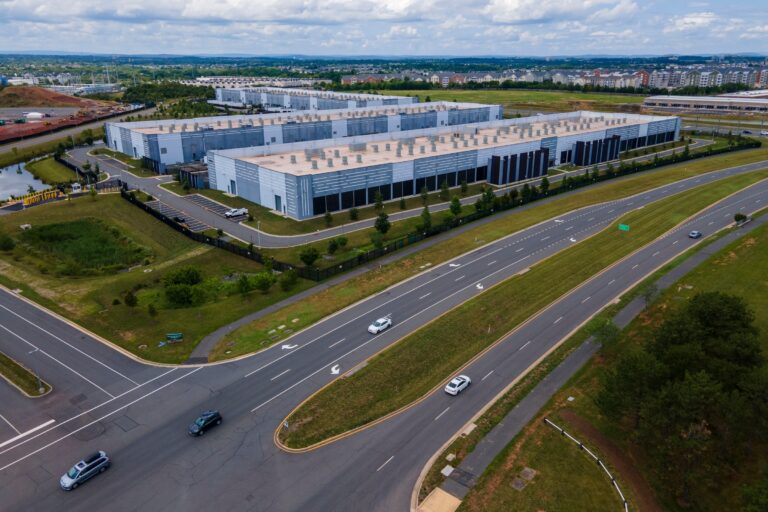
FILE - Cars drive past data centers that house computer servers and hardware required to support modern internet use, such as artificial intelligence, in Ashburn, Virginia, July 16, 2023. (AP Photo/Ted Shaffrey, File)
This story is part of the WHYY News Climate Desk, bringing you news and solutions for our changing region.
From the Poconos to the Jersey Shore to the mouth of the Delaware Bay, what do you want to know about climate change? What would you like us to cover? Get in touch.
Delaware lawmakers have introduced legislation that aims to protect ratepayers as the increasing demand for data centers threatens a surge in electricity bills.
The legislation aimed at data centers would require Delmarva Power, a subsidiary of Exelon, to create a separate, higher electricity rate for customers that use more than 50 megawatts a month.
Data centers are operated by big tech companies and house large computer servers necessary to power the growth of online processing, storage and artificial intelligence. The goal of the legislation is to prevent the technology industry from passing on the costs of required infrastructure expansion to residential customers.
“There was a strong push at the federal level and the state level throughout the country to build data centers as quickly as possible with as little governmental process as possible,” said the bill’s co-sponsor state Sen. Stephanie Hansen, D-Middletown. “Today, that push has been tempered by experience, and by the outcry of citizens throughout the county who see their electric bills wildly increasing month over month.”
The legislation would combine two previous legislative proposals to create tariff provisions for large energy-use facilities and give the Delaware Public Service Commission, which regulates utilities in the state, the authority to oversee connections to the electric grid.
Delmarva Power said in a statement that the utility will review the newly introduced legislation. The Data Center Coalition, a trade group for the industry, did not immediately respond to a request for comment.
Data centers house the computer servers required to run internet services worldwide. While they have been around since the mid-20th century, the acceleration of power-hungry artificial intelligence has boosted demand for larger sites.
Last year, the Trump administration announced plans to accelerate AI development with limited regulatory oversight.
Data center proponents are touting the prospect of increased tax revenue and job creation. However, as utility bills continue to soar in the region, residents are concerned that a strain on the power grid could mean higher energy bills.
PJM Interconnection, which manages the region’s electrical grid, has pointed to the increase in data centers as a reason for increased demand leading to higher electricity bills.
Under the proposed legislation in Delaware, the Public Service Commission would be required to review and approve agreements between large energy-use facilities and transmission providers and utilities, and ensure these contracts fairly allocate costs among customer classes.
The commission must consider factors like environmental impacts, the viability of facilities and whether ratepayers are protected from the economic loss of a stranded asset, such as when a data center closes or never gets built.
The bill would require that individual data centers incur the costs associated with building new transmission and distribution infrastructure, as well as capacity procurement, whenever possible. When that’s not feasible, these costs would be spread among the class of large energy-use customers.
Related Content

How much water do data centers use? One in Delaware City could use up to 20 million gallons a year
A proposed data center in New Castle County would use tens of millions of gallons of water every year.
8 months ago
Listen 1:03The Independent Market Monitor of PJM has estimated that at least $23 billion in new costs in the capacity market set by PJM are the direct result of new data center load.
A Delaware state report found that increasing energy demands driven by data center development could cause the average wholesale electricity price to increase by more than 80%.
“We think the bill threads the needle between promoting economic development and providing safeguards to other customer classes,” said Matt Hartigan, executive director of the Public Service Commission.
The legislation would also aim to protect ratepayers when large energy-use facilities impact grid reliability, meaning data centers might be required to reduce their power to avoid outages.
“We can’t have people who are sitting home with oxygen generators and dependent on home medical equipment, as well as our water treatment facilities and our water purification facilities, having the power cut off,” said bill sponsor state Rep. Frank Burns, D-Newark.
Facilities that construct in-state generation would be exempt from reliability requirements. This year, seven leading AI and tech companies signed a White House-led pledge to voluntarily cover the full costs of their energy and infrastructure demands.
“Delaware is uniquely vulnerable to the impacts of large energy users,” Burns said. “We are not in the middle of some big grid mesh. We are a peninsula hanging off the edge of a grid. We have limited in-state generation of electricity, which I’m hoping this will help to fix.”
Facilities like data centers would also be required to contribute to the state’s low income and green energy funds at higher rates.
The legislation is being applauded by the state’s Public Advocate Jameson Tweedie, who represents ratepayers when utilities seek rate hikes and fights for affordability.
“We have to make sure that existing customers are protected from the impacts that the massive growth in power demands of data centers may have, and we have to make sure those new highly profitable customers like data centers are paying their fair share,” he said.

Get daily updates from WHYY News!
WHYY is your source for fact-based, in-depth journalism and information. As a nonprofit organization, we rely on financial support from readers like you. Please give today.
Part of the series

A network of air quality monitors grows in a formerly redlined area of West Philadelphia
The network will provide residents of formerly redlined areas of West Philly and Harrisburg real-time info about the air they’re breathing.
3 days ago
Listen 1:07
In Philadelphia’s Eastwick neighborhood, plans for a temporary solution to flooding hit a snag
The issue with temporary HESCO-style flood barriers comes after a plan for a levee in Eastwick was deemed not viable.
4 days ago
Listen 1:07
Proposed Delaware City data center hits major setback from environmental regulators
Environmental regulators in Delaware say the proposed data center, known as Project Washington, would be one of the state’s top polluters.
8 months ago
Listen 1:13