

Restorative justice advocates in Philadelphia are rethinking accountability beyond incarceration
Restorative justice is rooted in an empathetic, comprehensive and more solution-based approach to addressing criminal behavior.
Listen 1:42
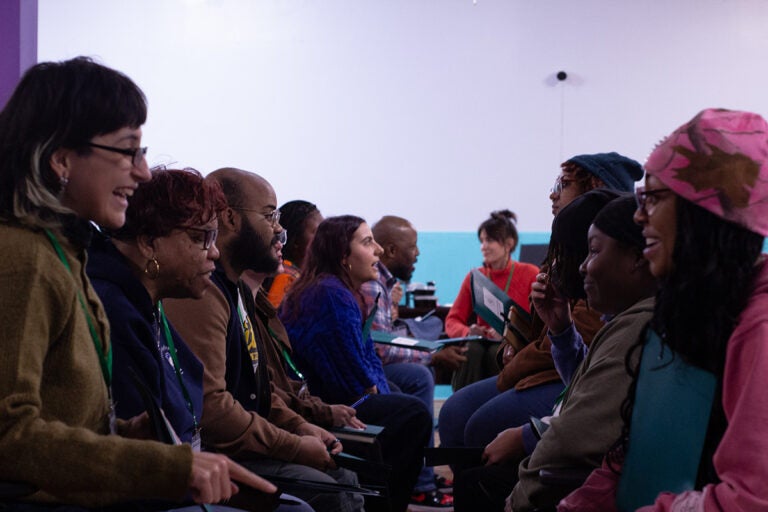
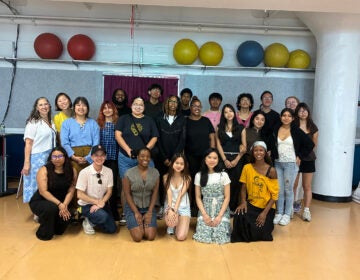
Workshop attendees getting to know their fellow workshop members in a "speed dating" format. (Eric Nixon/WHYY News)
From Philly and the Pa. suburbs to South Jersey and Delaware, what would you like WHYY News to cover? Let us know!
Late last year, restorative justice organization Let’s Circle Up gathered community members in West Philadelphia for a two-day workshop to explore alternative approaches to punitive models of criminal justice.
The event comes as lawmakers, prosecutors and advocates across Pennsylvania debate whether restorative justice practices should play a larger role in the state’s legal system — and whether healing, accountability and repair can coexist with public safety.
Encounter, repair, transform
A concept dating back to an experiment in Canada in the 1970s, restorative justice is rooted in an empathetic and comprehensive approach to criminal behavior that is more solution-based than standard approaches. According to the First Step Alliance, the process requires three key principles: encounter, repair and transform.
“Encounter” refers to a setting that brings together everyone affected by the crime. “Repair” refers to the need to address the needs of each person involved, such as the victim’s need for healing and the offender’s need to make amends. “Transform” refers to the intended final result of this restorative mediation, where victims and offenders alike can heal and move forward.
One key factor in the process is that participation is wholly voluntary for all parties.
On day one of the Let’s Circle Up workshop, attendees examined “justice” from several perspectives. Felix Rosado, co-founder of the organization, and Raymond Tucker facilitated the evening’s activities.

First, to connect everyone personally and to encourage friendships, Tucker led participants through an activity similar to speed dating. Everyone sat across from each other for a short time and, following his prompts, asked probing questions back and forth.
Then, the group did a word-association exercise. Rosado wrote the word “justice” on a large sheet of paper on the wall, and asked the group to call out whatever related words that came to mind, with participants saying “power,” “supremacy,” “system,” “racist,” “fairness” and “punishment.” As various words rang out, he recorded each one on the paper, completely filling the remaining space.
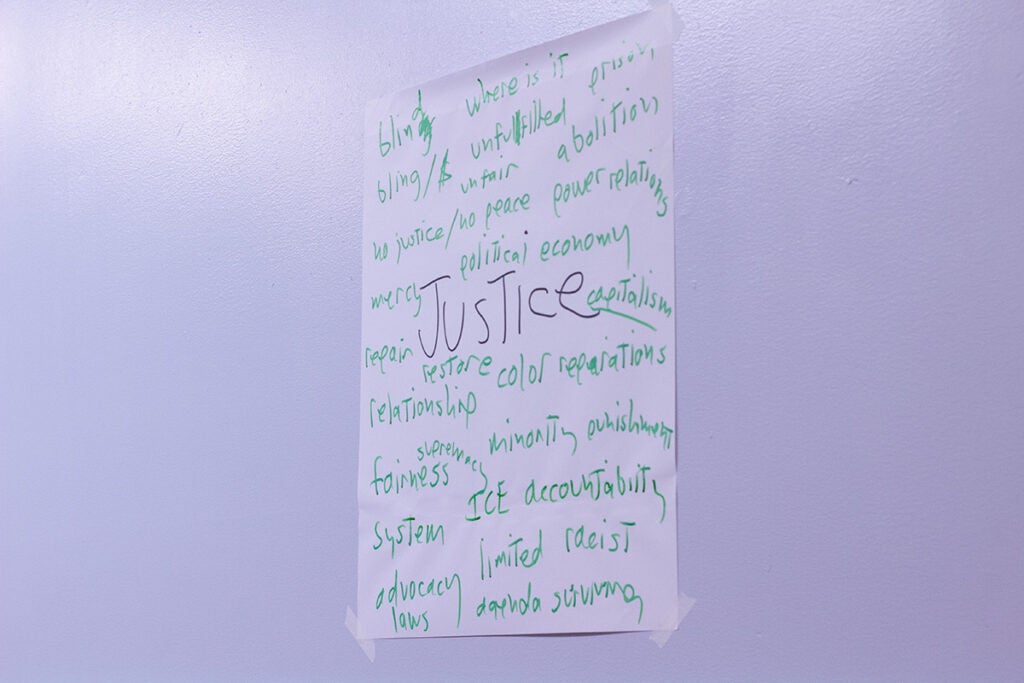
The exercise revealed some divisions among participants in how they saw justice playing out in the world, with some saying that justice is not equal and others seeing “harmony” as a goal.
Next, attendees split up into four groups. Each group was given 20 minutes to create an image of “Lady Justice” before presenting the result, and the reasons behind it, to the room.
On day two, the focus of exploration shifted to “harm,” its causes and people’s experiences with it. The group discussion dug deeper into the values and principles of restorative justice, including an emotionally charged video of a facilitated conversation between a victim and an offender. Such “victim offender dialogues” demonstrate the restorative justice model in practice.
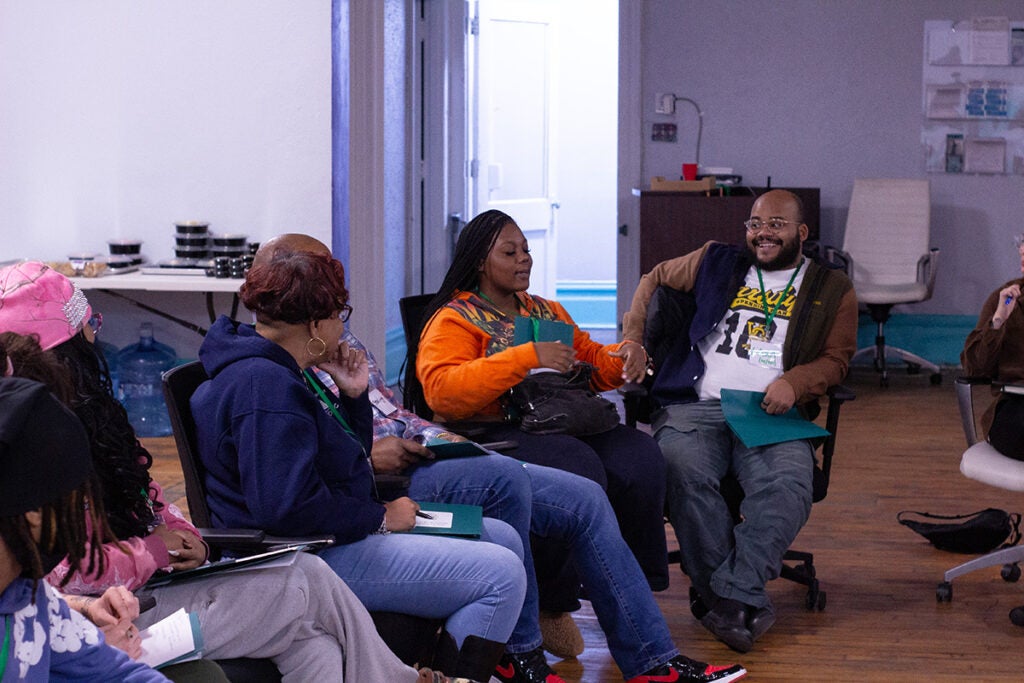
To close out the session, the facilitators and attendees circled up for an activity derived from Indigenous healing circle practices. Everyone sat in a circular formation, with one person acting as a guide for the discussions. An item called a “talking piece” was passed from person to person, giving each participant the floor to speak while others listened.
Related Content
‘Build the trust’: Philly youth find, create community at Collective Climb
The organization recently opened its first permanent space in Center City.
2 years ago
Listen 1:00What is restorative justice? What can it do for society?
Rosado said the organization’s mission is to help restorative justice become a viable rehabilitative and preventive approach. Former Gov. Tom Wolf pardoned Rosado in 2022 after signing off on commutations recommended by the Board of Pardons. Rosado had spent nearly three decades in prison after he pleaded guilty to a first-degree murder charge when he was 18 years old.
Rosado began practicing the restorative justice concept while incarcerated, and after his release, he continued to spread awareness of it.
“We’ve been conditioned to see putting people in cages being synonymous with justice,” Rosado said. “And I’m learning to break free from that and imagine other possibilities.”
Although restorative justice is not a new idea, it is only now gaining traction as a formally supported approach for rehabilitation in the criminal legal system. In Pennsylvania, House Bill 1671, introduced in 2024 by state Rep. Chris Rabb, D-Philadelphia, would establish restorative justice as a recognized option within the state’s criminal code.
Rabb says that a punishment-based structure alone cannot lead to healing or accountability. He hopes adding a restorative approach to the justice system would create pathways for rehabilitation. The bill, which passed successfully out of the judiciary committee last session, is set to come up for a third consideration in the state House.
“My hope is that I will have strong bipartisan support for this,” Rabb said.
Supporters say formal recognition would give courts and prosecutors clearer authority to use restorative justice across Pennsylvania. Jody Dodd, restorative justice facilitator with the Philadelphia District Attorney’s Office, said codifying the process would allow it to be used statewide while protecting participants.
“It allows people to speak honestly and openly about what really happened in a restorative process without the fear that that would be used if the process were to fail,” Dodd said.
Data from the Philadelphia DA’s Office suggests the approach can reduce repeat offenses. A 2022 report found that defendants who participated in and completed restorative justice programming for civil unrest-related cases had a 12% recidivism rate, compared with 53% for people who went through traditional incarceration or probation for comparable commercial burglaries.
Related Content

Prosecutors allege the rival gangs created music videos about the shootings and used the YouTube ad revenue to fund further crimes.
7 months ago
Community programs practicing restorative justice
There are many ongoing opportunities in the city for people to educate themselves on restorative justice principles. Programs such as Let’s Circle Up, the Youth Art & Self-Empowerment Project‘s Healing Futures program and Collective Climb’s Restorative Community Project use, discuss and teach restorative justice practice in the Philadelphia area.
The Community College of Philadelphia also offers a certificate program for students seeking restorative justice training.
The University of Pennsylvania started a program called Restorative Practices at Penn, which offers facilitated dialogue, conflict resolution training and community building circles for students, faculty and staff.
Rev. Donna Jones founded the Restorative Cities Initiative, a program that promotes training and advocacy in collaboration with residents and agencies with the goal of connecting the city and surrounding neighborhood through restorative practices and working toward community well-being.
The National Center for Restorative Justice has an interactive map on their website tracking the status of restorative justice’s implementation, from enacted laws supporting the practice in their justice systems to laws supporting restorative justice education in schools.

Never miss a moment with the WHYY Listen App!


WHYY is your source for fact-based, in-depth journalism and information. As a nonprofit organization, we rely on financial support from readers like you. Please give today.
Philadelphia’s young people learn to lead on violence prevention and restorative justice
The city’s first youth restorative justice cohort completed nearly a year of training designed to help young people address conflict, violence and harm in their communities.
3 months ago

‘Mad or nah?’: Philly residents react to city suing state over gun laws
Tamara Russell, aka Revive POC, hit the streets of Philadelphia to see what residents think about the city’s efforts to quell rising gun violence.
6 years ago
Listen 4:32
Philly first assistant district attorney devoted to keeping kids out of criminal justice system
Robert Listenbee Jr., a former official in the Obama administration, works to keep kids out of the criminal justice system through rehabilitation.
8 years ago