

Philadelphia’s water department wants to know whether your pipes are lead-free
Cities across the U.S. are required to find lead pipes over the next decade.
Listen 1:04
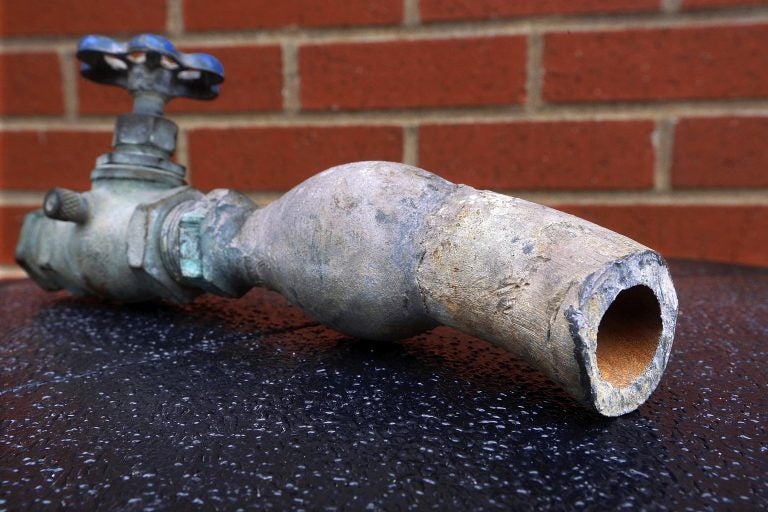
An example of lead pipes that deliver water to the nation's homes is on display. (Seth Perlman/AP Photo)
This story is part of the WHYY News Climate Desk, bringing you news and solutions for our changing region.
From the Poconos to the Jersey Shore to the mouth of the Delaware Bay, what do you want to know about climate change? What would you like us to cover? Get in touch.
As U.S. cities aim to meet federal regulations that require them to find and replace lead pipes over the next decade, the city of Philadelphia is making strides to determine whether service lines connected to hundreds of thousands of properties contain lead.
Lead pipes can corrode and contaminate drinking water, putting those exposed at risk for serious health problems, including cognitive impairment among children.
The Philadelphia Water Department sent letters this month notifying residents about the status of their pipes. However, the materials of a majority of lead service lines remain unknown.
“We’re going to continually do this on an annual basis, essentially, until we know what each pipe is made from, which is a truly daunting project [because] there’s somewhere around a half-million accounts that we’re dealing with across the city,” said spokesman Brian Rademaekers.
The Philadelphia Water Department last year released a public inventory of lead pipes throughout the city, as required of all U.S. municipalities by the U.S. Environmental Protection Agency.
The water department has since worked to fill in the missing gaps, hiring new staff to sift through hundreds of paper documents to digitize and track records of historic lead line replacements.
Identifying’s Philly’s problematic pipes
Since October 2024, the water department has determined the materials of almost 85,000 previously unknown lines.
The city has also helped residents identify their pipes at home. Tracking underground pipes is more challenging, however, because digging up pavement is disruptive and costly. To date, the materials of 351,514 service lines have yet to be determined.
More than 157,823 service lines in the city are lead-free, while another 16,805 service lines contain lead.
The water department uses anticorrosion treatment, which is effective at preventing lead from pipes from leaching into tap water. Three out of 104 homes in Philadelphia have elevated levels of lead in their drinking water, according to the water department.
“In the Philadelphia area, while there can still be some homes that will have some small level of lead introduced into the home water supply, that amount is minimal and is minimized by the treatment that Philadelphia Water does,” said Howard Neukrug, executive director of the Water Center at the University of Pennsylvania and the city’s former water commissioner.
Still, people with lead or undocumented pipes are encouraged to run their faucets before using their tap water. Lead can seep into stagnant water that sits in pipes for several hours.
The water department estimates about one in 20 Philadelphia properties — or 5% — may have a lead service line.
Related Content

What you need to know if you have lead pipes
Municipalities must locate and replace lead pipes over the next decade. Here’s what you need to know.
2 years ago
Listen 1:57What Philly residents should do
Homeowners are responsible for replacing the pipes that connect to their homes. The water department provides a database of certified contractors, and offers zero-interest loans for people who need assistance paying for lead pipe replacement.
Contractors are required to obtain permits for service line replacements, which are tracked by the city. However, not all replacements are reflected in the city’s records.
Terrie Lewine, of Kensington, said her lead pipes were replaced about 10 years ago, but she received a letter from the city stating that her service line information was incomplete.
“The fact that they didn’t know what was going on was a little concerning, but I like the idea of them [attempting to find out] exactly what the infrastructure is,” she said.
Residents are asked to notify the water department if their replacement hasn’t been documented.
The EPA estimates there are more than 9 million lead pipes across the U.S. The Bipartisan Infrastructure Law approved in 2021 provided $15 billion to help cities replace their lead pipes, but the total cost will be several times higher.
Water infrastructure across the U.S. is aging, and according to the EPA, the nation needs at least $630 billion over the next 20 years for stormwater and wastewater projects alone — and combined with drinking water upgrades, the water providers need a total of more than $1 trillion.
Water providers are faced with new requirements to remove toxic chemicals from drinking water, and reduce wastewater discharges into waterways. Determining how to prioritize spending is one of the toughest challenges they face, Neukrug said, and it will cut a hole in ratepayers’ wallets.
“For a city like Philadelphia, a lot of the infrastructure was built in the 19th century,” he said. “And the way that the charging works for getting revenue to do replacements or improvements to the system is on the backs of the homeowners, the people who pay the water bills. There is very little federal support.”
Philadelphia residents can get their water tested for lead free of charge by calling 215-685-6300.

Get daily updates from WHYY News!
WHYY is your source for fact-based, in-depth journalism and information. As a nonprofit organization, we rely on financial support from readers like you. Please give today.

Earth Day: How climate change is threatening vulnerable species in Pennsylvania
Five decades after the original Earth Day, some Pennsylvania species are still at extreme risk.
3 days ago
PECO announces new leadership following controversial rate hike and stalled union negotiations
David Vahos, PECO president and CEO, will become “special advisor” to parent company Exelon’s CEO.
4 days ago
Listen 1:17
Anglers help stock White Clay Creek with trout, celebrate improvements to water quality
Pennsylvania has awarded more than $17 million in grants to 89 state projects to improve water quality and support trout.
5 days ago
Listen 1:17