
The Philadelphia Museum of Art is 150 years old. Here’s how it has evolved
What started as a showcase of industrial ingenuity at the 1876 Centennial Exposition has shape-shifted many times.
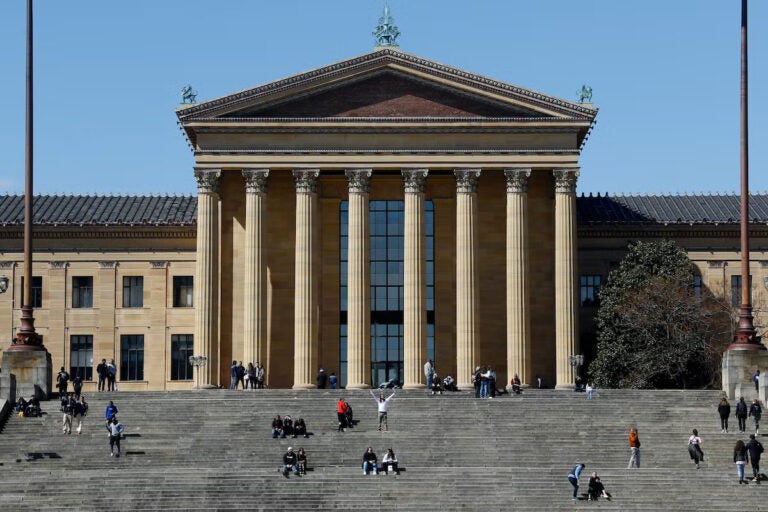
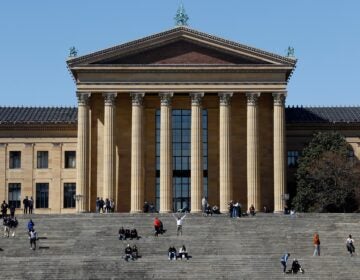
File: The Philadelphia Museum of Art on the Ben Franklin Parkway. (AP Photo/Matt Slocum)
From Philly and the Pa. suburbs to South Jersey and Delaware, what would you like WHYY News to cover? Let us know!
On Feb. 26, 1876, what we now know as the Philadelphia Museum of Art was chartered by the commonwealth of Pennsylvania as the Pennsylvania Museum and School of Industrial Art as part of the Centennial Exposition celebrating the country’s industrial accomplishment. The museum was always meant to outlast the Expo.
Now, 150 years later, the PMA has evolved both physically and philosophically. What began as a display of industrial aspiration has turned into an effort to tell the stories of communities.
That shift comes at a moment of reckoning for museums. Long seen as stewards of culture, many institutions are confronting their origins in wealth, their ties to colonial collecting practices and the exclusion of artists and audiences of color. In recent years, debates over repatriation, labor practices, board governance and the role of museums in civic life have pushed institutions to reconsider what they display.
“If you look at early museums, the works were just there. People were supposed to observe and be and in awe,” said Jessica Todd Smith, chief curator at the PMA. “That could be intimidating for people. A central function of museum work is to help our viewers have a pathway into understanding the collections and how they could be relevant to our lives today.”
It’s been a long journey to reach here.
Related Content

Philadelphia Museum of Art’s CFO, chief of staff resign amid months of staffing turmoil
The PMA faces more leadership turnover months after the CEO’s firing and as the museum moves past a disputed rebrand.
2 weeks ago
Listen 0:54How the Philadelphia Museum of Art came into existence
The 1876 Exposition in Philadelphia was part of a world’s fair movement that swept the globe following Prince Albert’s 1851 Crystal Palace exhibition in London, where American industrialists realized they had a problem.
“American manufacturers had gone [to Crystal Palace] and felt their works looked very poor, quite shoddy,” said historian Sara J. MacDonald, a former library archivist at the University of the Arts. “They felt that American-made goods looked very bad compared to European manufacturers. The whole Museum and School of Industrial Art idea sprouted out of that.”
The exposition primarily showcased American industrial ingenuity. Memorial Hall was built as an art gallery, but art was often shown in the context of industry. Thomas Eakins’s celebrated painting “The Gross Clinic” was displayed in a wing dedicated to medical devices.
Afterward, the museum remained in the building but largely rejected fine art in favor of industrial design. Its first established departments were pottery, textiles and numismatics.
The museum operated in tandem with its School of Industrial Art, teaching students strong design skills that could be applied to Philadelphia’s expanding manufacturing sector.
MacDonald said the school was determined to not teach fine arts.
“If you read the early School of Industrial Art reports, they say very clearly that their plan for this institution will not interfere with the Pennsylvania Academy of the Fine Arts,” she said. “’We’re doing something completely different, and we’re not going to go into your territory.’”
The School of Industrial Art, originally established on South Broad Street, would formally separate from the museum in 1964, becoming the Philadelphia College of Art and then the University of the Arts.
The museum’s shift toward fine art began in earnest in 1893 with a substantial gift of 153 works of Victorian art from Anna Wilstach, the widow of a leather-bridle manufacturer. More significantly, she bequeathed $500,000 to fund further acquisitions of art, which led to the collection of, for example, Henry Ossawa Tanner’s “Annunciation,” the first museum acquisition of work by the major American Black artist.
The gift nudged the museum to prioritize fine art over design.
Related Content
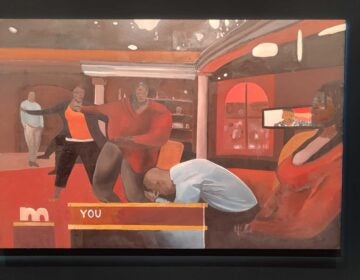
Gone too soon: A posthumous retrospective of the late Noah Davis at the Philadelphia Art Museum
Davis painted large-scale scenes of Black life in an abstract style. His quick rise in the art world only lasted six years before he died at 32.
1 month ago
Listen 1:23Building a palace on a hill
Soon, the museum was going all in on fine art and needed a building to match. Thus began the long, laborious and destructive journey to build the palace on the hill, where the Philadelphia Museum of Art sits now.
Shortly before the turn of the century, the city of Philadelphia began envisioning a grand boulevard in the French style, linking City Hall with Fairmount Park. They wanted to call it Ben Franklin Parkway.
“The idea of taking a street that would go directly from City Hall to the entrance to the park, obliterate a smoking industrial zone along the way, that idea just kept being repeated,” said David Bruce Brownlee, author of “Making a Modern Classic: The Architecture of the Philadelphia Museum of Art.”
At the same time, the national City Beautiful movement was afoot, with an increased interest in city planning. Along with other cities such as New York and Boston, Philadelphia sought a major art museum in the heart of downtown. A proposal gained traction to shift the direction away from Fairmount Park and toward Fairmount Hill, which had been used as a reservoir and would be the site of a museum.
That would draw the school closer to the city than Memorial Hall was across the Schuylkill River.
“It was located in the middle of the damn park,” Brownlee said. “There was some public transportation; there were trolley lines that went into the park, but it was not judged to be in a very good location.”
Construction of the Parkway with a museum at its endpoint began roughly at the same time, with a general plan in place by 1911, but the museum took much longer to build. The Fairmount Park Commission hired two architectural firms for the design. Brownlee said the respective heads of those firms, Horace Trumbauer and Clarence Zantzinger, hated each other.
“They would barely speak to each other,” he said. “There are drawings that strongly indicate that they immediately started to design two different buildings.”
Butting heads and conflicting design ideas caused delays. The 1911 commission did not produce coherent building drawings for another eight years. Funding the construction took another decade.
When the museum building finally opened to the public in 1928, it was barely half finished. Brownlee said some portions of the building, like the Great Stair Hall, were still roofed by tarps.
-
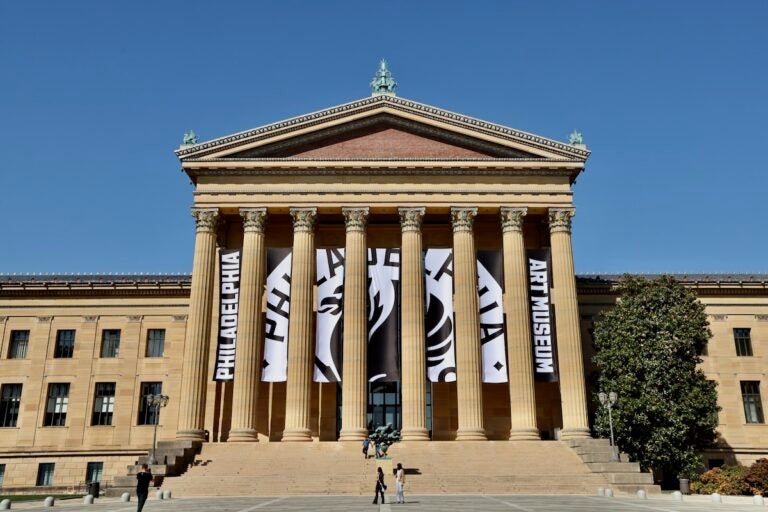
File: A banner at the east entrance to the Philadelphia Art Museum shows a short-lived rebrand. (Emma Lee/WHYY) -
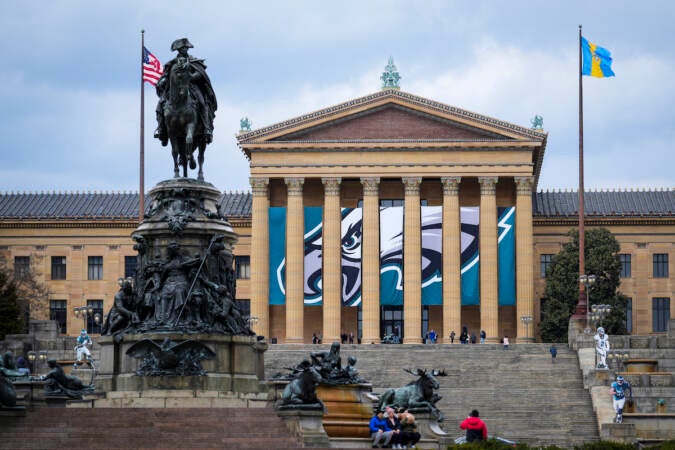
File: The Philadelphia Museum of Art is decorated with the Philadelphia Eagles logo on Jan. 27, 2023, in Philadelphia. (AP Photo/Matt Rourke) -
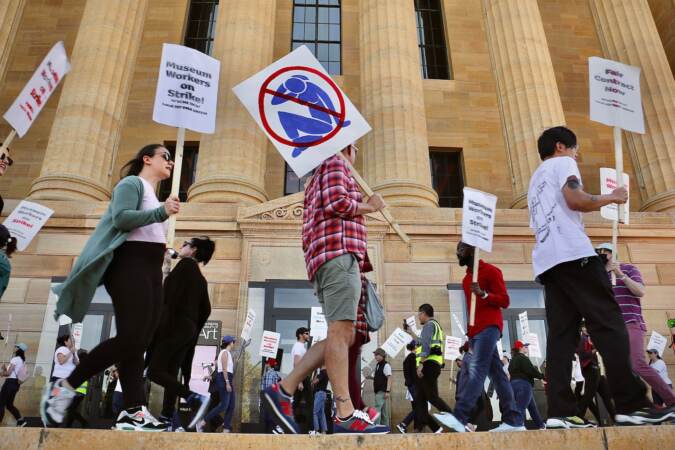
File: Union members picket outside the west entrance of the Philadelphia Museum of Art while the museum hosts a press preview of a Matisse exhibit on Oct. 12, 2022. (Emma Lee/WHYY) -
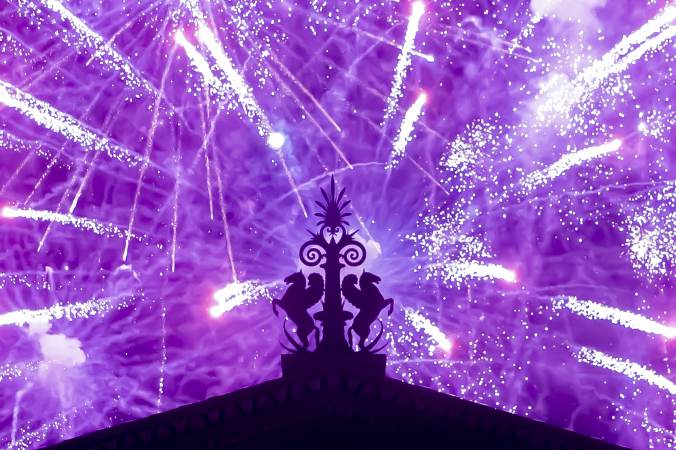
File: Fireworks explode in the background behind a gargoyle atop of the central portico of the Philadelphia Museum of Art on July 4, 2021. (Jonathan Wilson for WHYY) -

File: Fireworks cascade behind the central portico of the Philadelphia Museum of Art on July 4, 2021. (Jonathan Wilson for WHYY) -
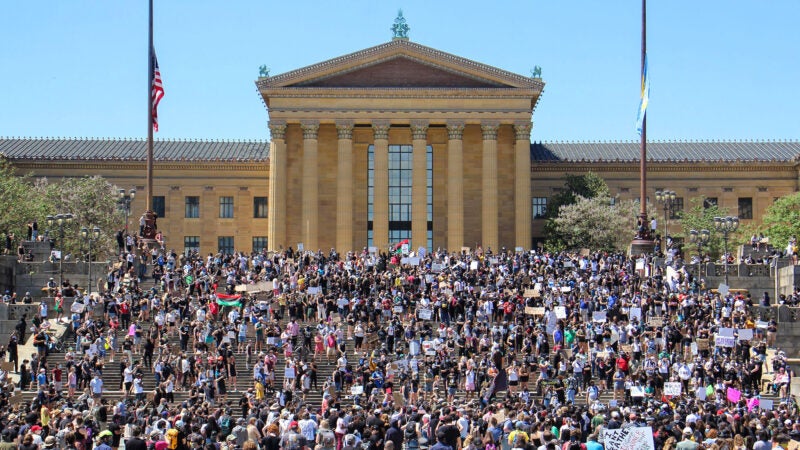
File: Thousands gather near the Art Museum steps during a protest against police brutality in the summer of 2020. (Emma Lee/WHYY) -
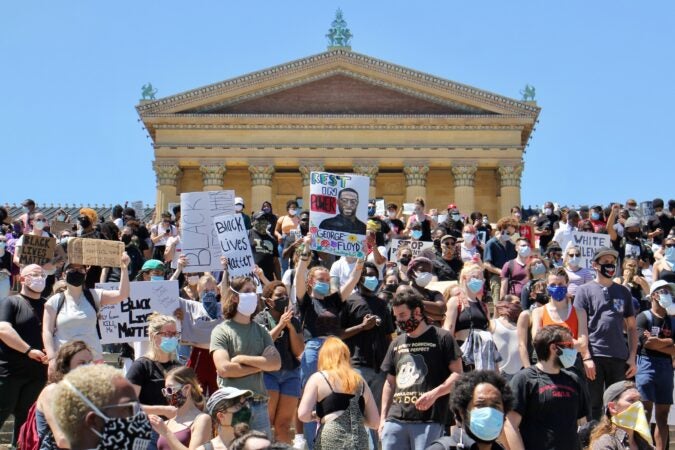
File: Hundreds rally on the steps of the Philadelphia art museum on May 30, 2020, to protest the killing of George Floyd by Mineapolis police. (Emma Lee/WHYY) -
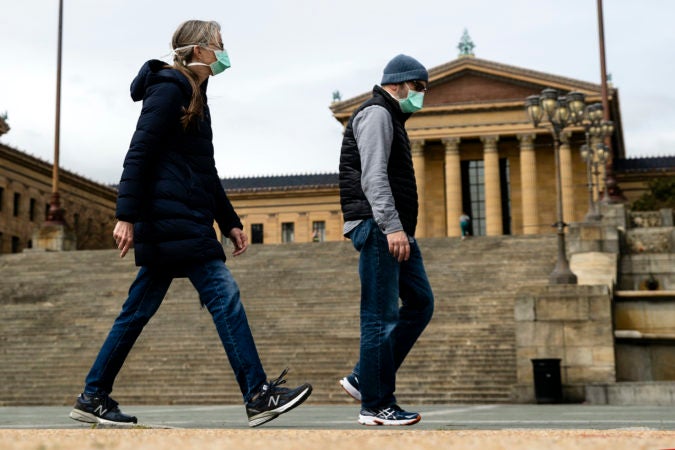
File: A couple in protective masks walk past the Philadelphia Museum of Art in Philadelphia, Friday, April 3, 2020. (Matt Rourke/AP Photo) -

File: Confetti flies to end a celebration in front of the the Philadelphia Museum of Art after a Super Bowl victory parade for the Philadelphia Eagles on Feb. 8, 2018, in Philadelphia. (AP Photo/Alex Brandon) -
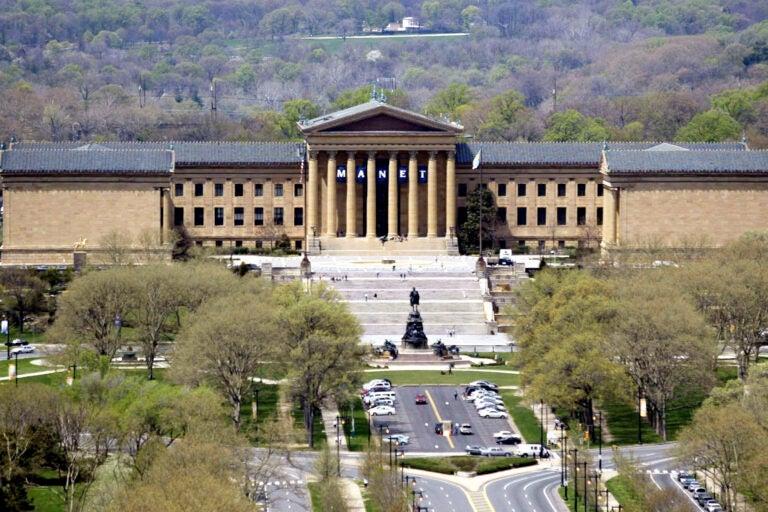
File: This April 20, 2004, file photo shows the Philadelphia Museum of Art, located at the end of the Benjamin Franklin Parkway in Philadelphia. (AP Photo/Joseph Kaczmarek, File)
From industrial art to fine art
Fiske Kimball, who became the museum’s president in 1925 and remained for 30 years, pushed the construction over the finish line. He is largely credited with putting the museum on the international map.
“He is like a god,” MacDonald said.
Several prominent Philadelphia art collectors made promises of donations, anticipating the museum’s success. George Elkins stipulated in his will that the donation of his art collection was contingent on the building being completed within five years of his death. He died in 1919, so in 1924, Kimball opened the museum’s basement as a gallery space for a few days to comply with the terms of Elkins’ will.
“When the main building opened in 1928, only about 20 galleries were truly complete,” Smith said. “Fiske Kimball was an ambitious guy and built the building, understanding that it would leave quite a bit of room for growth. People joked that it was like a Greek warehouse. There were these empty spaces but that provided Fiske Kimball with extraordinary opportunity.”
A big building needs lots of art and Kimball immediately started acquiring the best. In 1930, he bought Renaissance art and artifacts collected by Edmond Foulc of Paris. The reported price for 191 objects exceeded $1 million, a record at the time for a museum purchase.
“In the purchase of so large a group of objects, it is usual to find that some of the objects are pieces of little consequence or of minor value,” Kimball told reporters at the time. “In the Foulc collection, however, every one of the 191 objects is a museum piece of the first quality.”
If Americans still felt in the shadow of European art and design, landing the Foulc purchase was a coup, even if it would take Kimball two decades to pay for it.
“There is nothing like the Foulc collection still in private hands today,” said Marcel Aubert, curator at the Louvre Museum in Paris at the time. “Since we could not keep it in France, there is no place where I would rather see it than in your museum.”
The Foulc collection was followed by other major acquisitions, including the John G. Johnson Collection of European art, the Alfred Stieglitz Collection of photographs, the John D. McIlhenny Collection of furniture and the George Grey Barnard Collection of Medieval art.
In 1950, Kimball secured the highly coveted Walter Arensberg collection of modernist art, including pieces by Pablo Picasso, Marcel Duchamp and Paul Cézanne. The Arensberg collection formed the basis of the museum’s now substantial modern art holdings, including the finest Duchamp collection anywhere.
One of Kimball’s strengths was his ability to visualize for donors how their collections would be seen in Philadelphia, Smith said.
“Fiske Kimball had a background in architectural history and was able to literally draw what the spaces would look like with their collection there,” she said. “Aresnberg sent Duchamp to the museum to case the joint.”
In 1939, during this period of rapid acquisition, the museum became the Philadelphia Museum of Art, officially shedding its industrial art beginnings and adopting the name it was already colloquially known by. The museum recently changed its name again to the even more colloquial Philadelphia Art Museum, but then changed it back.
Related Content
Philadelphia Museum of Art rebrands itself, again, back to its old name
The original rebranding in October was the start of a tumultuous period for the museum.
3 weeks ago
Listen 1:01Getting a plug from ‘Rocky’
On the centenary of the Philadelphia Museum of Art, it entered the realm of pop culture.
In 1976, Sylvester Stallone released “Rocky,” a film about a down-and-out boxer of the same name who tries to punch his way to the top. Spoiler alert: He doesn’t. But in his iconic training montage, Rocky runs up the seemingly endless number of steps leading to the Philadelphia Museum of Art’s upper terrace, turns to face the city skyline and defiantly punches the sky.
That series of gestures has been repeated millions of times over the last 50 years. The museum’s façade and the fictional boxer have become inextricably linked. A statue of Rocky, made as a movie prop for the “Rocky III” sequel, is a popular spot for selfies at the bottom of the museum steps.
Now that the link has grown tighter, with plans for a statue of Rocky to be planted at the top of the steps. While a replica had been placed atop the steps in 2024, the original will soon be moved from the bottom to the top at the end of this summer.
“People come not because they’re told to. They come because it already belongs to them,” said Rebecca Segall of the city Art Commission, at the time of the decision to relocate the statue. “That kind of cultural legitimacy cannot be manufactured.”
-
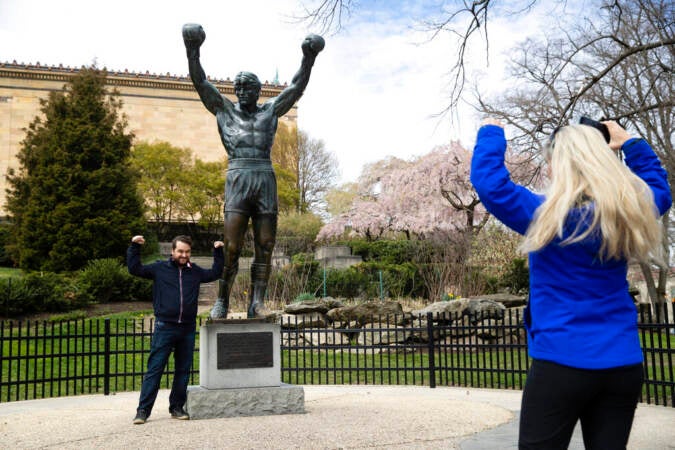
File: In this April 3, 2020, photo, Jessica Shiroff (right) directs exchange student Joao Martucci, of Brazil, as he poses for a photo with the Rocky Statue at the Philadelphia Art Museum in Philadelphia. (AP Photo/Matt Rourke) -
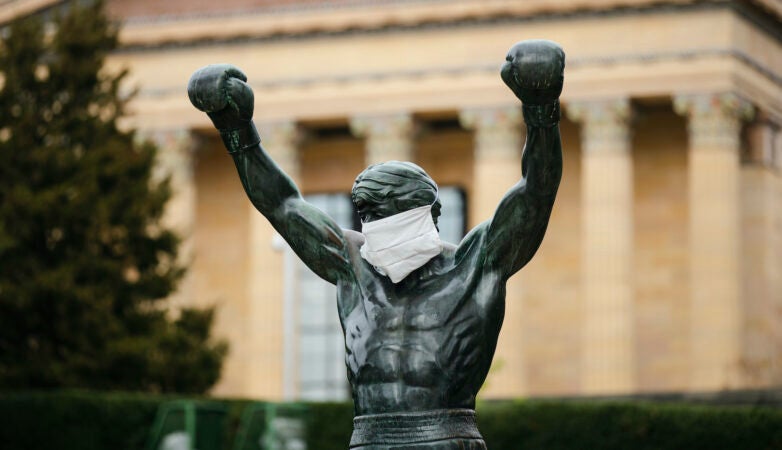
File: In this April 14, 2020, file photo the Rocky statue is outfitted with a mock surgical face mask at the Philadelphia Art Museum in Philadelphia. (AP Photo/Matt Rourke, File) -
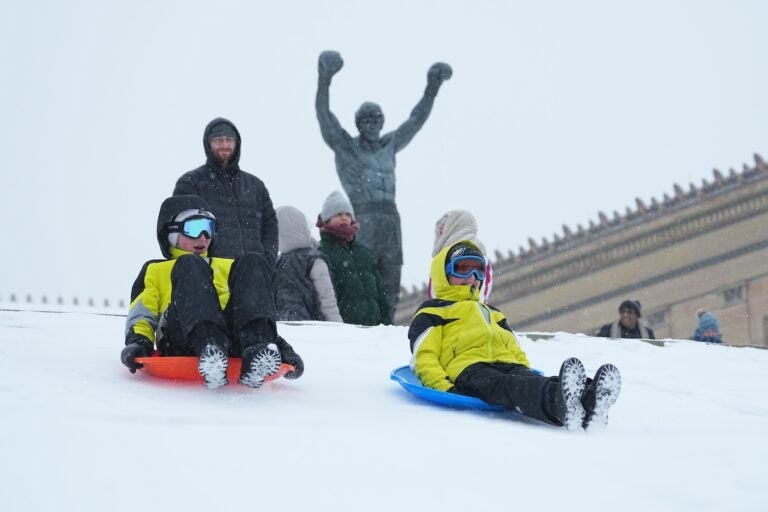
File: People sled on Philadelphia Art Museum steps by the Rocky statue during a winter storm in Philadelphia, Sunday, Jan. 25, 2026. (AP Photo/Matt Rourke) -
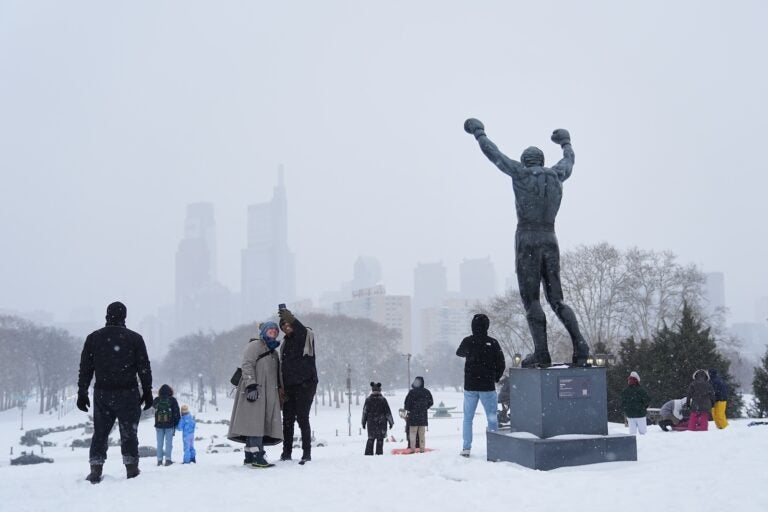
File: People gather at Philadelphia Art Museum steps by the Rocky statue during a winter storm in Philadelphia, Sunday, Jan. 25, 2026. (AP Photo/Matt Rourke) -
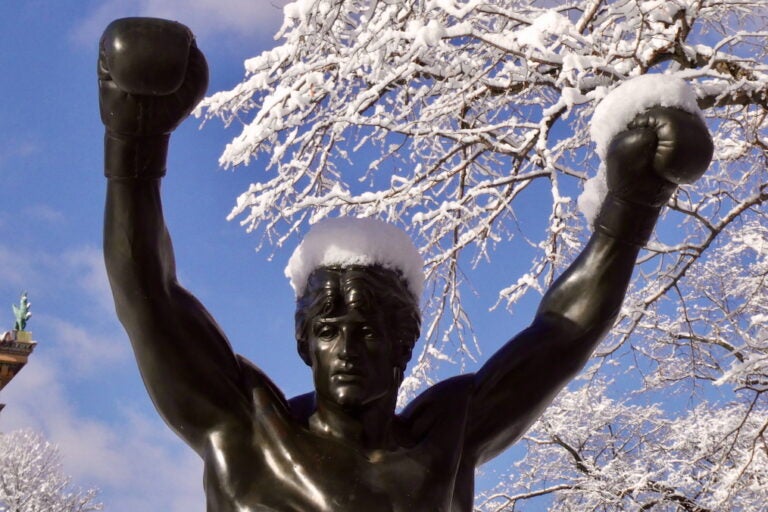
File: The Rocky Balboa statue at the Philadelphia Museum of Art is outfitted with a light dusting of snow on Dec. 14, 2025, somewhat reminiscent of the iconic mountain training montage from ''Rocky IV.'' (Cory Sharber/WHYY) -
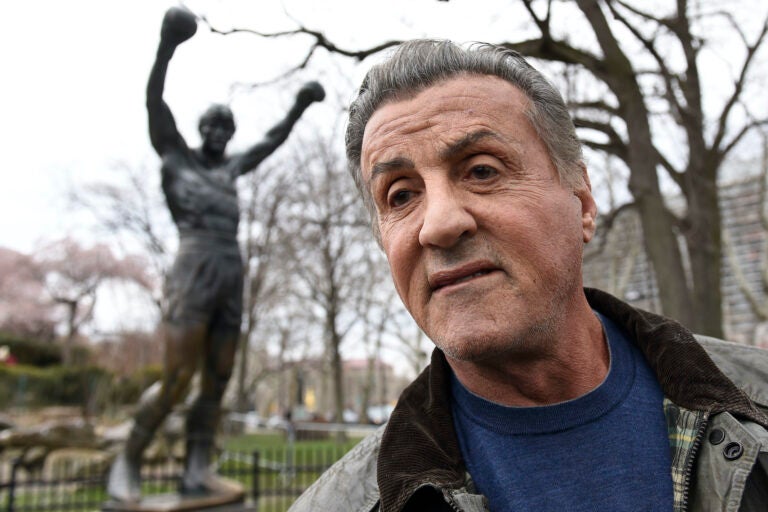
File: Sylvester Stallone talks to reporters in front of the Rocky statue for a ''Creed I'' photo op on April 6, 2018, in Philadelphia. (AP Photo/Michael Perez)
Related Content
‘Smokin’’ Joe Frazier statue could move to beside the Art Museum steps, replacing the Rocky statue
The bronze sculpture of Philly’s real heavyweight champion, an inspiration for Stallone’s fictional creation, has been in the sports complex since 2015.
2 weeks ago
Modernizing the museum
In the 21st century, the Philadelphia Museum of Art set out to transform itself physically.
At the time, its leaders believed the museum needed to expand its square footage. But the building perched on a hill could not be added to without destroying its perfectly distinctive neoclassical proportions.
In 2006, CEO Anne D’Harnoncort hired architect Frank Gehry to figure out how to get more square footage and make the interior more spatially coherent without changing the footprint.
She suggested he dig downward.
“I loved that idea,” Gehry said in 2017. “It’s a very perverse idea.”
Gehry died last December at age 96, but he was able to see his design come to fruition when the museum unveiled its new interiors in 2021.
He said that when he started to investigate the PMA to conceive a renovation plan, he realized the building that Trumbauer and Zantzinger designed, despite their personal friction, had “elegant bones.”
“I feel honored to be able to do it,” Gehry said in 2019. “I can’t imagine there’s anything like this where something designed 100 years ago still has cred, and vibrates, and makes sense today for a collection of contemporary art.”
The museum raised $223 million to fund the Gehry renovation, which is roughly what it cost to build the entire museum in 1928, adjusted for inflation.
The role of museums in American life has shifted over the PMA’s 150 years. What was once an institute designed to collect, maintain and uphold objects representing the best of human achievement has, in recent years, strove to become more community-centered.
“Museums can be intimidating places because I think people come in, see things that are on view that must be important because they’re on view at a museum. It can be a little off-putting,” Smith said. “Part of the museum’s job always has been, always will be, to help make those stories accessible to our viewers.
“They’re not just lofty ideas on the top of the hill at the end of the Parkway,” she said.
-

File: A suspended stairway leads to the Williams Forum at the Philadelphia Museum of Art. (Emma Lee/WHYY) -
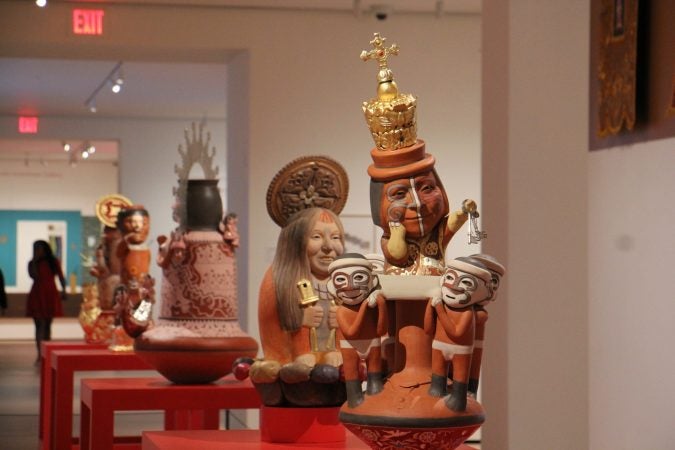
File: A series of clay statues by Philadelphia-based Peruvian artist Kukuli Velarde, are displayed in the modern and contemporary galleries at the Philadelphia Museum of Art. (Emma Lee/WHYY) -
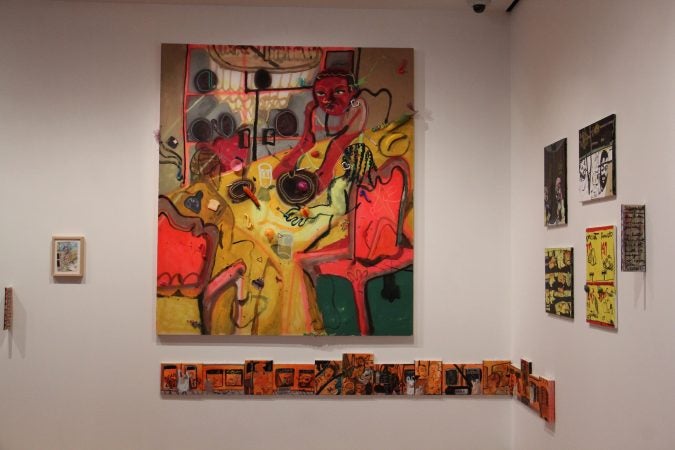
File: The work of Philadelphia artist Jonathan Lyndon Chase is displayed in the contemporary art galleries at Philadelphia Museum of Art. (Emma Lee/WHYY)

Get daily updates from WHYY News!
WHYY is your source for fact-based, in-depth journalism and information. As a nonprofit organization, we rely on financial support from readers like you. Please give today.
‘BOOM’: Philly Art Museum explodes with 1940s art and design
“BOOM” examines a lesser-acknowledged decade for creative innovation.
11 months ago
Philadelphia Museum of Art may have original Vermeer in its vault
Scholars argue the Art Museum’s damaged “Lady with a Guitar” is not a copy of a 17th century Old Master, but the real deal.
3 years ago
Listen 1:23
The motherlode: Whistler’s iconic portrait is back in Philly after 142 years
The Philadelphia Museum of Art’s exhibition of the iconic portrait of American motherhood explains how it has European roots.
3 years ago
Listen 1:22