
Philadelphia launches real-time flood monitoring to help Eastwick residents prepare for storms
Newly installed flood gauges will detect rainfall and water levels to help inform Eastwick residents of potential risks.
Listen 1:03
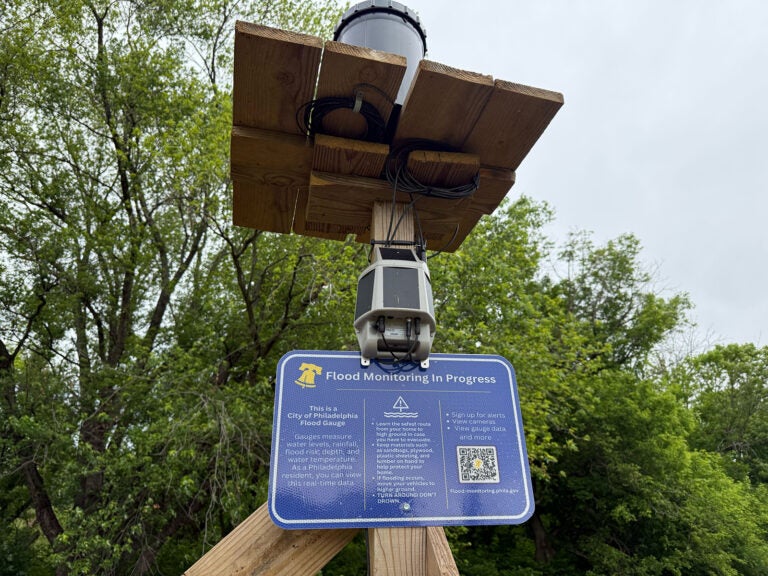
New flood gauges in Eastwick can determine water levels. Residents will be able access the data on their phones and computers. (Zoë Read/WHYY)
From Philly and the Pa. suburbs to South Jersey and Delaware, what would you like WHYY News to cover? Let us know!
When the rain pours down in Philadelphia, residents of the city’s Eastwick neighborhood feel anxious, not knowing whether their homes will flood one more time.
The city’s Office of Emergency Management launched a monitoring system Saturday that uses flood gauges to notify residents when water levels are rising. Residents say it will ease some of the uncertainty and dread that comes with heavy storms.
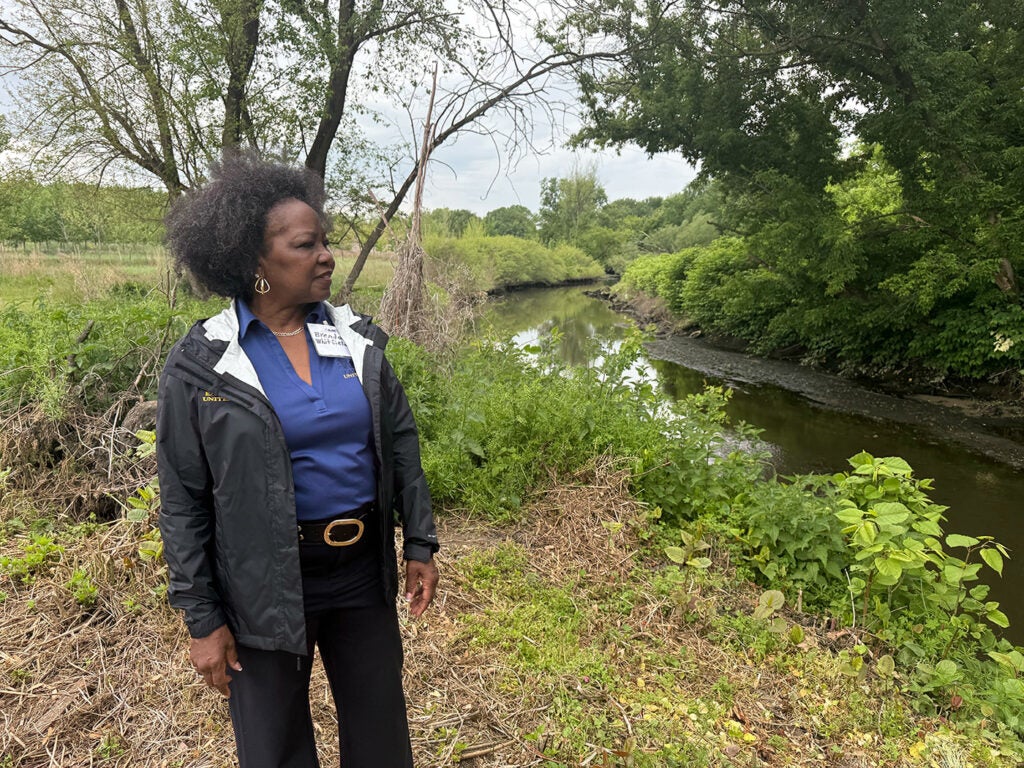
“Now we have something to warn us, to make sure that we get our cars, get our handicapped people, our pets, and make sure we get our things out of the basement and move up to a higher level,” said Brenda Whitfield, an Eastwick resident and community advocate.
The project, six years in the making, uses sensors and cameras to provide real-time data on conditions like rainfall, water level and flood risk. Residents can access the information on their phones and computers, and get resources to help mitigate flooding at home.
“It was really important to us to make sure that the residents themselves could see this information directly, whether at times to give them peace of mind or to be able to make more informed decisions before and during a storm,” said Erin Mossop, OEM’s alerts and warning coordinator.
“This can look like anything from making sure your medication and your paperwork are together, knowing when to move your car, or even deciding to stay elsewhere until the storm has passed,” Mossop said.
The Southwest Philadelphia neighborhood was built on low-lying marshland. The nearby Cobbs and Darby creeks have a history of overflowing, and residents have experienced property damage and the increased cost of flood insurance. The community has seen several so-called “100-year floods” in recent decades, and conditions in the area are expected to worsen as climate change threatens more intense rainfall in the years ahead.
Residents advocated for a flood warning system during the summer of 2020 in the aftermath of Tropical Storm Isaias, when flood waters surged through homes, damaging property and leading to about 100 rescues in the community.
“While it’s a wonderful thing that we had no loss of life from that event, it’s not the ideal scenario. We would much prefer to not have to rescue people in those types of events,” city Managing Director Adam Thiel said. “And of course, the big thing is we would like for that recurrent flooding to stop recurring.”
Related Content

Close to a dozen residents of the flood-prone neighborhood met with members of Congress Tuesday.
1 year ago
Listen 1:10In 2024, the city launched Eastwick Alerts, which provides residents with weather information to help them prepare for severe storms. The alert system and new flood gauges are among several projects supported by city, state and federal funding that aim to mitigate the impacts of flooding in Eastwick.
The Federal Emergency Management Agency is working to build HESCO flood barriers — a series of metal baskets containing a durable fabric filled with a soil mixture that blocks the overflow of water. The project was billed as a temporary fix until a proposed levee is built. However, the U.S. Army Corps of Engineers ditched the levee plan this year to evaluate an alternative smaller design.
The city’s Eastwick Flood Resilience Strategy recommends combining structural barriers like levees and berms, wetland restoration, improved stormwater infrastructure, and voluntary property buyouts to protect people from severe storms.
Now, Eastwick community advocate Whitfield said that residents no longer feel ignored by city, state and local agencies.
“We don’t feel like the abandoned child anymore,” she said. “We feel like they’re hearing our voice and they’re listening to us, and that’s a good feeling.”

Never miss a moment with the WHYY Listen App!


WHYY is your source for fact-based, in-depth journalism and information. As a nonprofit organization, we rely on financial support from readers like you. Please give today.

Lessons learned from Ida: Philadelphia must brace for next big storm, Penn researchers say
During the aftermath of Hurricane Ida, the Schuylkill River rose to levels that hadn’t been recorded in more than 150 years.
2 months ago
Listen 1:04
Conservationists launch plan to protect Wissahickon Valley Park and Creek
During the aftermath of Hurricane Ida in 2021, water rushed down the creek, flooding Forbidden Drive.
2 months ago
Listen 1:26
Villanova University rain garden shows 20-year success at soaking up stormwater runoff
The school's rain gardens have proven effective at helping prevent raw sewage from overflowing into waterways.
2 years ago
Listen 1:17