
Medicaid cuts ahead: ‘It’s going to affect everyone,’ Philly health care workers warn
PASNAP unions and 10 partner organizations have introduced a “Healthcare Bill of Rights” and are urging lawmakers to pledge support for safety net programs.
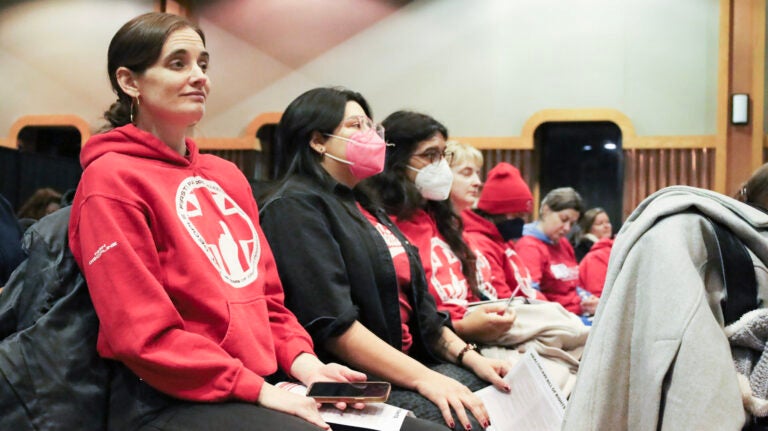
About a dozen unions, organizations and advocacy groups representing thousands of health care workers, patients and vulnerable populations attend a PASNAP health forum Thurs., Jan. 22, 2026 to talk about changes to the Medicaid program and cuts to other health funding. (Nicole Leonard/WHYY)
From Philly and the Pa. suburbs to South Jersey and Delaware, what would you like WHYY News to cover? Let us know!
Health care workers in the Philadelphia area are calling on federal lawmakers to prevent impending funding cuts to Medicaid, a safety net insurance program for people with low incomes, before they officially take effect next year.
They warn that new restrictions on eligibility and cuts to reimbursement funding will hurt struggling hospitals and vulnerable communities the most, as well as widen gaps in health care access at a time when demand for services continues to rise.
“People are going to lose hospitals and health care systems in the areas that they live, so it’s going to affect everyone,” said Peggy Malone, a registered nurse and union board member at the Pennsylvania Association of Staff Nurses and Allied Professionals, or PASNAP. “We really need to send the message now to our legislators that they have got to act and they have got to act quickly.”
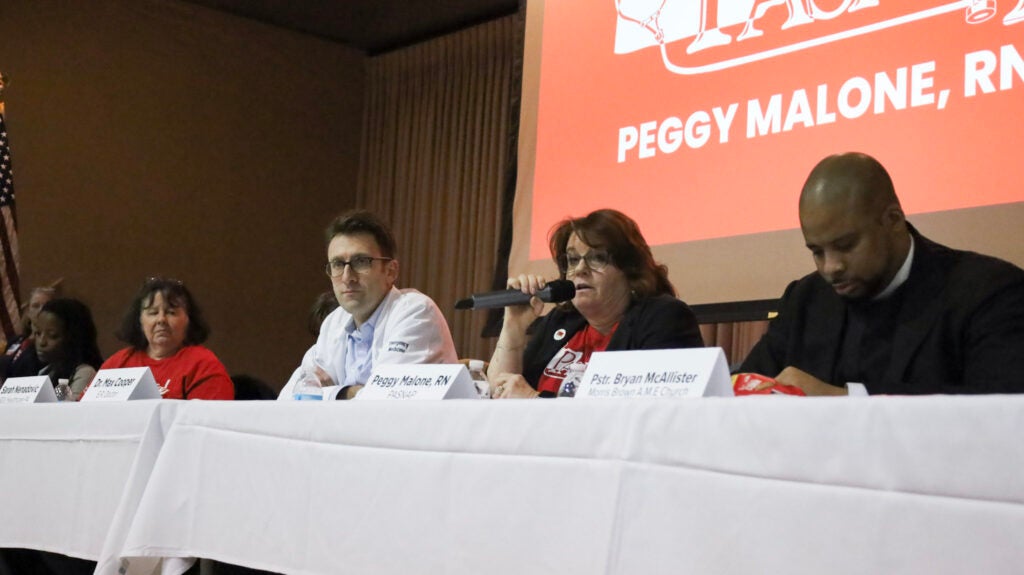
More than 100 union members and advocates from a dozen organizations and groups gathered in Philadelphia on Thursday to decry the coming changes, which were passed by Congress in the so-called “One Big Beautiful Bill” last summer.
Medicaid participants face new work requirements and eligibility paperwork requests beginning next January.
An estimated 310,000 Pennsylvanians could lose coverage in the program under the new rules, according to the Pennsylvania Health Law Project.

The legislation will also limit the way states can raise funds to pay for their portion of Medicaid expenses and reimbursements to hospitals, clinics and providers. Experts say states will likely have to make cuts at the local level.
Related Content
Fewer Americans sign up for Affordable Care Act health insurance as costs spike
The 3.5% decline in enrollment is linked to expiring subsidies and rising health expenses.
2 weeks ago
All of this makes it especially difficult for organizations and communities that hope to open new health care facilities or reopen ones that have closed, like the Crozer Health hospitals in Delaware County, the last of which shuttered in May 2025.
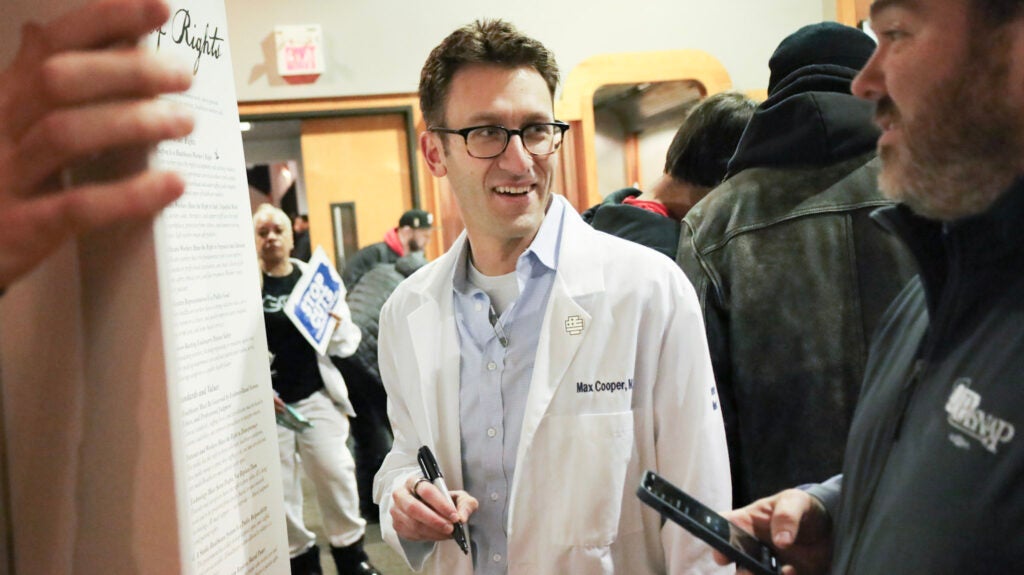
“We desperately need to increase our health care capacity, and all of our efforts on that front are threatened by making the reimbursement landscape more challenging,” said Dr. Max Cooper, who was an emergency physician at Crozer-Chester Medical Center. “It’s harder to reopen a hospital when the hospitals are looking to invest all of this money into something that’s going to be entirely nonviable financially.”
Other health systems in the region have scaled back services or closed individual units and departments, with many citing existing and anticipated financial challenges.
The changes and Medicaid cuts will put already “broken” health care systems and emergency rooms “under enormous strain,” said Maureen May, PASNAP president and registered nurse at Temple University Hospital.
“People show up sicker,” May said. “They’ll show up to the ER, they’ll show up to the hospital, they’ll show up to care much later, and there will be fewer resources to help them. We know people will die due to the lack of access to care.”
Union members and advocates at the Thursday forum introduced a “Healthcare Bill of Rights” and are asking local and federal legislators to pledge support for programs like Medicaid and Medicare, a federal insurance program for people 65 and older.
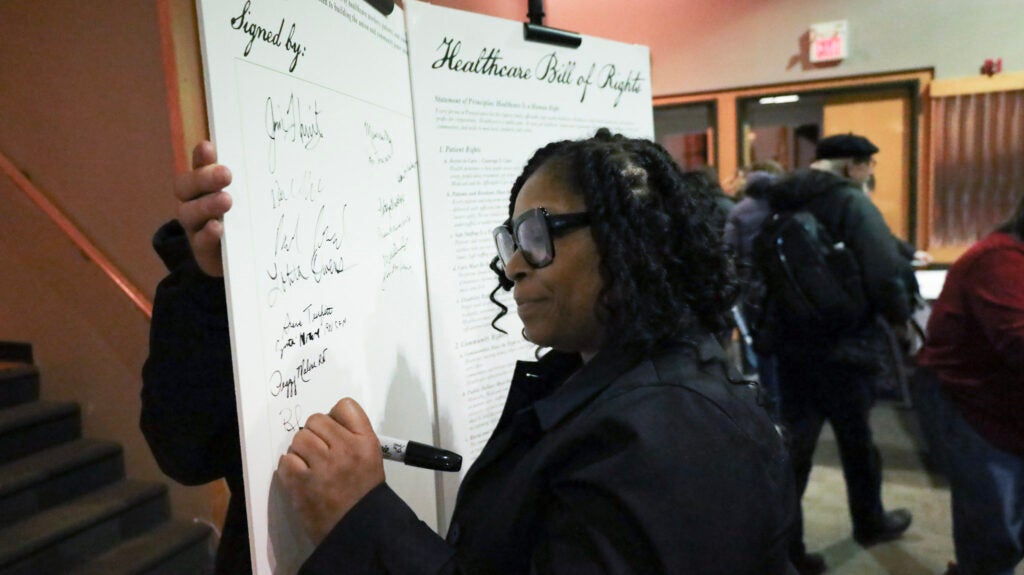
The document also calls for the restoration of federal health subsidies for people who buy insurance on Affordable Care Act marketplaces. Enhanced premium tax credits that helped people reduce their monthly payments officially expired on Jan. 1.
In Pennsylvania, out-of-pocket premium costs have doubled, on average, according to state officials, which has caused some enrollees to switch to less comprehensive plans or drop coverage altogether.
Hospitals and health systems anticipate that they will see an increase in the number of uninsured patients as a result.
“The increase on those premiums, if you want quality insurance, it’s ridiculous,” said Latonta Godboldt, an in-home child care provider and business owner in Philadelphia who gets insurance through Pennsylvania’s ACA marketplace. “I was forced between choosing, ‘Am I going to pay the health insurance? The car insurance? A dance activity?’ Where am I going to make up these gaps?”

Get daily updates from WHYY News!
WHYY is your source for fact-based, in-depth journalism and information. As a nonprofit organization, we rely on financial support from readers like you. Please give today.

Unclear how much Pa. stands to gain from feds’ $50 billion rural hospital program
Mehmet Oz, the administrator of Medicare and Medicaid, has sole discretion as to the distribution of the federal funds.
4 months ago

Delaware County residents plagued by longer ambulance rides, emergency room waits
Crozer Health’s shutdown is affecting everyone from Delaware County’s working-class neighborhoods near the riverfront all the way to the Main Line.
6 months ago
Listen 4:02
ChristianaCare to open West Grove ‘neighborhood hospital’ in August
The site of the former Jennersville Hospital in Chester County will soon be home to ChristianaCare’s first neighborhood hospital.
6 months ago
Listen 0:43