N.J. General Assembly passes bill requiring large data centers to pay for their grid upgrades
The bill aims to shield households and small businesses from electric bill hikes caused by large data centers.
Listen 1:04
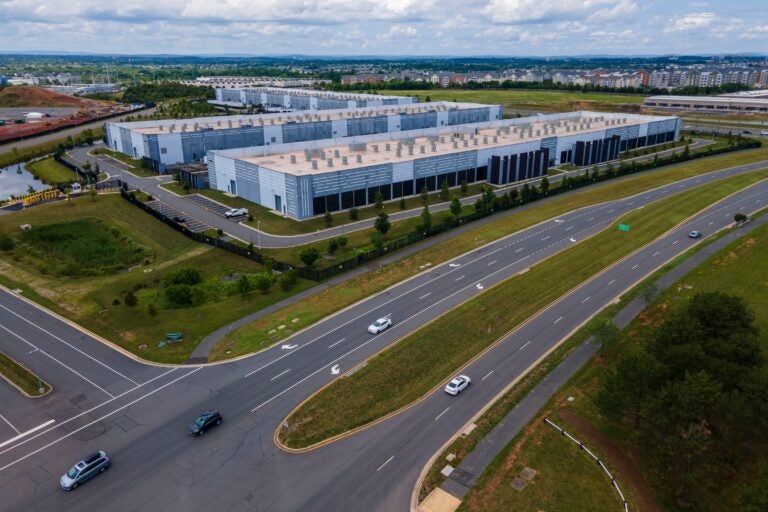
FILE - Cars drive past data centers that house computer servers and hardware required to support modern internet use, such as artificial intelligence, in Ashburn, Virginia, July 16, 2023. (AP Photo/Ted Shaffrey, File)
From Camden and Cherry Hill to Trenton and the Jersey Shore, what about life in New Jersey do you want WHYY News to cover? Let us know.
A bill requiring electric utilities to protect households and small businesses from soaring costs caused by hyperscale data centers passed New Jersey’s General Assembly on Monday.
The bill would require public electric utilities in the state to design special rate structures for data centers using at least 100 megawatts of electricity, enough to power tens of thousands of homes. These rate tariffs would prevent other utility customers from subsidizing costs associated with providing power to these large data centers or paying for stranded costs if the data centers shut down or use less power than expected.
Assemblyman David Bailey Jr., a Democrat representing Cumberland, Gloucester and Salem counties who sponsored the bill, compared it to a prenuptial agreement.
“This is not an anti-data center bill,” Bailey said during a committee hearing earlier this spring. “We want to be married to data centers. We want them to come here. … [This bill] says, ‘You want to come here? Pay for what you say you’re going to do. … Put your money where your mouth is.’”
New Jersey customers saw their electric bills increase by as much as 20% last summer. The spike was driven by a statewide electricity supply auction that reflected an increase in capacity costs on the regional grid. Capacity costs have skyrocketed recently in part due to rising demand projections from data centers throughout the region.
How the ‘prenup’ would work
Brian Lipman, director of the New Jersey Division of Rate Counsel, which advocates for ratepayers, testified during a meeting of the Assembly Telecommunications and Utilities Committee earlier this spring that Bailey’s bill would force large data centers to pay for any grid infrastructure upgrades needed to support their power demand, such as new wires, transformers or substations.
“Right now, the way that would work is all ratepayers would subsidize that,” Lipman said. “The data center comes in and needs $100 million of upgrades on the [utility’s] system. … That is then put into rates, and all ratepayers are going to share in that. What this bill would do is say, ‘No, we’re not doing that. If you cause $100 million dollars worth of cost, you’re going to pay that $100 million.’”
But Bailey’s bill would only address the costs of delivering electricity to customers, not increases in the cost of the electricity itself driven by growing demand, Lipman said. Last year’s 20% jump in electricity bills in New Jersey reflected an increase in the electricity supply costs, which are determined by regional market forces.
Lipman said rising electricity supply costs will need to be tackled collectively by PJM Interconnection, the regional grid operator, through legislation that would require data centers to supply their own power generation.
“If we require a data center to bring its own new generation, that would solve that second problem,” Lipman said. “The issue with that is if we pass that here in New Jersey, and no one else passes it, then we’re kind of screwing New Jersey because they’ll just go across the river to Pennsylvania. We’ll have the same impact, [but] we won’t get the economic benefits. So we really need our partners in other states in PJM to work with us on that.”
Related Content
Vineland residents are protesting AI data center as concerns mount over noise and emissions
The project in South Jersey, already under construction, is being developed by DataOne for the Nebius Group as part of a $17 billion deal with Microsoft.
2 days ago
Listen 2:18Avoiding stranded costs from overblown data center projections
Under Bailey’s bill, utilities’ tariffs would require data centers to pay for at least 85% of the power they request for a period of 10 years. Utilities could also implement transmission security agreements to ensure any new transmission costs resulting from large load data centers are “allocated fairly.”
“The tech giants are pouring billions of dollars into the AI boom,” Bailey said during a hearing of the Assembly Appropriations Committee earlier this month. “It is not fair for my constituents to subsidize their profits. It is not fair for my constituents to bear the risk of big tech’s investments through their electric bills. That is what this bill will do. It protects the ratepayers.”
Related Content

Politicians, energy providers, Big Tech and climate activists are talking about data centers. Here’s what to know.
1 month ago
Critics say bill holds data centers ‘hostage’
Assemblywoman Dawn Fantasia, a Republican representing Sparta and Chester, opposed the bill before Monday’s vote on the Assembly floor. She said energy supply issues existed before the rise of hyperscale data centers, but Bailey’s bill pins blame on data centers because it is politically convenient. She criticized the legislation for forcing data centers into what she characterized as long, 10-year contracts.
“We have other states who are actively competing for this investment,” Fantasia said. “They offer certainty, we offer uncertainty. We’re holding [data centers] to 85% for 10 years. That’s the message: Come to New Jersey, we’re holding you hostage.”
Dan Diorio, vice president of state policy at the nationwide Data Center Coalition, called the bill overly restrictive. He said data centers are the “essential digital infrastructure” behind everything from online shopping to telehealth appointments, and that data centers contribute jobs, economic investment and tax revenue to local communities.
“The data center industry is committed to paying its full cost of service for the electricity it uses,” Diorio said in a written statement. “Aligned with sound ratemaking principles, no customer, industry, or class should be singled out for differential or disparate rate treatment unless that approach is backed by verifiable cost-based reasoning.”
“We are committed to continuing to work with the General Assembly and state leaders to ensure the continued responsible development of the industry in New Jersey,” Diorio added.
The Chamber of Commerce Southern New Jersey and Utility & Transportation Contractors Association also opposed the bill, Assemblyman Wayne DeAngelo said during a committee hearing in February. Neither group responded to a request for comment Tuesday.
Bailey’s bill would need to pass the state Senate and be signed by Gov. Mikie Sherrill before it could become law. An identical bill in the Senate was reported out of a committee in February.

Get daily updates from WHYY News!
WHYY is your source for fact-based, in-depth journalism and information. As a nonprofit organization, we rely on financial support from readers like you. Please give today.
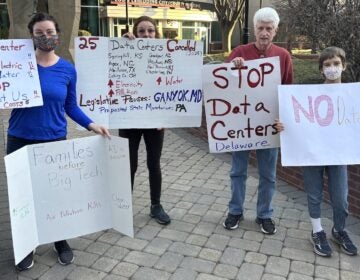
‘A modest start’: New Castle County passes zoning rules for regulating massive data centers
The new requirements don’t apply to data center projects already in the works in New Castle County.
2 weeks ago
Listen 0:49
Why Gov. Shapiro wants to scrutinize electric utility profits
Gov. Josh Shapiro has a plan to scrutinize utility profits. Investor-owned utilities say it's important to invest in infrastructure that keeps the lights on.
1 month ago
Listen 5:35
They want the Democratic governor, Senate president and Assembly speaker to pass bills to protect the state’s most vulnerable populations.
6 months ago
Listen 1:09