Delaware Gov. Matt Meyer reveals his fiscal year 2027 budget, relying on spending cuts and tax and fee increases
Meyer’s recommended budget would "modernize" business formation fees and raise cigarette taxes to add state revenue.
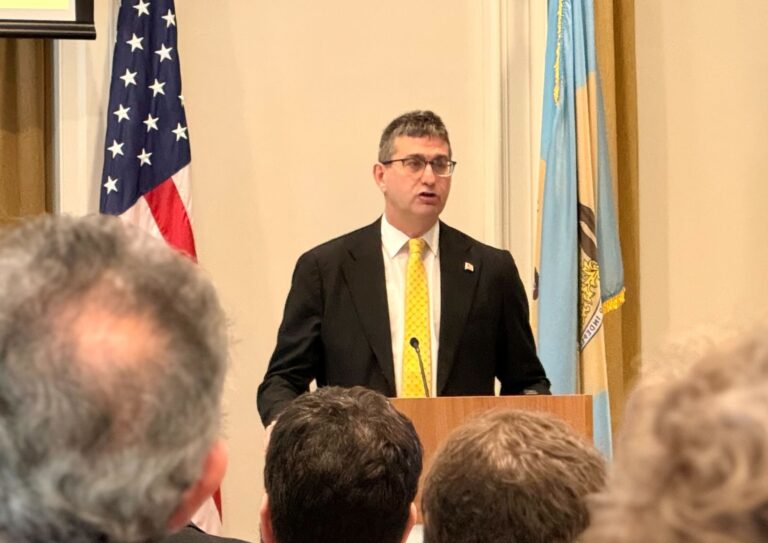
Gov. Matt Meyer outlines his fiscal year 2027 budget proposal, highlighting priorities in education, housing, healthcare and workforce development. (Johnny Perez-Gonzalez/WHYY)
Delaware Gov. Matt Meyer is proposing slashing spending and raising revenue through taxes and fees for the next fiscal year state budget.
Meyer promised earlier this month to constrain spending growth to less than 5%. He’s recommending spending $6.9 billion in the fiscal year 2027 budget.
The General Assembly’s 2026 budget was about $6.5 billion, a 7.3% increase from the prior year. The operating budget for fiscal year 2025 totaled $6.1 billion, which was a 9.3% increase from the previous year’s budget.
The plan maintains the state’s rainy day fund of $366 million and the Budget Stabilization Fund, which stands at $469 million.
Senate President Pro Tem David Sokola said that while there are cuts all around, the budget conversation goes beyond how much money the state spends and focuses on whether that spending is effective.
“There are some areas where we may be funding things but not getting the bang for the buck,” Sokola said. “In each of those areas, it’s not just about funding.”
The governor’s recommended budget is still above the 3.9% budget growth benchmark set by the Delaware Economic and Financial Advisory Council. But Senate Minority Leader Gerald Hocker said he liked what he saw.
“The mix that the governor is proposing at this point has got to be as good as I’ve seen from any governor since I’ve been here, and I started with the Gov. [Ruth Ann] Minner days,” he said.
Related Content
Delaware Gov. Meyer promises to cap budget growth in State of the State speech
Meyer said he wants to create more statewide affordable housing and railed about high energy prices.
2 months ago
Listen 1:13Recommended budget aims to close ‘structural gap’
Meyer said there was a structural gap between expenses and revenue of more than $500 million. He’s proposing reductions to several areas of the budget to help close the divide.
“We don’t believe in going around and cutting government with chainsaws,” he said. “We believe in doing it with scalpels, going line by line, looking intelligently at the services Delawareans are receiving and making sure that we can make more efficient those that aren’t working or don’t make sense.”
Brian Maxwell, director of the Office of Management and Budget, said spending on cost drivers, which totals $524 million, has grown 8% from the current fiscal year. The administration wants to reduce cost drivers by nearly $108 million. Maxwell said Medicaid, inmate medical services, personnel cost and student population growth make up 66% of total for cost drivers.
Other reductions include a $131 million reduction in state investments and a $168 million cut in one-time spending.
The governor’s recommended capital projects legislation, known as the Bond Bill, is $43 million less than the $934 million total in fiscal 26. The recommended budget also slashes $12.5 million from last year’s grants-in-aid bill, giving about $85.5 million in state funding to nonprofits, local fire companies and senior centers.
Meyer also wants to use $10 million to create a film tax credit.
Adding revenue from fees and taxes
The administration wants to balance the budget by raising approximately $160 million in new revenue.
Meyer did not include a proposal to revamp the state’s regressive personal income tax system so wealthier residents would pay more taxes, one of his signature priorities he outlined last year.
About $81 million of that would come from revamping business formation fees, such as when companies form limited liability companies, or LLCs, and the annual franchise tax. Another $18.9 million would come from hiking tobacco taxes, including taxes on cigarettes and vaping products. The tax on cigarettes would go from $2.10 to $3.60 per pack.
House Speaker Melissa “Mimi” Minor-Brown introduced legislation to raise tobacco taxes last year, but it stalled in committee.
Meyer said the proposed tobacco tax increase reflects changes in how people consume nicotine and how outdated the current tax structure has become.
“The tobacco tax also has to do with the changing nature of that industry and tobacco products,” Meyer said. “When you look at the tax system we have in place now for tobacco, I don’t think it makes sense for the current industry — and I wouldn’t say that about alcohol.”
Senate budget chief Trey Paradee, D-Dover, said he’s unsure there’s the political will to rework the tax brackets.
“Coming out of this property reassessment debacle, for lack of a better word, I don’t think that there is much of an appetite to touch people’s personal income taxes at this time,” he said.
Related Content

Some of the issues Delaware lawmakers plan to address include property reassessments, rising health care costs and education funding.
2 months ago
Budget investments in housing, education and workforce development
Meyer’s recommended budget adds year-three funding for educator salaries, gives 2% pay increases for state employees, devotes $19 million to the Housing Development Fund and expands high-quality early childhood education.
The plan includes targeted rental assistance, providing low-barrier funding for homeless services and down payment assistance for people to become homeowners.
Sokola pointed to housing as one area where policy changes –– not just additional dollars –– could make a difference, particularly for affordable development.
“One of the areas in housing that [the governor] has talked about, and that I think is important, is the way we do permitting and the way we regulate construction, especially for affordable housing,” he said. “It’s hard in certain areas of the state to get a developer to build affordable housing. It’s not at all hard to get the McMansions built. So, you know, there’s multiple aspects to it, other than just the amount of money you’re going to put into it.”
Maxwell said the revenue proposal closes the gap between spending and revenue and leaves nearly $43 million for strategic investments. Those investments are as follows:
- $25.3 million for purchase of care;
- $9.9 million for student unit growth;
- $8.0 million for Delaware early childhood care;
- $8.0 million continues emergency literacy fund;
- $3.0 million teacher-driven projects;
- $2.8 million for education funding formula implementation.
—
Editor’s note: WHYY receives grant-in-aid funding from the state of Delaware.

Get daily updates from WHYY News!
WHYY is your source for fact-based, in-depth journalism and information. As a nonprofit organization, we rely on financial support from readers like you. Please give today.
Part of the series

Delaware Supreme Court upholds controversial overhaul of state corporate law
The revamp of Delaware’s corporate code was sparked by Elon Musk’s "DExit" from the state after an Chancery Court decision not in his favor.
2 weeks ago
Listen 0:43
“What we wanted to highlight at the State of the Union was that, a year later, things are not better,” said Democratic Sen. Lisa Blunt Rochester.
2 weeks ago
The governor wants to raise new revenue by changing the personal income tax brackets and increasing fees on cigarettes, state parks and roads.
12 months ago
Listen 0:54