

‘The federal government is looking to ignore their rights’: Delaware ACLU urges leaders to limit ICE, police cooperation
The ACLU of Delaware is asking state leaders to establish statewide rules governing when police can assist ICE and share information.
Listen 1:25

File: A U.S. Immigration and Customs Enforcement officer listens during a briefing, Monday, Jan. 27, 2025, in Silver Spring, Md. (AP Photo/Alex Brandon, File)
ICE latest: What to know
- ‘ICE Out’ in Philly: Here’s what to know about ICE-related legislation in the city.
- ICE cooperation: WHYY News explores what immigration agreements are in place in Philly, the suburbs, New Jersey and Delaware.
- Legal protections: Here’s what to know if you’re an immigrant living in Philly. Plus, advocacy groups share what to know if you are stopped by federal immigration agents.
The American Civil Liberties Union of Delaware is urging Gov. Matt Meyer, Attorney General Kathy Jennings and other state leaders to adopt statewide limits on how Delaware law enforcement agencies cooperate with U.S. Immigration and Customs Enforcement.
In a letter sent Monday and signed by more than two dozen advocacy and community organizations, the organization is calling for two immediate reforms: establishing clear statewide guidelines outlining when law enforcement can assist ICE; and guidance prohibiting state and local agencies from sharing information with federal immigration authorities unless ICE presents a valid judicial warrant or court order.
“We need clear guidelines from the governor with supporting information from the Attorney General about how and when Delaware law enforcement can assist, as well as reiterating the call that Delaware law enforcement and state agencies should not be sharing information and data with ice unless they have a valid warrant or a court order,” Helen Salita, ACLU of Delaware’s immigrants rights campaign manager, said in the letter.
The organization says its request comes amid what it describes as an escalation in ICE operations across the country, along with newly obtained public records and several incidents in Delaware over the past two years that it argues raise concerns about how local law enforcement agencies interact with federal immigration officials.
Salita said the letter ultimately asks one question.
“Is Delaware going to allow our law enforcement to continue to assist ICE despite their violent activity, despite their unlawful conduct, despite the fact that they are routinely lying to the public?” Salita questioned. “Because we’ve seen their behavior escalate across the country and even here in Delaware.”
A timeline of incidents
While Delaware has not experienced any deaths during ICE encounters, the ACLU of Delaware points to multiple fatal encounters involving ICE in other states this year, arguing those incidents demonstrate the need for safeguards before a similar tragedy occurs in the state.
The organization said the state has seen a series of immigration enforcement incidents over the past two years and provided a timeline that underscores its concerns.
- Between January and April 2025, the Laurel Police Department shared addresses associated with Haitian immigrants, along with the name of one individual, with the FBI. The ACLU of Delaware said there was no judicial warrant compelling that information to be turned over.
- In March 2025, ICE agents entered a Sussex County woman’s home after she requested to see a warrant before letting them inside. The organization said she was later detained in Louisiana.
- In May 2025, the town of Camden entered into a 287(g) agreement with ICE, which allowed certain local officers to assist with federal immigration enforcement.
- In November 2025, ICE sought assistance from Delaware State Police and Seaford Police after a man fled during a vehicle stop and hid beneath a trailer. According to the ACLU of Delaware, the man was injured when ICE officers moved the trailer without a judicial warrant for his arrest.
- This May, ICE agents used a taser to detain a father near an elementary school bus stop. The ACLU of Delaware said the incident unfolded in front of children, including the man’s own.
Related Content
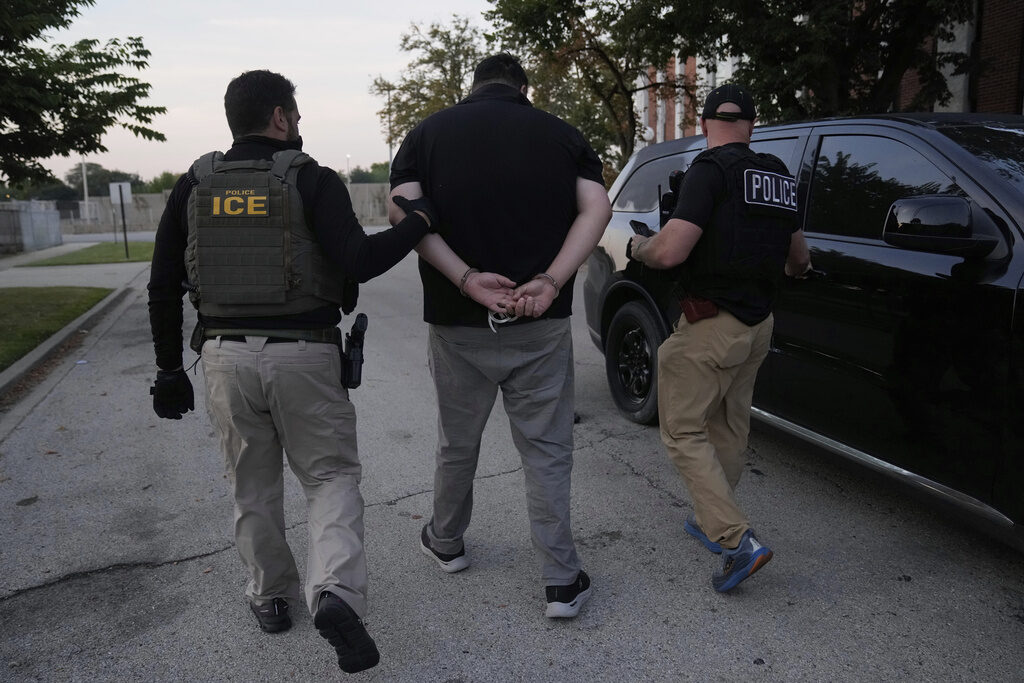
Under Trump, immigration arrests surge in Pennsylvania, Delaware and New Jersey
New Jersey and Pennsylvania rank among the 10 states with the most immigration arrests during the first 14 months of President Donald Trump’s second term.
3 months ago
Listen 1:43FOIA records raise concerns
Salita said the organization’s issued letter was also driven by records obtained through Freedom of Information Act requests submitted to the Laurel, Camden and Seaford police departments.
She said one of the most significant findings came from Laurel Police, where text messages showed an FBI agent’s expressed interest in working with Laurel Police and ICE, in regard to immigrants in the area, before officers shared addresses associated with Haitian immigrants.
“They knew up front the information their office was gathering on these immigrants was going to be shared with ICE to see if there were any immigrants in their area that were a high priority,” Salita said. “[It’s] very clear the Laurel Police Department is engaging in civil immigration enforcement by providing or assisting in civil immigration enforcement providing information to the FBI, knowing that it was going to be shared with ICE.”
Salita said the records conflict with repeated public statements from law enforcement agencies that they do not participate in civil immigration enforcement.
“This contradicts the promise we have heard time and time again from law enforcement here in the state — that they in no way want to be involved in civil immigration enforcement or that’s not anything they do,” she said. “It makes it clear here that Laurel PD was pretty willing to assist.”
Related Content

Some local law enforcement agencies have signed 287(g) agreements with ICE. Others are doubling down on limiting cooperation with federal agents amid a nationwide crackdown.
8 months ago
Transparency concerns
Salita said the ACLU of Delaware found a similar disconnect after Camden entered into a 287(g) agreement with ICE in 2025, which is, essentially, a formal partnership between ICE and local law enforcement that allows local officers to perform federal immigration duties.
At the time, Camden officials said the agreement was withdrawn because residents opposed it.
But Salita said records later obtained through a FOIA request told a different story.
“They told ICE, ‘Hey, we want to put this agreement on pause. There is now a push in the state to ban these agreements and we don’t want this to be a reason that they can use to try to do this,’” she noted. “So even there, they weren’t saying, ‘Our community told us, no, they don’t want to see this happen.’ They said, ‘Hey, we want to pause this until it dies down. And then we want to talk to you again about re-entering into this program.’”
She said those records reinforced the organization’s concerns about transparency.
“What they’re telling us publicly, what they’re trying to say their actions are or what they aren’t engaging with, is not lining up with what they are doing and what they’re saying behind the scenes,” she said.
Related Content
“Anonymous tips” led ICE investigators to seek wage records for 15 businesses, the attorney general said. She suspects more subpoenas are coming.
4 months ago
Listen 0:55Judicial vs. administrative warrants
A central part of the ACLU of Delaware’s request is requiring state law enforcement to verify that ICE has a judicial warrant before assisting with enforcement actions or sharing information.
Unlike administrative warrants, which are issued internally by ICE, judicial warrants are signed by a judge after law enforcement establishes legal justification.
Salita said that distinction is essential to protecting Delaware residents’ constitutional rights to due process under the Fifth and 14th amendments.
“Before we will assist ICE, before we will hand over any Delaware residents information to ICE, we need to be protecting our people right now because the federal government is looking to ignore their rights or act like their rights don’t exist,” she said.

Never miss a moment with the WHYY Listen App!


WHYY is your source for fact-based, in-depth journalism and information. As a nonprofit organization, we rely on financial support from readers like you. Please give today.
Part of the series

Part of the series

Justin Dynlacht thought his employer and health insurer didn’t provide adequate coverage for Crohn’s disease, but took his complaints way too far.
12 hours ago
Listen 1:52
A man working for the contractor Greggo & Ferrara alleged he was called the N-word and “boy” by a white co-worker.
1 week ago
Listen 1:11
Delaware was the first state to employ nonattorneys to represent tenants who earn under 200% of the federal poverty level.
3 weeks ago
Listen 0:48