

Plymouth Township, Conshohocken-area residents shout, boo, as hearing for data center begins
Residents say they’re concerned the new data center will reduce property values and impact their quality of life in the suburban Pennsylvania towns.

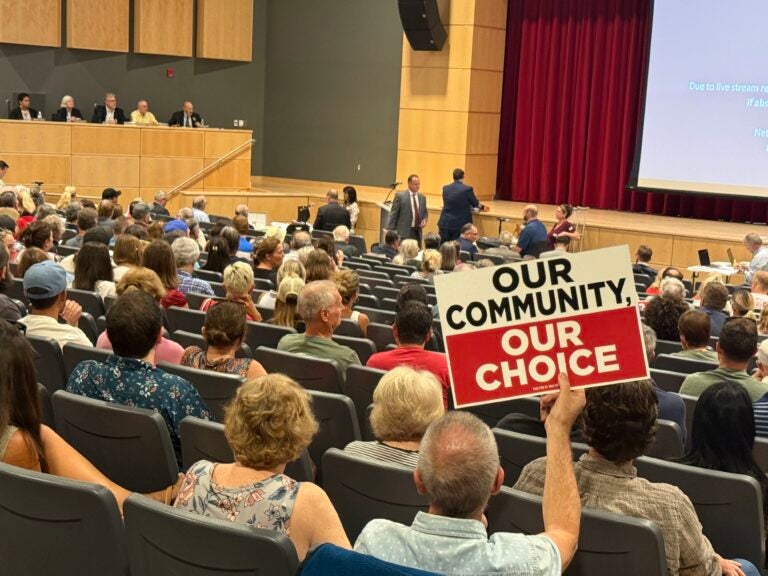
Residents booed and shouted at a hearing over a proposed data center in Plymouth Township, Pennsylvania, near Conshohocken. (Zoë Read/WHYY)
This story is part of the WHYY News Climate Desk, bringing you news and solutions for our changing region.
From the Poconos to the Jersey Shore to the mouth of the Delaware Bay, what do you want to know about climate change? What would you like us to cover? Get in touch.
The first hearing for a proposed data center in Plymouth Township-Conshohocken area was interrupted multiple times as a crowd of residents booed, cursed and shouted at the developer’s attorney and witness.
Developer Brian O’Neill is seeking approval for a 2 million-square-foot data center that is technically located within the boundary of Plymouth Township, Pennsylvania, but also impacts nearby residents of Conshohocken. The facility would span 10 existing buildings at the recently closed Cleveland-Cliffs steel mill, which sits on 66 acres of land along the Schuylkill River, about a mile from the Conshohocken borough’s vibrant downtown area.
The Thursday night hearing before the Plymouth Township Zoning Hearing Board was contentious as attorneys representing several separate opponents to the proposal challenged the qualifications of the applicant’s expert witness. The board, an independent, quasi-judicial body appointed by the township council, will decide whether to approve the data center’s development.
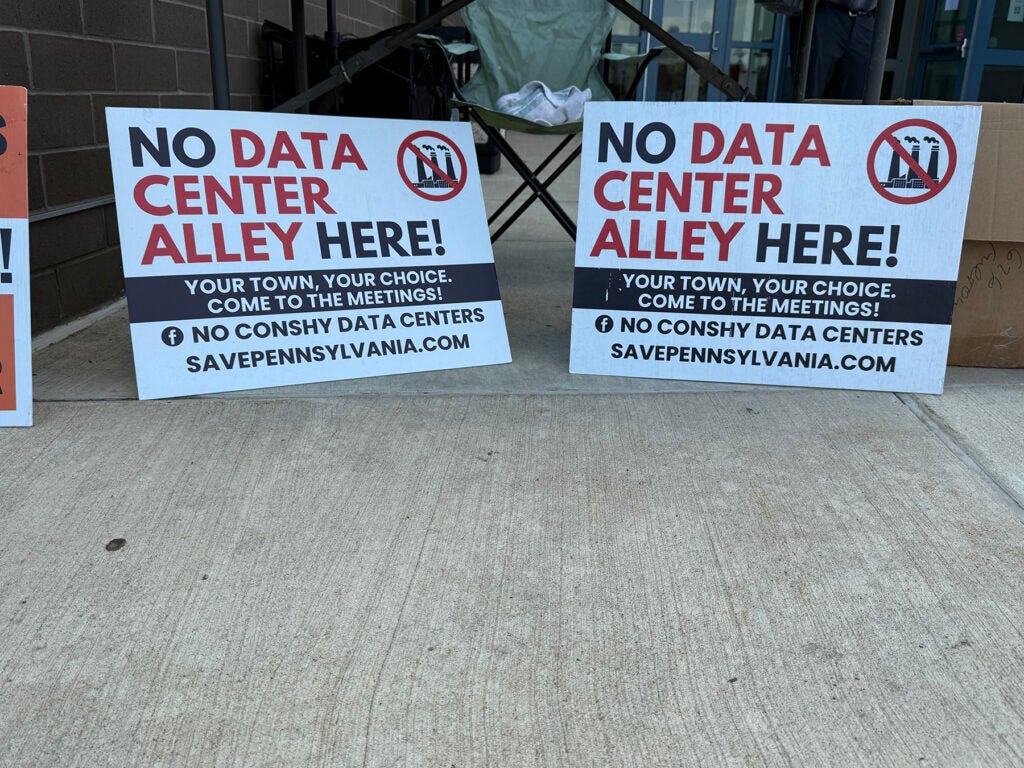
Residents have pushed back against the proposal, which they say could harm the environment, reduce property values and impact their quality of life. An online petition opposing the data center has garnered more than 4,000 signatures.
“They just don’t care. They want the money, they want the win at this point,” said Ardis Leukens, who lives about 500 feet from the site, after the hearing. “They don’t care about people, because if [O’Neill] did, he would be listening to us and saying, ‘Hey, let’s build this area up,’ not knock it down, not destroy it.”
Data center opponents make several legal challenges during the hearing
Attorneys representing multiple parties that oppose O’Neill’s plan made several motions during the hearing, including a challenge to the adequacy of the developer’s application.
They also questioned the qualifications of Richard Roseberry, senior principal at Colliers Engineering & Design, a witness called on to testify about the planning and zoning process. The motions were supported by loud applause from the audience, but were rejected by the board.
Roseberry was called on by O’Neill’s legal team to interpret the township’s zoning ordinance.
The data center battle over zoning
Last month, O’Neill filed an application that challenges the validity of the current zoning ordinance, which does not authorize data centers as a permitted use in a heavy industrial zoning district within Plymouth Township. Although the law allows for O’Neill to apply for an exception, which he has done, he argues the law is exclusionary, and unfairly creates roadblocks to data center development. In response, Plymouth Township Council accused O’Neill of “throwing a tantrum.”
Thursday night’s hearing will help the zoning board decide whether to approve the special exception application.
After Roseberry explained the definition of a data center, he testified that their characteristics align with those of manufacturing, research and development, and warehousing — uses listed under the township’s ordinance.
O’Neill’s attorney Edmund Campbell said if an applicant’s project is of similar character to one of those uses, the applicant has a right to that use. Campbell said that, according to state law, if an ordinance does not provide a use, the applicant gets that use by right, prompting O’Neill to file a validity challenge.
“The similarities between manufacturing and data centers is that both process raw materials,” Roseberry said. “One process is a hard product, the other process is data. Data is a raw material, which is used to manufacture a product. AI is a product.”
The statement was met with loud boos and jeers from the audience, with the reaction becoming so loud the court reporter had difficulty transcribing.

“I appreciate the efforts that you’ve made to conduct the meeting …. We can’t get through a sentence or two without being interrupted,” said O’Neill’s attorney.
David Sander, the board’s solicitor, attempted to appeal to the crowd.
“I know you’re in an emotional situation. I know that you are invested in this,” he said. “I think that the zoning board understands that, and has seen the crowd and seen you tonight.”
“Hear us!” shouted a member of the audience in response.
“We are, we will, but we have to do it in a certain order,” Sander said calmly.
Related Content
Vineland data center makes case for on-site power generation during 6-hour hearing
Developers for the New Jersey-based center plan to use on-site fuel cells, saying the new plan will not draw power from the grid or increase residential rates.
1 month ago
Kaden Beegle is a Norristown resident who showed up to oppose the project. He said while he understands the legal technicalities of the ordinance are complicated, he didn’t agree with Roseberry’s testimony.
“I do completely disagree with the notion that manufacturing is the use case of a data center,” he said after the hearing. “[A data center] is essentially a power plant that is being proposed because of all of the generators needing to be present to be able to meet the demands of the constant 24/7 usage and processing of that data.”
Data center developer promises jobs and tax revenue
Data centers house the computer servers required to run internet services worldwide. While they have been around since the mid-20th century, the acceleration of power-hungry artificial intelligence has boosted demand for larger sites.
O’Neill estimates his proposed data center would generate $420 million in tax revenue over the next 20 years, including millions for the school district. He said it would also create 800 permanent jobs and thousands of construction jobs. It’s not clear who would operate the facility, but O’Neill told WHYY News this week he’s in discussion with a top 5 technology company.
The facility is one of 10 proposed data centers in Montgomery County and across the country led by O’Neill, with multiple applications also submitted to Upper Merion Township for potential data centers in the King of Prussia area.
“All these young people stream movies, use Instagram, TikTok, Meta, they are on the internet, they’re doing work from home — all that runs through data centers. ” O’Neill said during the interview.
“The very young people that are here are the ones who need the power of the data center, and it creates great jobs and it also creates a cascading effect and attracts other technology companies to the region if they feel that this is a tech-friendly environment.”
Residents worry about noise, air pollution and property values
Still, residents are concerned about increased noise, reduced property values and rising electricity bills. PJM Interconnection, which manages the region’s electrical grid, has pointed to the increase in data centers as one of the drivers of higher electricity bills.
However, O’Neill said he plans to utilize on-site natural gas generators, which would reduce the impact on the electrical grid and prevent ratepayers’ bills from increasing.
He said the data center would also utilize diesel generators.
Burning natural gas and diesel creates air pollution, which can exacerbate respiratory problems and other health conditions among people who live nearby. O’Neill asserts the facility would use scrubbers to control emissions.
O’Neill said he has had discussions with Delaware’s Bloom Energy and other companies about the potential to use fuel cells on site, but hasn’t finalized any deals. A data center under construction in Vineland, New Jersey, plans to use Bloom fuel cells.
Fuel cells turn natural gas into electricity through an electrochemical reaction without releasing the high amounts of air pollutants like nitrous oxides and sulfur dioxides that result from burning the fuel.
Related Content

Politicians, energy providers, Big Tech and climate activists are talking about data centers. Here’s what to know.
7 months ago
Residents are also concerned about water use, which in some areas of the country have threatened drinking water supplies. Hyperscale data centers can consume up to 5 million gallons of drinking water per day to cool the facilities and their servers to prevent overheating.
O’Neill said his data center would use a closed loop system to reuse the water and reduce its strain on water supplies. He has not indicated where the water would come from.
Lavone Gregory, who lives about 200 feet from the site, said she’s concerned about noise and light pollution, as well as the potential health impacts on her sister who lives across the street and suffers from asthma.
“Can you imagine having some type of sound and vibration nonstop? What does that do to your quality of life? What does that do to your mental health, which then provides stress to your body?” she said.
Gregory, who has lived in her home since 1988, said she’s also concerned about declining property values. She said she may consider moving if the data center is approved, which could be an added stress as she nears retirement age.
“This was supposed to be our starter home, and we wound up loving the community. We did a lot of renovations … raised our daughter here,” she said. “I might have to worry about finding somewhere else to live and taking a hit on my property value that I worked for all of these years to improve.”
The Plymouth Township Zoning Hearing Board said they will continue hearing the case in September, but has yet to set a date.

Get daily updates from WHYY News!
WHYY is your source for fact-based, in-depth journalism and information. As a nonprofit organization, we rely on financial support from readers like you. Please give today.
Part of the series

Delaware at-home solar initiative aims to reduce energy bills while reducing emissions
The plan aims to expand access to grants and rebates that help people install solar at home.
14 hours ago

Conservationists to restore wetlands, save habitat for diamondback terrapins in New Jersey
Tidal salt marshes across New Jersey are being drowned out by sea level rise.
3 days ago
Listen 1:17
Conshohocken-area residents push back against proposed data center
The facility would replace the recently closed Cleveland-Cliffs steel mill, which sits on 66 acres of land along the Schuylkill River.
11 months ago
Listen 1:24