

Want to understand Lyme disease risk? Look to mice and acorns, not deer
Deer have long gotten a bad rap as drivers of Lyme disease — but a new study, using more than 35 years of data, shows they aren’t the biggest culprit.

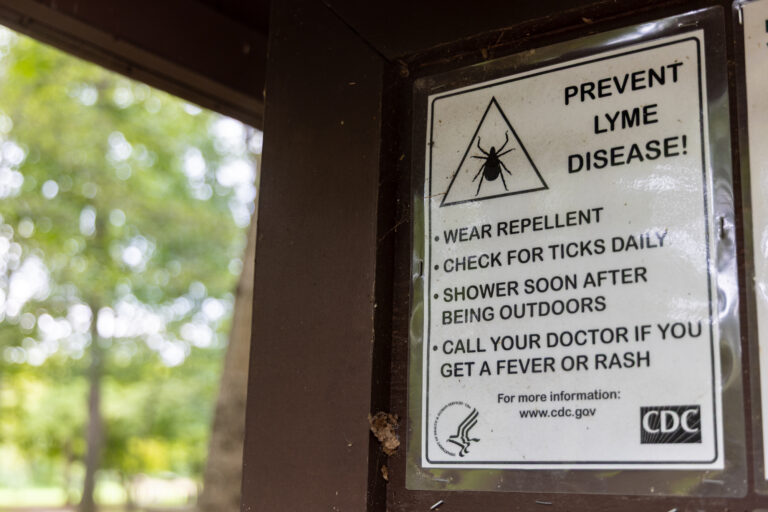
A sign gives recommendations for avoiding ticks at a Pa. state park in Bucks county. (Kimberly Paynter/WHYY)
From Philly and the Pa. suburbs to South Jersey and Delaware, what would you like WHYY News to cover? Let us know!
For years, whenever University of Pennsylvania biology professor Dustin Brisson gave talks on Lyme disease, he’d always get the same question from the audience.
“Everyone always says, ‘Well, what about deer? You know, they’re called deer ticks,'” said Brisson, who studies the ecology of Borrelia burgdorferi, the bacterium that causes Lyme disease. “At least in the majority of the locations where Lyme disease is a problem, the variation in the amount of deer is not a major problem.”
That may prove a relief to residents of Pennsylvania, which not only boasts one of the densest deer populations in the country, but was recently declared “ground zero” for Lyme disease. But as we close in on the end of an especially active tick season, it also raises a question — if deer aren’t the missing link when it comes to Lyme disease, what is?
According to a recent study, the answer is twofold: mice and acorns.
-
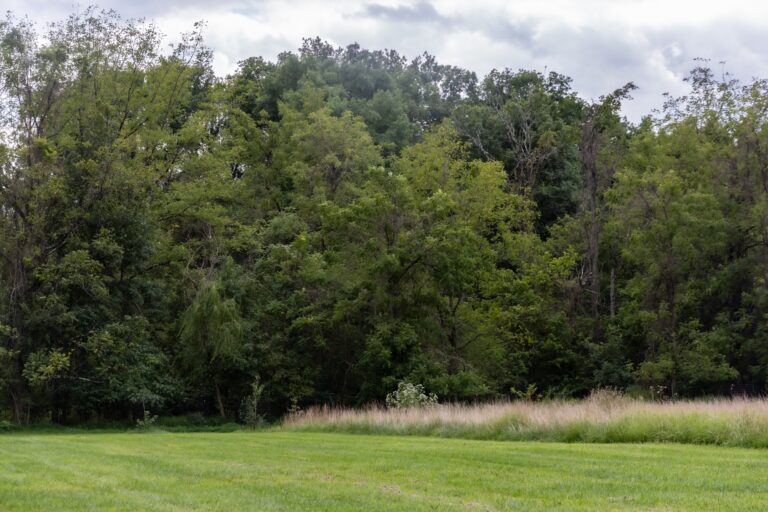
Ticks can live on the edge of woods and grasses, waiting for animal hosts to feed on. (Kimberly Paynter/WHYY) -

Hikers walk dogs in Tyler State Park in Bucks County, Pa. (Kimberly Paynter/WHYY) -
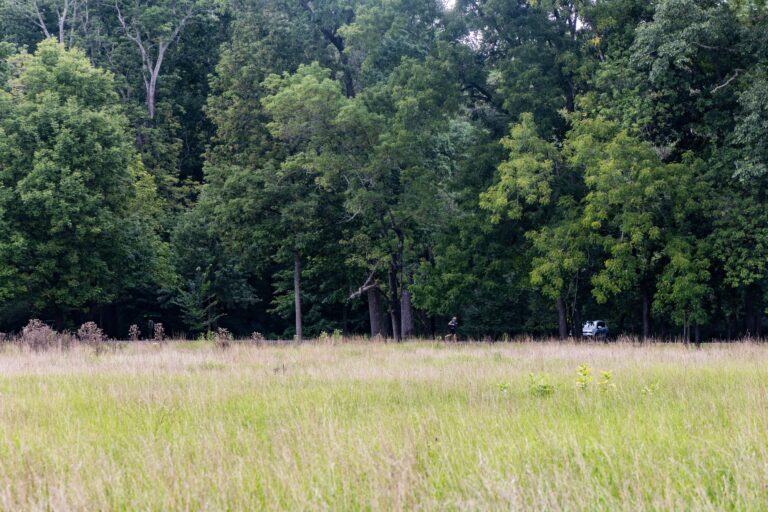
A jogger runs in Tyler State Park in Bucks County, Pa. (Kimberly Paynter/WHYY)
Why mice matter to Lyme risk
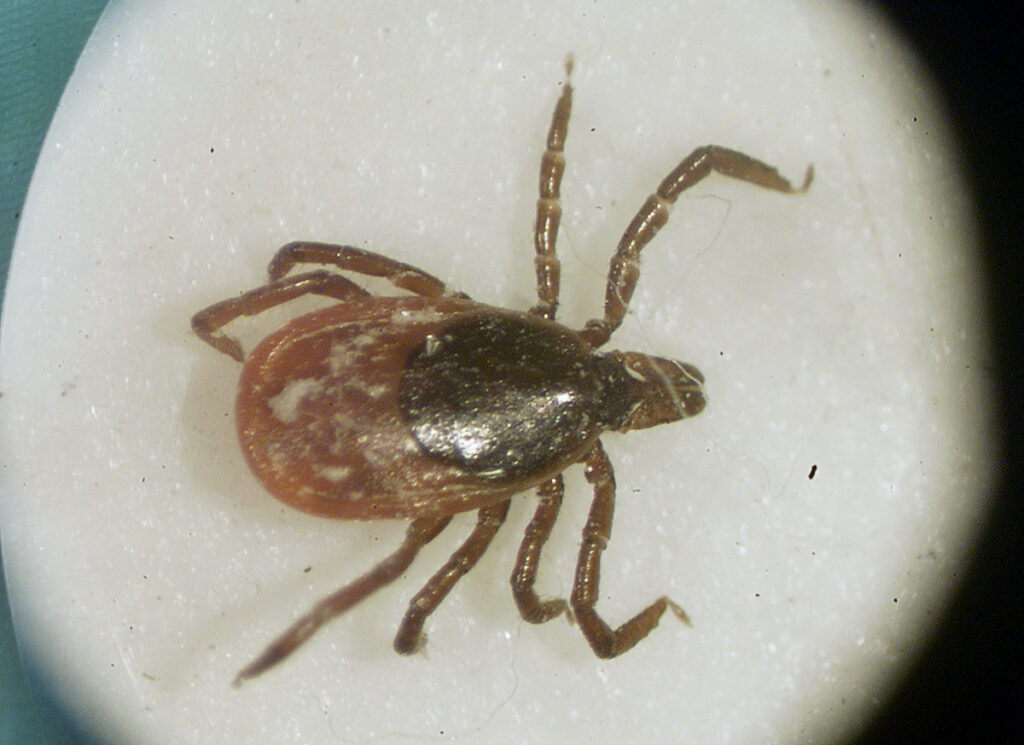
When Lyme disease was first being studied in the 1970s and ‘80s, some researchers made what seemed to be a logical connection — deer killed by hunters were often found to be covered in blacklegged ticks, the main conveyors of Lyme disease. Therefore, they reasoned, deer likely played an important role in spreading the illness — if not as reservoirs of Lyme disease, which they later discovered deer don’t carry, then as crucial hosts for tick mothers to successfully procreate.
But a recent study, which was conducted by researchers at the Cary Institute of Ecosystem Studies in New York, confirms once and for all that deer play less of a role than previously believed. The study looked at more than 35 years of data from a forested area in the Hudson Valley, analyzing factors that lead to fluctuations in Lyme disease risk.
It found that, although white-tailed deer — the most common species of deer in the U.S. — are an important food source for adult ticks, there is no statistical relationship between their abundance and the density of nymphal ticks, the immature ticks responsible for the majority of Lyme disease infections. In other words, more deer doesn’t mean greater Lyme disease risk.
Instead, the study found that another animal played a larger role: white-footed mice.
“Mice are really good hosts for the immature stages — the larvae and the nymphs, particularly larvae,” said Brisson, who didn’t work on the study. “And they can also transmit the pathogen to the feeding ticks.”
In fact, the study states that mice are better at transmitting the bacteria that causes Lyme disease than any other host.
Related Content
How to protect yourself — and your yard — from ticks
Experts say this summer is shaping up to be the worst tick season in a decade — and a lot of bites are happening in people's own backyards.
4 months ago
Listen 0:54How acorns explain and complicate the picture
With those two factors at play — mice providing a good food source for tick larvae, and being especially efficient at transmitting Lyme disease — you would think that more mice would not only mean more nymph ticks, but more nymph ticks infected with Borrelia burgdorferi. But only half that equation turned out to be true.
The study found that years with large mouse populations were followed the next year by a 40% increase in nymphal ticks, thanks to the crucial blood meal that mice provided the nymphs as larvae.
Surprisingly, though, it didn’t necessarily follow that a higher proportion of ticks would be infected by Lyme disease. The question is — why not?
The study’s explanation hinges on another player: acorns, which play a crucial role in the forest ecosystem, sustaining mice through the winter so they’re able to birth pups in the spring.
But mice aren’t the only animals that rely on acorns.
“This is really an acorn-driven ecosystem, meaning so many of the organisms rely on acorns either directly or indirectly,” Brisson said. “So you might expect when there’s a lot of acorns, there’s also going to be a lot of everything else.”
For instance, skunks, squirrels and opossums, which also serve as hosts for ticks. So while there may be more Lyme disease-harboring mice for ticks to feed on, there are also more of other small mammals that are much less likely to harbor or transmit Borrelia burgdorferi.
“It doesn’t matter if you have a lot of mice or not very many mice,” Brisson said. “The proportion of ticks that are infected stays the same.”
Related Content

A look inside the lab tracking Pennsylvania’s ticks
The director of Pennsylvania’s Tick Research Lab offers guidance on tick hotspots, emerging pathogens — and what to do if you’ve been bitten.
5 months ago
Listen 0:58The same advice applies
Still, even at similar infection rates, more nymphs raises the risk of human infection.
Brisson said it’s unlikely that the findings of this study will lead to substantive changes in how we approach tracking or managing tick populations.
“You can’t regulate mice,” he said. “What am I gonna do — go out there and catch all the acorns?”
But these findings could help improve prediction models regarding which areas harbor the most Lyme-infected ticks.
Whatever the impact, Brisson said the best thing people can do to protect themselves is to check for ticks after spending time in wooded areas. Ticks must remain attached for at least 24–36 hours before they can transmit Lyme disease bacteria, which means if they’re removed before that window closes, it’s possible to prevent most infections.
“Almost no one on our field crews ever get Lyme disease,” Brisson said. “We are out there every day looking for ticks, collecting hundreds and hundreds and hundreds of them. And they absolutely bite our field crews.”
But they finish each outing by doing full-body checks of one another.
“Everyone makes sure before you go home that all the ticks you came in from the field with are staying in that room,” Brisson said. “All of them.”

Never miss a moment with the WHYY Listen App!


WHYY is your source for fact-based, in-depth journalism and information. As a nonprofit organization, we rely on financial support from readers like you. Please give today.
Some scientists and government agencies are concerned over the test’s impact on animals, and whether it is still useful for research.
2 years ago
Listen 11:50
Advocates cheer new standards that could save horseshoe crabs from bloodletting
Up to 1 million horseshoe crabs in the U.S. are harvested for biomedical purposes. A synthetic alternative could mean less harvesting of the “living fossils.”
2 years ago
Listen 1:15
Pa. has seen an increase in chronic wasting disease since 2012. While the state has implemented tracking and mitigation efforts, testing is still optional for hunters.
3 years ago