

How to protect yourself — and your yard — from ticks
Experts say this summer is shaping up to be the worst tick season in a decade — and a lot of bites are happening in people's own backyards.
Listen 0:54
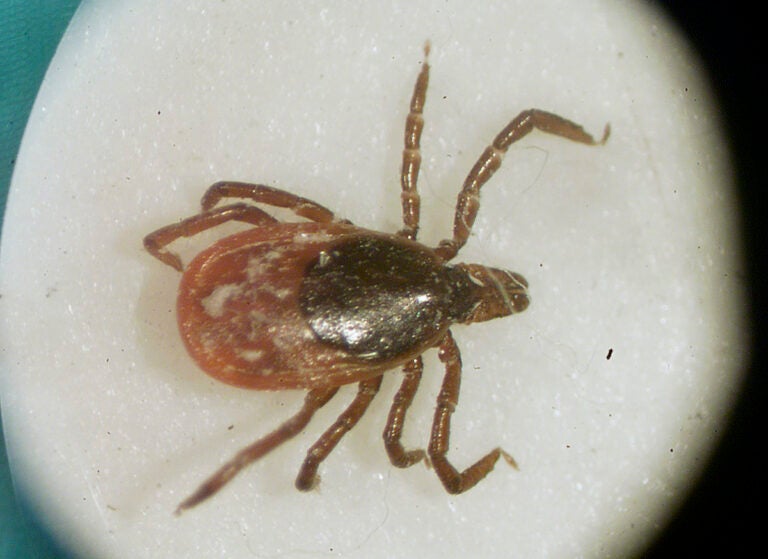
FILE - A female deer tick is seen under a University of Rhode Island microscope in the entomoloy lab March 18, 2002. (AP Photo/ Victoria Arocho, File)
From Philly and the Pa. suburbs to South Jersey and Delaware, what would you like WHYY News to cover? Let us know!
It’s a bad summer for ticks, according to recent data from the Centers for Disease Control and Prevention, which showed that emergency room visits for tick bites has reached a 10-year high.
Arborist Mike Halloran, the assistant district manager of the Davey Tree Expert Company‘s branch in Wilmington, Delaware, hasn’t particularly noticed more ticks this summer than usual — but his mother-in-law has.
“She was bit by the lone star tick and she got Alpha-gal syndrome, which makes you allergic to red meat — which is awful,” he said.
While Halloran says his mother-in-law isn’t exactly sure where she was bitten, they suspect it happened right around her house.
That fits with warnings from the CDC and with the findings of several studies, which revealed that roughly 70% of tick bites happen in people’s own backyards.
But there are measures that can be taken to reduce the chances of tick encounters.
“Really, it’s those typical landscape maintenance tasks — keeping things tidy and cleaned up — that will really cut down on the chances of harboring ticks,” Halloran said. “Cleaning up debris, any fallen branches, mowing grass.”
Related Content

A look inside the lab tracking Pennsylvania’s ticks
The director of Pennsylvania’s Tick Research Lab offers guidance on tick hotspots, emerging pathogens — and what to do if you’ve been bitten.
3 months ago
Listen 0:58That’s because ticks thrive in damp, shaded areas that prevent them from drying out — which means they like to hide in ground cover like grass or overgrown weeds, under leaf litter and in woodpiles.
They tend to be especially dense in areas where forests meet yards.
“It’s that transition zone that we worry about,” Halloran said. “It’s that sort of forest-into-suburban sprawl transition that really harbors the ticks that we run into on a daily basis.”
But there is a solution for those areas — mulch buffers made from dry wood chips or gravel that create a hot and dry barrier between the woods and your lawn.
Halloran says you can also avoid planting things that deer and mice like to eat, since both animals are frequent hosts of ticks — though it’s not his preferred solution.
“I’m a plant person, so I would never tell you not to plant things,” he said. “But if we want to live and grow a lot of plants, you’re going to have habitats for ticks. But again, it’s keeping that cleaned-up area, making sure everything’s maintained, doing that little mulch buffer so it’s hot and dry, keeping things pruned. All of those things go into deterring ticks.”
The CDC estimates approximately 31 million people in the U.S. are bitten by ticks each year. Lyme disease is the most common tickborne disease in the country, with an estimated 476,000 patients treated for it each year.

Get daily updates from WHYY News!
WHYY is your source for fact-based, in-depth journalism and information. As a nonprofit organization, we rely on financial support from readers like you. Please give today.
Bug season has arrived. How are Philly and Jersey fighting ticks and mosquito-borne diseases?
Mosquito and tick bites can put people at risk for contracting Lyme disease, West Nile virus and alpha-gal syndrome.
3 months ago
Pennsylvania researchers see tick population and related diseases ticking up
The state's Tick Research Lab, based at East Stroudsburg University, has recorded more than twice as many ticks this May compared to the same time last year.
1 year ago
Invasive Asian longhorned tick migrates to Delaware
Delaware is the 12th state to spot the invasive Asian longhorned tick.
7 years ago