

Vineland data center makes case for on-site power generation during 6-hour hearing
Developers for the New Jersey-based center plan to use on-site fuel cells, saying the new plan will not draw power from the grid or increase residential rates.

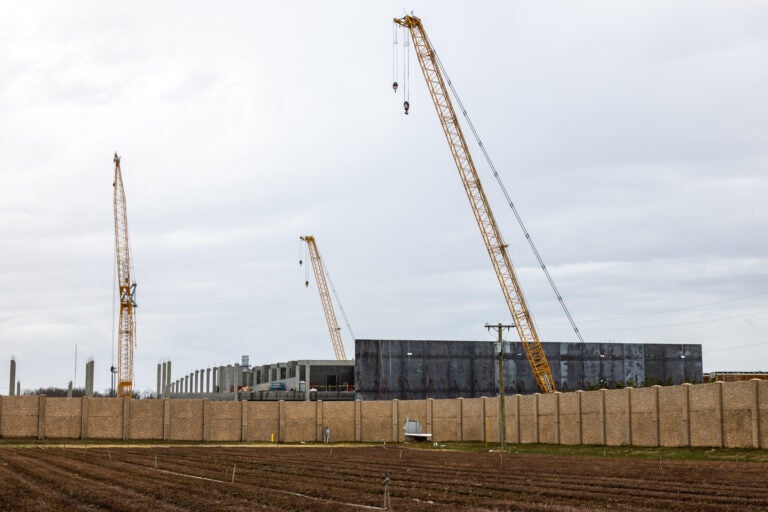
Vineland, N.J.’s data center is under construction in March of 2026. (Kimberly Paynter/WHYY)
This story is part of the WHYY News Climate Desk, bringing you news and solutions for our changing region.
From the Poconos to the Jersey Shore to the mouth of the Delaware Bay, what do you want to know about climate change? What would you like us to cover? Get in touch.
Representatives for a hyperscale artificial intelligence data center in Vineland, New Jersey, on Wednesday defended a proposal to house liquefied natural gas and utilize fuel cell technology to power the 300-megawatt facility.
The project, with the first phase already approved and under construction, is being developed by DataOne for the Nebius Group to support AI infrastructure as part of a $17 billion deal with Microsoft.
During a six-hour hearing before the city’s planning board, DataOne pleaded their case for the project’s second phase: a new proposal to use Bloom Energy fuel cells to power the site. If approved, it would be Bloom Energy’s largest single-site fuel cell project to date. Currently, the company’s largest fuel cell project is an 80-megawatt installation in South Korea.
DataOne’s attorney Michael Fralinger said the fuel cells, which do not utilize combustion, release fewer carbon emissions than traditional power generation. The fuel cells use a chemical reaction to convert natural gas into electricity. Fralinger also said on-site generation takes strain off the electrical grid and won’t impact ratepayers’ bills.
“This particular project has been deliberately designed and structured so that its energy requirements are not subsidized by existing electric or natural gas customers,” Fralinger said at the planning board hearing, which included six hours of witness testimony and cross examination. “All of the financial risk for this project is being borne by the project.”
The planning board, after ending the hearing at midnight, must reconvene to allow for additional comment and decide whether to approve the plan. Members of the public were not afforded the chance to speak during the lengthy and detail-oriented meeting, and many walked out as it neared the midnight hour.
“People in the room felt that he was going at a certain pace and focusing on extraneous details to basically run out the clock and to get it to a point where people were just like, ‘This is so boring, I don’t want to be here anymore,’” said Zac Landicini, who lives about 3 miles from the data center and has been advocating against its development.
The acceleration of power-hungry artificial intelligence has boosted demand for data centers. President Donald Trump’s administration last year announced plans to accelerate AI development with limited regulatory oversight.
DataOne said its facility will benefit Vineland by hiring more than 200 permanent, full-time workers, and by becoming one of the largest taxpayers in the city. The city’s mayor and City Council president have voiced support for the project, and have approved a tax exemption for the company as part of a five-year plan.
Residents have voiced concerns about the potential impact on air quality and water supplies, which in some areas of the country have been threatened. Some residents have also complained about whining metallic construction noises, leading to a class-action lawsuit that claims construction and operational noise will impact property values.
Related Content
Vineland residents are protesting AI data center as concerns mount over noise and emissions
The project in South Jersey, already under construction, is being developed by DataOne for the Nebius Group as part of a $17 billion deal with Microsoft.
6 months ago
Listen 2:18Much of the meeting was focused on DataOne’s plans to generate the majority of its energy on site, utilizing natural gas accessed through an already-existing gas pipeline that runs from the facility. The proposal would also make way for a 1.5-million gallon LNG storage tank on site in the event access to the natural gas pipeline is interrupted.
Eric Reaman, president and CEO of Cashman Preload Cryogenics, which is the manufacturer of the tank, said LNG cannot ignite inside the tank without coming in contact with a source of ignition. He also said there’s no oxygen inside the tank necessary to trigger a fire or explosion. Reaman said the tank is built with fire resistant concrete, and equipped with leak and heat detection monitors as well as an automatic shut-off system in case of emergency.
DataOne’s application previously proposed the use of 32 high-efficiency natural gas engines, of which five would be utilized for back-up generation, as well as six diesel generators for emergency power. During the hearing, Fralinger said DataOne scrapped the plan to use engines because of public outcry over potential air emissions.
The company is now seeking approval to use Bloom Energy fuel cells, which turn natural gas into electricity through an electrochemical reaction without releasing high amounts of air pollutants like nitrous oxides and sulfur dioxides. During the hearing, Marisa Blackshire, Bloom Energy’s vice president of environment and regulatory law, said the technology is quieter than a hair dryer and has such a low emission profile it’s exempted from New Jersey’s air permit requirements.
“The nature of the electricity generation being that it comes from a noncombustion reaction dictates that we have very low criteria pollutant emissions,” she said.
However, during cross-examination, Blackshire confirmed that the facility in Vineland would still emit about 2.19 billion pounds of climate-warming CO2 a year.
While the new energy plan is projected to emit fewer pollutants than the natural gas engines, it would increase the amount of water required to cool the data center.
Hyperscale data centers can consume up to 5 million gallons of drinking water per day to cool the facilities and their servers to prevent overheating. In some areas, that has drained residents’ well water supplies.
Previously, DataOne said the facility wouldn’t consume water from the region’s aquifer because it would use waste heat to generate its own water supply by utilizing thermal energy to extract moisture from the air. However, that water generation was only possible through the use of diesel or natural gas engines proposed in the original plan.
Instead, the new plan would use more than 400 fans to cool the data center, and during particularly hot days, a misting spray would be utilized to further cool the system. Though DataOne will use a closed-loop system that reuses water, the water from the misting spray would evaporate. An engineer testified that the project would require about 8 million gallons of water a year drawn from the city’s water supply. The proposed Bloom units would also require an undetermined amount of water on start-up, which would be reused.
Related Content
‘We will not be bullied’: Plymouth Township pushes back against proposed Conshohocken data center
Plymouth Township Council is speaking out after the developer of a proposed data center in Conshohocken challenged its zoning ordinance.
1 month ago
Listen 1:03Landicini said he’s concerned about the closed-loop system, which will likely need to be flushed during initial setup and for ongoing maintenance. Though the flushing of closed loop systems at data centers occurs infrequently, environmentalists say that if dumped improperly, contaminants can make their way into waterways and strain local sewer systems.
“That water likely goes to our sewage authority, and they’re very vague with how often that system is flushed, and all the details about it,” Landicini said.
He’s also concerned about the effectiveness of DataOne’s stormwater management plan, which would involve bioretention facilities that use engineered soils, mulch and vegetation to filter pollutants and reduce runoff.
“Yesterday, we had huge rainfall, and we’re in a drought, so the soil can’t absorb that,” he said. “You have dry soil plus a giant footprint data center with, honestly, piss-poor stormwater design, that water is going to go somewhere. It’s going into neighboring basements, it’s going to flood streets.”
The planning board will soon announce a date for a second hearing to give witnesses and the general public a chance to comment on the proposal.

Get daily updates from WHYY News!
WHYY is your source for fact-based, in-depth journalism and information. As a nonprofit organization, we rely on financial support from readers like you. Please give today.
Part of the series

Conservationists to restore wetlands, save habitat for diamondback terrapins in New Jersey
Tidal salt marshes across New Jersey are being drowned out by sea level rise.
5 days ago
Listen 1:17
Vineland data center accused of operating natural gas generators without permit
The 300-megawatt AI data center is being developed by DataOne for the Nebius Group.
2 weeks ago
Listen 1:11
N.J. lawmakers look to toss out higher coastal elevation rules
Lawmakers held a hearing Wednesday on a resolution that pits the state Legislature against Gov. Mikie Sherrill over climate-driven flood rules.
5 months ago
Listen 1:07