
Delaware governor’s order sets ethics standard for unclaimed property task force not applied to other legislative committees
Delaware Gov. Matt Meyer’s executive order raises questions about whether members of other task forces could meet the standards.

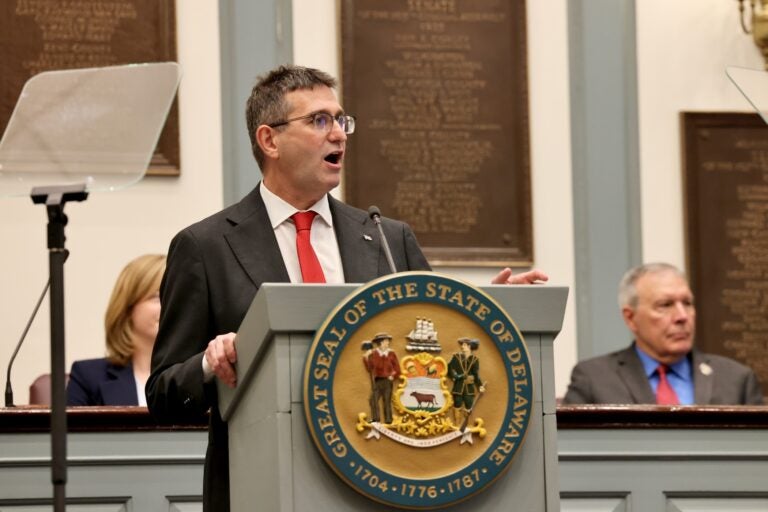
FILE - Delaware Gov. Matt Meyer delivers his first State of the State address, April 10, 2025. (Emma Lee/WHYY)
What are journalists missing from the state of Delaware? What would you most like WHYY News to cover? Let us know.
An executive order recently issued by Delaware Gov. Matt Meyer has been raising eyebrows, with some questioning the purpose and others cheering the move.
Executive Order 25 establishes a conflict of interest policy for members of Meyer’s administration who would serve on the newly created legislative unclaimed property taskforce. It applies just to that task force.
It asks that state legislators, who created the task force and will appoint the majority of the members, also follow the policy when staffing the panel, particularly when selecting members of the public.
Charles Elson, the founding director of the University of Delaware’s Weinberg Center for Corporate Governance, called the move “unusual.”
“It would be expected that any of his appointees would be free of conflicts of interest and meet ethical standards,” Elson said. “The necessity of issuing an executive order on this particular board, I find a little surprising.”
Meyer issued an executive order on ethics and transparency shortly after taking office last year that requires all state employees to “demonstrate exemplary conduct and be honest and ethical in the performance of their duties.”
Elson said he questioned whether the newly issued policy was directed at Senate and House leaders.
“Setting up a separate order for a commission that was a joint executive-legislative commission seems to me like almost you’re picking a fight with the legislature,” he said. “It doesn’t cast the best light on the legislature by doing so, suggesting that maybe they aren’t, and it also doesn’t suggest a very good light on the rest of his administration, suggesting that he has to issue an executive order to compel ethics from his appointees.”
A spokesperson for Meyer responded to a request for comment by highlighting the governor’s desire for lawmakers to agree to the executive order.
“The governor is confident in his cabinet’s ability to meet those [conflict of interest] standards,” Deputy Press Secretary Jonah Anderson said in a statement. “We also look forward to the General Assembly applying the same conflict free standards to their selections.”
Delaware’s controversial handling of unclaimed property revenue
Delaware is the incorporation destination for millions of businesses, receiving orphaned financial instruments from across the country. Because of that, the First State takes in more than its share of unclaimed property, relative to size and population, and adds it to its general revenue fund.
Delaware has been sued several times, including in 2016 by a coalition of states over it retaining cash issued by MoneyGram, which is incorporated in the state. Delaware settled in 2024 after the U.S. Supreme Court agreed with Pennsylvania and the rest of the bloc that the money orders should have been returned to the state where they were bought.
The state also oversees a secretive special unclaimed property fund controlled by the Department of Finance, which has been raided twice, by Meyer and former Gov. John Carney, to bridge funding shortfalls for the Edgemoor container terminal project at the Port of Wilmington. The Meyer administration has declined to reveal the fund’s balance.
Related Content
One local union has demanded the return of a political donation. But House Democratic leaders deny the existence of that contribution.
1 week ago
Listen 0:57New policy could restrict members from the private sector
The fiscal year 2027 capital improvements bill, known as the Bond Bill, lays out how the task force should be staffed. The Senate president pro tempore and the House speaker will each appoint a member from the Senate and House majority and minority parties, along with both selecting two members of the public for a total of four. It would also include the Delaware secretary of state, finance secretary, controller general or their designees, along with a representative from Meyer’s office.
Under the executive order’s terms, administration officials would be ineligible from participating if they had a “covered financial interest” dating back five years. If an agency head or their designate worked in the unclaimed property industry in the five years immediately preceding their appointment, they would be disqualified from serving on the committee. Executive branch appointees would have to certify they have no covered financial interest.
It also requests the Senate and House voluntarily adhere to those requirements, especially for the public members.
Senate Majority Leader Bryan Townsend, who chaired the 2014 unclaimed property legislative task force, said standing up the committee is in its early stages, with the first meeting tentatively planned for late August.
He told WHYY News earlier last month that the Senate plans to continue to appoint people from the private sector “who have the requisite experience,” as they had with many other taskforces.
“I think we had an extremely successful unclaimed property task force back in 2014-2015,” Townsend said. “It had members of the public and members of the private sector come together in full, transparent discussions about what was happening with our program, our third-biggest revenue source. So we intend to use that same kind of model again.”
House spokesperson Jenevieve Worley said in a statement that the speaker will choose individuals “who have expertise and knowledge on the subject and who can contribute positively” to the task force.
Related Content

Delaware bans private equity hospital purchases, expands health care access
Senate Majority Leader Bryan Townsend says his legislation phases in price caps on hospitals and strengthens primary care access.
2 weeks ago
Listen 0:57Policy could limit private sector participation
If the House and Senate leaders were to apply the governor’s executive order in choosing members of the public to sit on the task force, it could exclude some of the 2014 participants, such as Michael Houghton.
Houghton, a retired attorney with decades of experience in the unclaimed property industry, has appeared to frustrate the Meyer administration this year for publicly asking questions on sensitive topics.
Meyer fired Houghton from the Delaware Economic and Financial Advisory Council in March, just two days after WHYY News reported on his questions about a lack of corporate franchise revenue data presented at that month’s meeting. Meyer has denied the two are connected.
A lack of clarity also still surrounds Houghton’s May resignation from the legislative Port of Wilmington Expansion task force days after questioning Brian Devine, the port’s interim executive director, about where the $110 million in additional state funding for the Edgemoor container terminal project would come from.
The Meyer administration would not reveal the source of the funding until late June, which ended up being unclaimed property revenue.
Houghton declined to comment for this story.
Private industry participation on other legislative taskforces
This is the first time that Meyer has issued an executive order setting a conflict of interest policy for state agency heads to participate on a legislative taskforce, raising the question of how many participants on current or former task forces or other bodies could meet these high conflict of interest standards.
For example, the Delaware Nuclear Energy Feasibility task force included a vice president from PSEG, which owns five and operates three nuclear power plants in New Jersey and Pennsylvania, as well as a development director from the Exelon Corporation, Delmarva Power’s parent company.
Former Republican state Sen. Greg Lavelle said he has long been concerned about bias on the state’s commissions and councils. He and John Flaherty, spokesman for Delaware Coalition for Open Government, said they support minimizing or eliminating conflicts on this and other task forces.
“It’s a large sum of money that is collected by the state that helps keep our taxes low, but it’s also a very obscure section of our revenue stream,” Flaherty said. “I think the more that we can highlight the workings of the task force and abandoned property, I think the better off the public is going to be.”

Never miss a moment with the WHYY Listen App!


WHYY is your source for fact-based, in-depth journalism and information. As a nonprofit organization, we rely on financial support from readers like you. Please give today.
Part of the series
Gov. Matt Meyer said he cannot justify the expense when Delawareans are struggling to afford rising prices.
4 weeks ago
Listen 0:58
Legislation raising dozens of fees on businesses goes to Delaware Gov. Matt Meyer’s desk
The increases include annual taxes, miscellaneous fees and costs for expedited state services.
3 months ago
Listen 0:52
Meyer’s recommended budget would "modernize" business formation fees and raise cigarette taxes to add state revenue.
6 months ago