

Delaware officials raid secret fund again to close financial shortfall on Edgemoor port container project
State lawmakers previously approved diverting money from the little-known unclaimed property fund to the Edgemoor container terminal.
Listen 1:08
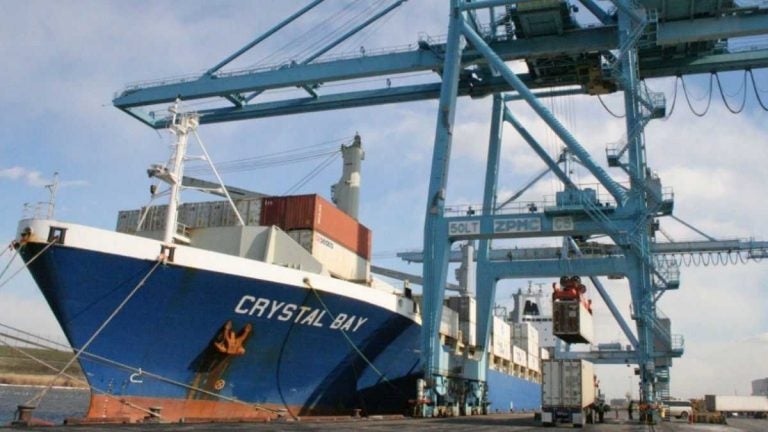
The Port of Wilmington in Delaware. (Courtesy of Port of Wilmington)
What are journalists missing from the state of Delaware? What would you most like WHYY News to cover? Let us know.
Delaware Gov. Matt Meyer’s administration publicly identified the source of state funding for a container terminal project for the first time Wednesday, after weeks spent dodging questions about it.
Secretary of State Charuni Patibanda-Sanchez confirmed to the lawmakers on the Joint Committee on Capital Improvements, also known as the bond bill committee, that the money was coming from unclaimed property.
The administration revealed last month that the phase one costs of the Edgemoor container terminal construction had ballooned from $415 million to $669 million. The state agreed to pitch in an additional $110 million to help cover a $189 million shortfall.
State Rep. David Wilson, R-Lincoln, questioned why it appeared the money had already been agreed to before lawmakers voted to approve the funds.
Patibanda-Sanchez said that while the Diamond State Port Corporation, the quasi-public entity that oversees the Port of Wilmington, had signed the amended joint finance development agreement earlier this month, it was still up to the General Assembly to approve the spending.
“Obviously, it is up to the legislature, up to you all, to appropriate the money. And so, I would not say that it was committed,” she said. “It was discussed, it was identified, and now we wait to see if it will actually be committed.”
The amended joint development agreement shows that the state is now contributing $325 million in state funding for the first phase of the project. The private port operator Enstructure is pitching in $225 million and another $119 million is coming from the federal government.
The state has spent years pushing to convert a former DuPont chemical plant at the Edgemoor site into a container shipping terminal that could draw traffic away from ports in Philadelphia and New Jersey. Diamond State purchased the property on the Delaware River in 2017. It has hit a few stumbling blocks along the way, including invalidated federal permits, court challenges from the Port of Philadelphia and neighboring ports, and soaring construction costs.
To cover the budget deficit, the state agreed to put in an additional $110 million, Enstructure is kicking in another $75 million and the project will get another $69 million in federal funding.
Related Content
Delaware’s use of its unclaimed property funding has led some to call it a “piggy bank.”
3 weeks ago
Listen 0:56Secretive escheat fund used again to pay for port project
If approved by the General Assembly, it would be the second time in two years that the state is using unclaimed property dollars to direct money to the Edgemoor project.
Unclaimed property is Delaware’s third-largest source of revenue. It’s earned the reputation of being a “slush fund” or “piggy bank” because it’s been raided for other uses, with past administrations using the money and declining to answer questions about it.
Because Delaware is a top destination for business incorporation, it provides an outsized revenue source for the state. Companies must turn over items, such as someone’s uncashed checks, old bank accounts and stocks and bonds after a certain time period. It can vary based on the type of property, ranging from three years to 15 years.
After the property is declared abandoned, the state transfers, or escheats, the money into the state’s general fund. Excess money goes into a pot reserved to satisfy what it defines as extraordinary claims. Amounts of money above what the secretary of the finance deems necessary to resolve those claims goes into another fund that is used for retired state employee benefits and can also be used for school construction projects.
It’s that little-known fund that former Gov. John Carney tapped during his tenure, and the Meyer administration is using now. In fiscal year 2023, lawmakers added “maritime terminal” to the bond bill, so the state could later transfer nearly $200 million to the port. The language in the fiscal year 2027 bond bill, House Bill 500, appropriates $328 million in special escheat funding, including $110 million to the Diamond State Port Corporation.
A spokesperson with the Delaware Department of Finance declined to say how much money was in the surplus escheat fund. However, Controller General Ruth Ann Miller told committee members there was “a significant balance.”
“There’s always money there that you can go in and get, simply with a change of law, which you do in the bond bill or the budget bill,” Bob Byrd, a lobbyist and former member of the Delaware Economic and Financial Advisory Council, recently told WHYY News.
Wise investment or waste of money?
Members of the bond bill committee approved adding the port funding into the bond bill. But not before debating whether the state’s continuing investment in the Edgemoor project, which has yet to break ground, has been money well spent.
“We’ve thrown about roughly $300 million at it with no return on investment so far,” said state Rep. Mike Smith, R-Pike Creek.
But other committee members argued the construction of the terminal and its operation, once completed, will bring thousands of jobs and drive significant economic development.
The secretary of state said that while Delaware cannot match the massive port facilities of Philadelphia and other neighboring ports, it has to build the container terminal just to compete.
“If we were to do nothing, we will definitely fall way, way behind,” Patibanda-Sanchez said.
State lawmakers must approve all of the budget bills before end of session on Tuesday.

Get daily updates from WHYY News!
WHYY is your source for fact-based, in-depth journalism and information. As a nonprofit organization, we rely on financial support from readers like you. Please give today.
Part of the series


What Delaware lawmakers passed — and what failed — before the legislative session ended
Lawmakers passed dozens of bills, addressing property tax rates, gun dealer regulations, affordable housing and more.
13 hours ago
Listen 1:04
Most House Republicans did not vote on the bill, depriving it of the 28 votes needed for approval.
1 week ago
Listen 0:49
Delaware Gov. Meyer wins fight with Senate Democrats over right to send own nominees for port board
The legal fight centered around whether Delaware lawmakers could ignore a governor’s request to withdraw nominations not yet Senate confirmed.
1 year ago
Listen 0:56