

What Delaware lawmakers passed — and what failed — before the legislative session ended
Lawmakers passed dozens of bills, addressing property tax rates, gun dealer regulations, affordable housing and more.
Listen 1:04
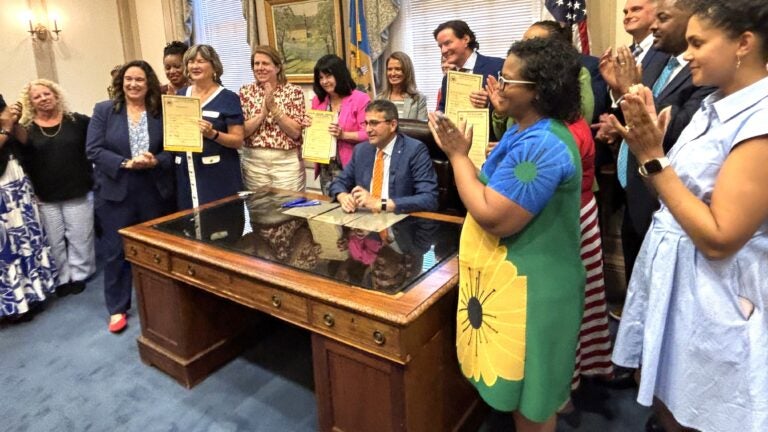
Delaware Gov. Matt Meyer and state lawmakers celebrate the signing of the fiscal year 2027 operating budget on June 30. (Sarah Mueller/WHYY)
Delaware Gov. Matt Meyer opened the last day of the legislative session Tuesday by signing the state’s nearly $7 billion fiscal year 2027 budget.
State lawmakers also approved a $1.25 billion capital budget for the new fiscal year that starts July 1, $146 million in one-time spending and $99 million in grants-in-aid funding to nonprofit organizations. They passed the budget bills along with dozens of bills, addressing property tax rates, gun dealer regulations, affordable housing and more.
“A budget is more than dollars and cents,” Meyer said. “It’s a statement of our values, and today we’re signing a budget that invests in people that tackles affordability and expands opportunity for every Delawarean.”
Lawmakers competed to get their bills across the finish line on a variety of issues, including tackling the lingering property assessment fallout from the recent statewide reassessments. They also considered several constitutional amendments on voting initiatives, reproductive freedom and same-sex marriage.
Because it’s the last year of the two-year 153rd General Assembly, which coincides with an election, bills that fail to make it past both chambers are dead and must start over next year. The one exception is constitutional amendments, which must be passed in two consecutive legislative sessions and are not affected by the beginning of a new General Assembly cycle.
Related Content

Most House Republicans did not vote on the bill, depriving it of the 28 votes needed for approval.
3 months ago
Listen 0:49Republicans voice concerns about the capital improvements bill
The atmosphere in the Delaware state House turned testy as June 30 turned into July 1. Republicans, along with a few Democrats, expressed frustration as members were asked to vote on complicated pieces of legislation coming back from the state Senate, complaining they were not given the time to read.
The state House put the vote on the capital improvements bill, known as the bond bill, on hold shortly after 3 a.m. to consider the governor’s 2025 override of legislation that would have loosened local government regulations for where recreational marijuana stores could be located within the state’s three counties. The veto essentially left the counties’ more restrictive rules in place. The state Senate overrode Meyer’s veto in January.
The state House approved the override Wednesday morning along party lines, with 25 voting yes and 16 voting no.
The state House and state Senate approved the bond bill despite a few Republicans voicing concerns about some of the funding. Because it’s an appropriations measure, it requires a three-quarters vote.
Some of the top bills passed by the legislature
- Senate Bill 300: Regulates gun dealers in the state, including setting license fees, requiring stores to have surveillance systems and to securely store and display firearms and ammunition inside facilities
- House Bill 461: Allows school districts in New Castle County to reset their tax rate for the 2026-2027 tax year
- House Bill 459: Prohibits the sale of energy drinks on public middle and high school campuses during school hours or school events
- House Bill 430: Prohibits corporations and entities from voting in elections. This bill is the first leg of a constitutional amendment that must be approved by the next General Assembly to become law. It comes after a court ruled “artificial entities” could continue voting in elections in Fenwick Island
Some bills that failed to pass both chambers
- House Bill 88: Legislation allowing same-day voter registration failed to advance from the state House to the state Senate.
- House Bill 215: This bill would have raised the taxes on tobacco products. It has been a priority of Meyer for the past two budget cycles.
- Senate Bill 272: The legislation would have required collective bargaining agreements for certain school district construction projects.
- House Bill 395: This measure would have banned the sale of “intoxicating hemp” products. It passed the state House, but stalled in the state Senate.
Editor’s note: WHYY receives grant-in-aid funding from the state of Delaware. WHYY News produces independent, fact-based news content for audiences in Greater Philadelphia, Delaware and South Jersey.

Get daily updates from WHYY News!
WHYY is your source for fact-based, in-depth journalism and information. As a nonprofit organization, we rely on financial support from readers like you. Please give today.

‘Chaos and confusion’: Delaware lawmakers warn Trump’s mail ballot order could disenfranchise voters
Election data shows that Democrats were more likely to vote by mail in 2024 than those with other political affiliations.
2 weeks ago
Listen 0:52
The legislation is named after a woman in Indiana who gave birth on the side of the road minutes after a hospital discharged her.
2 weeks ago
Listen 1:30
An investigation by the city's Board of Commissioners examined Commissioner Suzanne Goode's behavior through emails she sent in June and July.
2 weeks ago
Listen 1:30