
Delaware professor transforms writing class by teaching students to use AI as the technology reshapes the workforce
At the University of Delaware, a writing professor teaches students to use AI responsibly, exploring its capabilities and fact-checking tools.
Listen 1:45
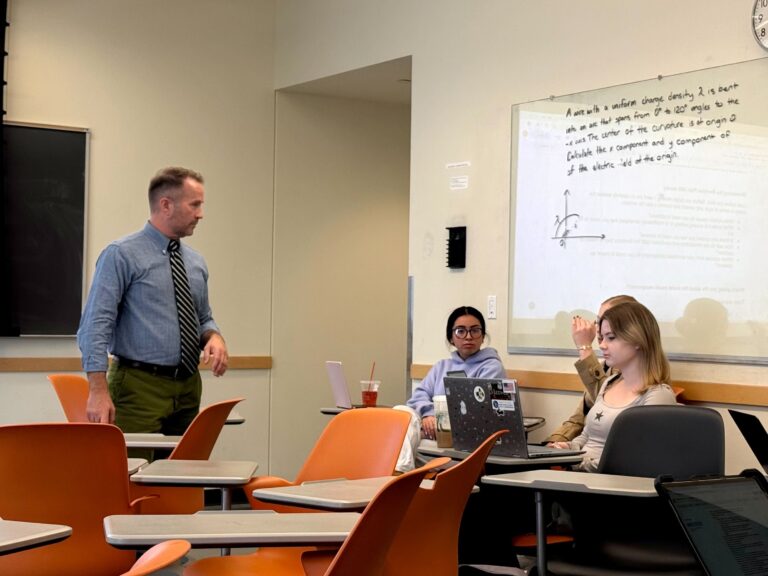
A University of Delaware English professor, Matt Kinservik, integrated AI into the classroom by having students generate an essay with a chatbot. In one session, students gathered to share the challenges they ran into, from incorrect citations to unnatural tone. (Johnny Perez-Gonzalez/WHYY)
In a first-year writing classroom at the University of Delaware, English professor Matt Kinservik is reimagining what it means to teach students how to write. While many instructors across higher education are cracking down on artificial intelligence or banning it outright, he has taken a different approach: teaching students to use AI critically and ethically.
After 27 years on campus, Kinservik walked into his English 110 class this fall with a concern that had been steadily growing for students in this introductory writing course required for all UDel freshmen.
“I’m really concerned that there’s so much discussion about students using AI to do their writing for them. But, we’re still offering a course that hasn’t changed for a long time. This course has to change to fit the times,” he said.
That concern was reinforced on the first day of class. When he asked students how many had ever received formal instruction on how generative AI works, not a single hand went up.
“It showed me this is a big problem,” he said. “We know that these students who are first-year students this year, they’ve had ChatGPT and they’ve used it for most of their high school years, but nobody has talked with them about it except to say don’t use it.”
Instead of prohibition, he wanted to confront the technology head-on. So he redesigned the course around a single guiding question: How will generative AI change the careers students are preparing for?
Related Content
New Jersey schools and students are cautiously embracing AI in the classroom
A recent report found a growing number of teachers and students use the technology, which is becoming a more common part of everyday life.
5 months ago
Listen 0:57A course built around the future
Kinservik says the goal wasn’t just to get students writing, it was to ground them in the realities of the workforce they’ll soon enter.
“The students had to identify ‘what’s my major and what kind of job do I think I want to have?’ And then the research question was, ‘What’s the best indication out there? What’s the best research out there predicting how AI is going to change civil engineering, history, education, physical therapy,’” he said.
The semester-long project unfolded in two stages. The first required students to complete intensive research entirely without AI. The second pushed them to engage directly with AI to create a 2,000-word essay.
“Part one, they had to learn how to do college-level research. They had to go find reliable, factual information, and they had to write an annotated bibliography of at least 12 sources,” Kinservik said. “Part two, they had to go to a chatbot and prompt the bot to write a college-level essay on that research question. Then, with that output, they had to edit it and annotate it because having done the bibliography, they’re the subject matter experts. The bot is just responding to a simple prompt.”
After receiving the AI-generated essay, students corrected inaccuracies, strengthened arguments, added real citations, and revised the writing to sound more human. Ignoring AI, Kinservik argued, would not prepare students for the workplaces waiting for them.
“We’re making two mistakes. One, we’re not engaging students with tools they are going to be made to use in their jobs,” he noted. “Two, we’re just pretending that those jobs are going to be the same in four years as they are today. I don’t think there’s any world where that’s true either.”
Related Content
How our primal intelligence gives us an edge over AI
Angus Fletcher argues our capacity for creativity, flexibility and story thinking gives humans a leg up over artificial intelligence.
Air Date: November 7, 2025 12:00 pm
Listen 50:27Feeling of alienation
WHYY News visited Kinservik’s class on the day the essays were due. The room was quiet — fewer than 20 students gathered in a small, intimate space, representing majors from kinesiology and finance to medical diagnostics and more. They leaned over laptops and notes, ready to talk about what it meant to write with AI.
Kinservik began by asking how many felt that chatbots like ChatGPT, Gemini or Grammarly had done a great job on their essays. Most hands went up. But when he asked how many felt the chatbot cited information accurately, nearly every hand went down.
One student explained that the bot had invented an entire list of citations. He described catching the error, confronting the bot, and watching it apologize before attempting to correct itself — a moment that drew laughter but spoke to a deeper truth: AI wasn’t doing the real work for them.
Isabella Abdmessih, a freshman university studies major on the kinesiology track, said she began the semester skeptical of AI. But by the end of the main assignment, she had a clearer picture of both its capabilities and its limitations.
“At first, I was very hesitant, and I think that comes from just not knowing AI’s capabilities, and I think that this class did give me a good grasp on its capabilities. So it kind of eased my mind a little bit,” she said. “With this assignment, it was hard because it was like you weren’t in control of what you were writing. I was given the essay, but I almost had to learn about the essay in itself. It’s not like I had the information and I was controlling the information and manipulating it.”
She struggled most with tone. Her first draft sounded far too formal for the audience she wanted to reach. When she asked the bot to make it more friendly, it overcorrected and added slang inappropriate for a college essay.
“It is a revolution, it’s something that’s new. So I appreciated that a class like this is teaching us more about it because it’s going to change everything.”
For sophomore finance major Amber Sirrell, the assignment felt emotionally distant — especially when the AI wrote about something she cared about.
“Having ChatGPT write something that I’m already really passionate about took away from its creativity because the chatbot is just pulling from somebody else’s writing and somebody else’s writing after that,” Sirrell said. “It really didn’t feel interpersonal.”
But the project also revealed something important: AI is already reshaping the finance industry she hopes to enter.
“With my interview with Savant Wealth Management, we talked about how I’d be peer reviewing AI in the workplace, checking what it puts into documents and correcting it if it’s wrong,” she said.
Both students — and most of the class — admitted that using AI wasn’t the shortcut many assume it is. If anything, it created more labor: more fact-checking, more editing, more rewriting.
For Kinservik, that was exactly the point. AI isn’t replacing students’ work, he argued, but it is reshaping the skills they must master. Reading, fact-checking, editing and synthesizing information are becoming the backbone of modern writing.
“If we don’t change our instruction, it’s too easy for students to save time and labor and to be lazy and to use these tools,” he said. “What I’m trying to do is to get the students to understand the stakes, to motivate them to do their own intellectual work and then to have them critically use and assess the use of chatbots because I know for a certainty they have not been challenged.”
He encourages educators not to push back against AI, but to embrace it and meaningfully integrate it into their lesson plans.

Get daily updates from WHYY News!
WHYY is your source for fact-based, in-depth journalism and information. As a nonprofit organization, we rely on financial support from readers like you. Please give today.
Part of the series


Rodel obtiene una subvención nacional de $1.5 millones para ampliar las trayectorias profesionales, aumentar la inscripción dual y fortalecer la orientación universitaria.
3 weeks ago

Delaware lands $1.5M national grant to strengthen career pathways — from middle school to workforce
Rodel secures a $1.5M national grant to expand career pathways, grow dual enrollment and strengthen college and career advising statewide.
1 month ago
Listen 1:29
Los líderes universitarios dicen que eliminar la investigación antirracista durante meses fue un error. Estudiantes e investigadores afirman que esto erosionó la libertad.
1 month ago