
Self-driving car company Waymo officially expands to Philadelphia, has started letting cars drive themselves
The company will expand to more than 20 cities, including Pittsburgh and Baltimore, but no word yet on when people will get to ride.
Listen 1:04
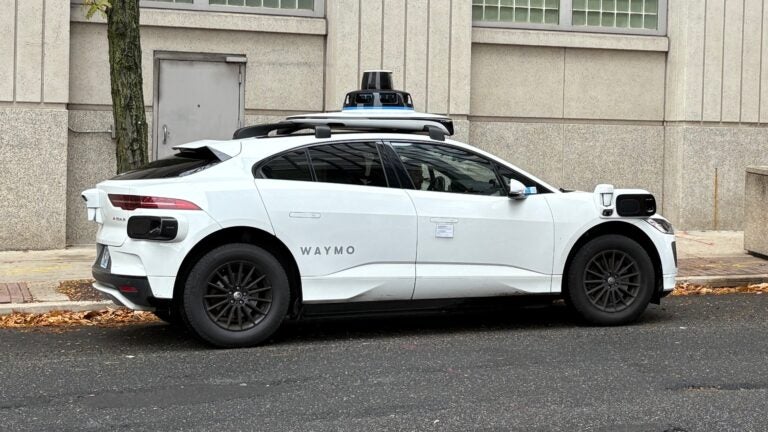
A Waymo vehicle on Seventh Street in Philadelphia in November 2025 (Alan Yu/WHYY)
From Philly and the Pa. suburbs to South Jersey and Delaware, what would you like WHYY News to cover? Let us know!
The self-driving car company Waymo says it is here to stay in Philadelphia, and has recently started tests where human drivers do not take the wheel.
Earlier this summer, the company did tests with humans doing the driving in about a dozen vehicles, and said it had no immediate plans for an autonomous taxi service in Philadelphia. Now, it has officially announced plans to stay, as well as in other cities including Pittsburgh, Baltimore and Washington, D.C.
It will work on getting permission from PennDOT to have fully self-driving cars with no human drivers. Then, people in Philadelphia will be able to request rides, company spokesperson Ethan Teicher said. He said he cannot say how long that will take.
Waymo is a subsidiary of Alphabet, the parent company of Google.
Right now, the company offers fully autonomous rides in San Francisco, Los Angeles, Phoenix, Austin and Atlanta.
“In every city, it is a methodical, deliberate process. And Philadelphia will be no different,” Teicher said. “When we brought vehicles to the city earlier this year, it was part of a road trip to see both how the technology performed in the city and to get started on exploring if Philadelphia was a city where we could operate.”
He said the company is confident that their technology can handle the conditions in Philadelphia after their local tests and the company’s previous experience operating in other places like Tokyo, New York and Michigan. Earlier this year, the company published a journal article showing that their driverless cars caused vastly fewer injuries and crashes compared to human drivers.
However, it remains “the world’s most complicated problem” to design fully self-driving cars that can work across all types of traffic conditions, says Paul Perrone, founder and CEO of Perrone Robotics, which ran a self-driving shuttle in the Philadelphia Navy Yard for a little more than a year.
His company has been working on self-driving car technology for more than 20 years, and had tested an automated shuttle at Newark Liberty International Airport.
Related Content
Last year, one neighbor resorted to making signs that read, "Only a real jabroni would honk at the Miracle" and "Honking makes the baby Jesus cry."
1 year ago
Listen 3:14The Navy Yard shuttle ended earlier this year. Perrone said his team found that there were some intersections with older traffic lights that even human drivers had trouble seeing, so they required human drivers to take over in those spots until the traffic lights got upgraded.
He said that while he applauds Waymo and any other company working on fully self-driving cars, there are still some tough problems to solve. For instance, what should a car do if there is a passenger inside a car caught up in a riot? This summer, in Los Angeles, protesters set some Waymo cars on fire, though there were no passengers inside at the time.
Waymo could also face resistance from unions representing human drivers. When the company announced the tests in Philadelphia this summer, the president of the Transport Workers Union of America, AFL-CIO, which represents transit workers in New York and Philadelphia, said “Waymo and other Big Tech companies should not be permitted to launch driverless vehicles with their unproven tech in some of the busiest cities in the world.” The union president also pushed back when Perrone Robotics started the Navy Yard shuttle last year.
Until Waymo gets its permit to have its fleet go fully driverless, riders won’t be able to hail one of their cars just yet. But they might see them on Philadelphia streets for more human-supervised test runs.
To get a permit to have fully driverless cars in Pennsylvania, Waymo will have to meet a list of requirements from PennDOT, such as showing that they have a cybersecurity plan, that cars store operational data, and that cars can identify and yield to emergency vehicles. However, if and when Waymo starts that process, it would be the first time that a company has applied for permission to have fully automated cars in Pennsylvania, so there’ll likely be some back and forth, said Derrick Herrmann, chief of transformational technology at PennDOT.
He said that compared to other states that already have self-driving cars on the road, Pennsylvania has “more stringent requirements.” He added that state officials “really take a balanced look at safety while also making sure we’re not too disproving of expansion of [self-driving cars] into the state.”
He added that PennDOT has been in touch with states like California, Arizona and Texas, where Waymo already has self-driving cars offering rides, to hear about their experiences. He said the department learned that they have to be proactive about letting self-driving car companies know about any road closures, work zones and big events like games or protests where there could be a lot of traffic.
PennDOT has also learned from research on self-driving cars, such as the Navy Yard shuttle in Philadelphia, as well as research with Carnegie Mellon University and Penn State University on how self-driving cars handle work zones.
Based on that research, Herrmann said PennDOT is looking into whether they need to change the way they design roads. For example, he said that in Pennsylvania, some highway exit lines don’t extend all the way from the start to the end of an exit lane, so the department is wondering if that needs to change to better accommodate self-driving cars.
Overall, he said Waymo’s commitment to staying in Philadelphia and Pittsburgh is an exciting moment.
“Industry is now at this turning point where they are really moving from testing to trying to do actual operations,” he said. “It’s really kind of what’s next to come in the future of transportation.”

Never miss a moment with the WHYY Listen App!


WHYY is your source for fact-based, in-depth journalism and information. As a nonprofit organization, we rely on financial support from readers like you. Please give today.
SEPTA still unsure about when Center City trolley tunnel will reopen after damage to overhead wires
The wires that power the trolleys were damaged during an attempt to change a key piece of equipment on the trolley power poles.
2 weeks ago
Renderings of new SEPTA train cars for Market-Frankford Line revealed
The company, Hitachi Rail STS USA, will deliver the first 200 cars starting in 2029.
1 year ago

SEPTA to spend $22 million to upgrade fare collection boxes in buses and trolleys
The box replacement is necessary to swap out vintage units from the ‘90s that can’t be repaired, and won’t accept payments.
3 years ago