
‘Maliciously outrageous’: National Park Service reveals plans to replace slavery exhibit at President’s House Site
Advocates for the site say digital renderings of new display panels diminish references to slavery and whitewash American history.

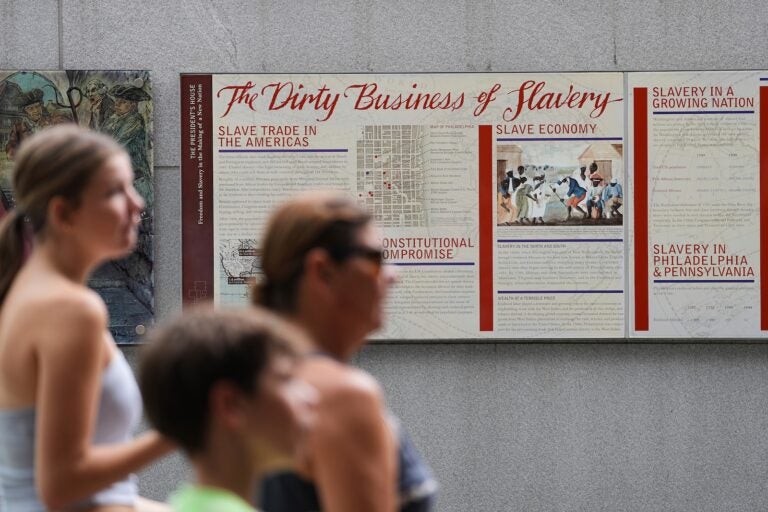
File: People walk past an informational panel at President's House Site Tuesday, Aug. 19, 2025, in Philadelphia. (AP Photo/Matt Rourke, File)
From Philly and the Pa. suburbs to South Jersey and Delaware, what would you like WHYY News to cover? Let us know!
The National Park Service has released digital images of exhibit panels intended to replace those currently at the President’s House Site at Independence National Historic Park.
The new panels include references to slavery, the Underground Railroad and figures like Frederick Douglass. Like the previous panels, they also make mention of the nine enslaved people held by Washington while he was president and living in Philadelphia.
However, they would change the overall tone of the site, softening and significantly reducing references to slavery, and shifting the focus toward the “anti-slavery sentiments” of the slave-owning Founding Fathers.
For example, text on one notes that the U.S. Constitution did not contain the word “slavery,” and another one argues that Washington had “doubts” about the institution.
“Privately, George Washington often expressed discomfort with the institution and a desire to see it abolished,” it reads. “Yet as a Virginia plantation owner, his wealth and livelihood were deeply tied to it.”
After learning about the new panels, the Avenging the Ancestors Coalition, which led the movement to develop the original site focused on Washington’s slaves, released a statement calling it “whitewashing.”
“What we are seeing now is not restoration—it is revision,” the statement read. “It is an attempt to sanitize history and present a version of the past that is more comfortable, but far less truthful.”
Related Content
Philadelphia’s slavery exhibit is being restored at the President’s House
“This is the American people fighting back and saying we will not accept this,” said one Independence Mall visitor. “Will not allow history to be rewritten.”
2 months ago
Civil rights lawyer Michael Coard called the new exhibit “maliciously outrageous.”
“If George Washington had some discomfort with slavery, what do you think those 316 black men, women and children at his Mount Vernon, Virginia plantation had? What do you think the nine held illegally in Philadelphia had?” he told WHYY News. “So to talk about George Washington’s discomfort is offensive and outrageous.”
Coard was similarly incensed by another panel describing the people enslaved at the house as having “a modicum of autonomy” and the ability to “explore the city and sometimes even attend the theater.”
“When you talk about a human being who has no control over his or her own body, everything about that individual legally belongs to somebody else who can buy and sell and trade you, beat you, whip you, rape you, murder you at a whim — and you’re talking about a ‘modicum of autonomy?’” he said.
In a statement sent to WHYY News, a Department of Interior spokesperson defended the renderings saying “this administration has been committed to celebrating and acknowledging the full breadth of our nation’s history.”
“The hard work and sacrifices of the men and women who built this nation deserve to be remembered and honored,” the statement said. “By telling the full story, every triumph, every challenge, and every step towards a more perfect union we strengthen our shared understanding and ensure that future generations inherit not just the land we love, but the truth of the journey that brought us here.”
The new renderings also go deeper into the old house’s history, explaining that the widow of Philadelphia mayor William Masters had the house built in 1767, and was later occupied by Pennsylvania Lt. Gov. Richard Penn, the grandson of William Penn.
“This site marks the home of colonial governors, a British general, traitors, and patriots alike, and it served as the executive mansion for the first two presidents of the United States,” the panel reads.
Text on another panel says that, as the executive mansion, the house received many dignitaries, including federal officials, foreign ambassadors and “many delegations from Native American Nations,” including Iroquois and Chickasaw leaders.
Like the earlier panels, the new replacements do include some information on the nine people enslaved by Washington, including Oney Judge, the personal maidservant and seamstress of Martha Washington, who the new exhibit notes “ran away from the President’s House and escaped to freedom in 1796.”
Whereas the old site made clear that Washington rotated his servants out of Philadelphia back to his Mt. Vernon estate in Virginia so they couldn’t claim freedom under Pennsylvania law, a new panel instead says he did so “in acknowledgement of a Pennsylvania law requiring slaves to be set free after six months in residence.”
Coard said he would not approve of any of the new displays.
None of it “is acceptable because you got to consider the source,” he said. “The source did this maliciously, so I accept nothing from it. Let the historians tell history.”
Related Content
Activists celebrate the return of slavery exhibit at Philadelphia’s President’s House Site
Workers began restoring the exhibit Thursday after a judge’s order to return, despite a Trump administration appeal.
2 months ago
Listen 1:24The fight over the exhibit traces back to a sweeping executive order President Donald Trump issued last year that aimed to reshape how American history is presented at federal sites. The order called for the removal of what it described as “negative” or “disparaging” portrayals of the nation’s founders.
Soon after, the park service moved to take down long-standing panels, though the removal sparked immediate backlash, with historians, activists and local officials staging protests and arguing the move amounted to an erasure of slavery’s central role in the nation’s founding.
The dispute shifted to the courts when the city of Philadelphia filed a lawsuit against the federal government, arguing that the removal violated preservation agreements and public trust. A federal judge ordered the panels restored, a decision seen as a major victory for advocates for the original display. However, before it could be fully restored, federal officials appealed, winning an injunction against restoration. The site now sits idle with about half of the original panels still missing.
It’s not clear if the new panels have been created, but the park service is prohibited from altering the current site by court order while the city’s case is on appeal.

Get daily updates from WHYY News!
WHYY is your source for fact-based, in-depth journalism and information. As a nonprofit organization, we rely on financial support from readers like you. Please give today.
Part of the series
Activists celebrate the return of slavery exhibit at Philadelphia’s President’s House Site
Workers began restoring the exhibit Thursday after a judge’s order to return, despite a Trump administration appeal.
2 months ago
Listen 1:24
Philadelphia’s Independence Hall reopens after being closed for 4 months
The birthplace of democracy got spruced up for America’s 250th celebrations.
2 months ago
Listen 1:16
The Citadel CEO's first-edition copies will be placed in a new public exhibit, marking the center’s largest renovation since it opened in 2003.
11 months ago