

Upper Makefield jet fuel leak prompts U.S. Rep. Brian Fitzpatrick to propose pipeline safety reforms
Kristine Wojnovich's well water is contaminated from the Sunoco pipeline leak. She hopes the legislation will protect other communities at risk of contamination.
Listen 0:56
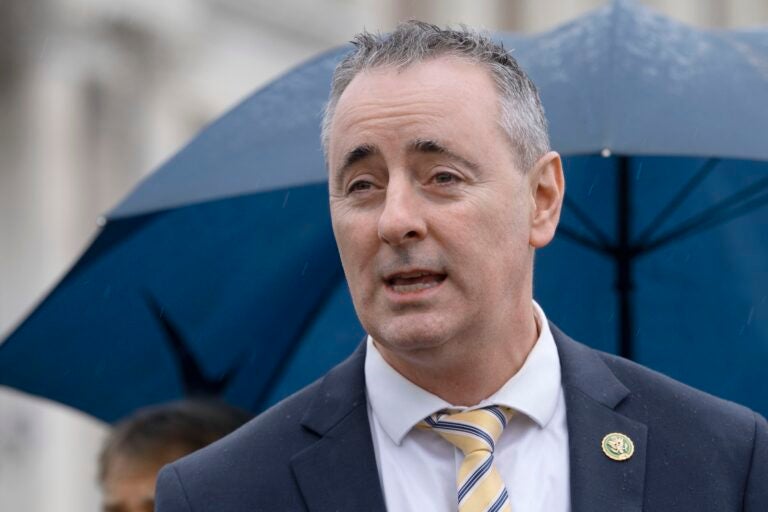
FIILE - Rep. Brian Fitzpatrick, R-Pa., speaks at a news conference, Jan. 31, 2023, on Capitol Hill in Washington. (AP Photo/Jacquelyn Martin, File)
From Delco to Chesco and Montco to Bucks, what about life in Philly’s suburbs do you want WHYY News to cover? Let us know!
U.S. Rep. Brian Fitzpatrick, R-Bucks County, introduced legislation Thursday to overhaul pipeline safety and emergency response nationwide.
The Wojnovich Pipeline Safety Act, co-sponsored by Democrat Tom Suozzi (D-New York), is named in honor of Kristine Wojnovich and her family, who were among the first impacted by the Sunoco Twin Oaks pipeline leak that contaminated at least six private wells with jet fuel in Upper Makefield’s Mt. Eyre neighborhood.
Wojnovich first noticed a gasoline smell in her tap water in September of 2023, and reported it to Energy Transfer, the pipeline operator. Water sampling did not show contamination at the time.
A leak in the Mt. Eyre neighborhood was later identified by Energy Transfer on Jan. 31. A preliminary investigation by the federal agency that regulates the pipeline found the leak had been going on for at least 16 months before it was identified.
Wojnovich told WHYY News that the goal of the legislation is to help protect other communities at risk of contamination from leaks.
“Our situation here is actually a national issue,” she said. “There are aging pipelines all over the country.”
Wojnovich said she hopes that legislators acknowledge “that pipelines are aging and will need to be replaced, and that there should be better leak detection systems, and really that old legacy pipelines should really be removed, and not just left in the ground.”
Related Content

Upper Makefield residents sue Energy Transfer, Sunoco Pipeline L.P. over pipeline leak
Plaintiffs’ demands include shutting down operation of the pipeline while investigation into the leak is ongoing.
12 months ago
Listen 0:52The measure calls for a new federal grant program to replace or upgrade high-risk hazardous liquid lines to modernize the infrastructure.
Other provisions include expanding public transparency so that families can easily access leak, inspection and remediation data; mandating disclosure of nearby pipelines to prospective home buyers; strengthening emergency response systems; improving leak detection; introducing new multimillion-dollar penalties for leaks and failures; and establishing an Office of Public Engagement.
Fitzpatrick said in a statement that “every page of this bill is shaped by what Upper Makefield families lived through — the gaps in testing, the delays in information, the uncertainty about their water, and the absence of clear standards for communication and emergency response.”
He said he worked side by side with the Mt. Eyre task force, a group of residents who have advocated for the community throughout the remediation process, to identify where federal law was lacking and respond with the “strongest pipeline safety reforms in more than a decade.”
“From the very first day, we pressed every agency together, demanding action, transparency, and full accountability,” Fitzpatrick said. “This legislation turns that collective effort into permanent protections. And the courage of this community will now strengthen federal law and protect families across the country.”
Energy Transfer could not immediately be reached for comment.
Related Content
‘Our lives have been upended’: Bucks Co. residents call for shutdown of Sunoco pipeline
Residents are meeting with company representatives on Thursday night.
1 year ago
The company is following the Pennsylvania Department of Environmental Protection’s Act II remediation process, and is continuing to make repairs to the pipeline and recover leaked fuel. Despite calls to shut down the pipeline, Energy Transfer is continuing to operate it.
The company created a website with resources for impacted community members and has hosted a series of public meetings.
Several residents filed a lawsuit against Energy Transfer in March.
But Wojnovich said that for her and her family, “not much has changed.”
“To be honest, our well is still contaminated,” she said. “The water that comes into our house is still contaminated. It’s been over two years now. We don’t drink or cook with the water still. We don’t shower in the water. It’s pretty much the same as it’s been.”

Get daily updates from WHYY News!
WHYY is your source for fact-based, in-depth journalism and information. As a nonprofit organization, we rely on financial support from readers like you. Please give today.

U.S. Rep. Brian Fitzpatrick is one of three GOP members in the 119th Congress who serves a district former Vice President Kamala Harris won in 2024.
8 months ago

Ashley Ehasz is challenging Republican incumbent Brian Fitzpatrick in another bid to unseat the U.S. congressman.
1 year ago
Listen 1:08
The top Democrat on the state senate’s environmental committee says the legislature likely won’t take any action on pipeline safety.
4 years ago