

Philly-area heat wave could push electricity demand to record levels
The dangerous heat is accelerating air conditioner use. Data centers could be directed to use their own backup power.

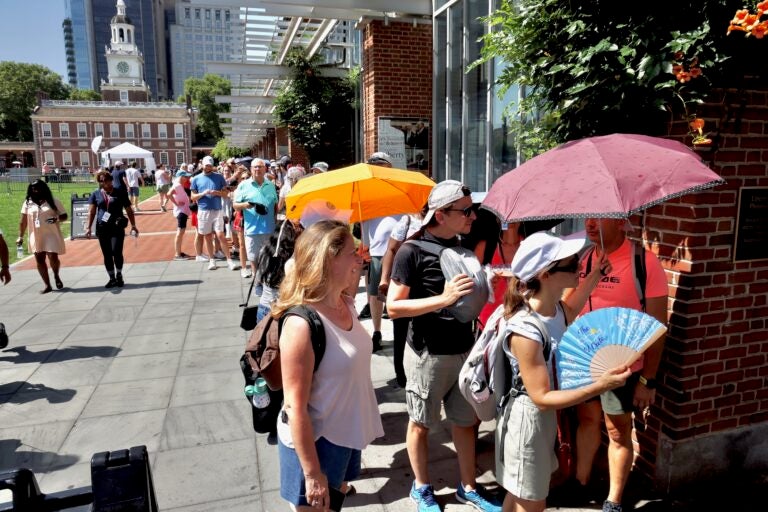
Visitors wait in line on Independence Mall to see the Liberty Bell on Thursday, July 2, 2026. (Emma Lee/WHYY)
This story is part of the WHYY News Climate Desk, bringing you news and solutions for our changing region.
From the Poconos to the Jersey Shore to the mouth of the Delaware Bay, what do you want to know about climate change? What would you like us to cover? Get in touch.
Air conditioners are running on full blast as a dangerous heat wave bakes the Philadelphia region. All that electricity use could push demand on the regional grid to record levels Thursday afternoon.
But the regional grid operator, PJM Interconnection, predicts it’ll have enough electricity to meet demand over the next few days, if electric power plants and the lines that carry electricity over long distances perform as expected.
“The system’s tight,” said Jeff Shields, a spokesperson for PJM. “But we think we should be fine.”
High temperatures can affect the grid in multiple ways. They can increase outages of gas and coal-fired power plants if equipment overheats, and more electricity running through transmission lines can cause lines to heat up, sag and break, said Suzanne Glatz, an energy consultant and former infrastructure planner at PJM.
But PJM is taking steps to increase the grid’s capacity and decrease demand.
The grid operator has asked power plants and transmission line owners to defer routine maintenance so that they are all available for use. PJM may also ask big electricity users that have agreed in advance to lower their usage during emergencies to do so.
Coping with extreme heat
- Heat emergency in Philly: Here’s what the declaration means and how the city is impacted by the extreme heat.
- Stay cool: Looking to beat the heat in Philly? Here’s where you can find pools and spraygrounds.
- Know the facts: Learn how to protect yourself and loved ones, what happens to the body in extreme temperatures and how heat becomes deadly.
- Going outside?: If you’re going out in the heat, here are eight mistakes to avoid.
Avoiding blackouts amid dangerously high heat
The U.S. Department of Energy has also given PJM permission to direct local utilities to require data centers and other big electricity users to switch over to their own backup electricity generation if needed to avoid blackouts for residential and other customers. Shields said PJM will only use this tool as a last resort.
“[PJM is] leveraging every one of the tools that they have available to them, which gives me confidence that we won’t have any issues this week,” Glatz said.
These measures do not require action from residential customers, PJM said. Glatz recommended residential customers still try to conserve energy by avoiding running multiple electric appliances during the hottest part of the day and closing their blinds.
Related Content

Philadelphia heat wave: City emergency in effect amid ‘dangerous’ conditions. Here’s what to know
“This is not the kind of heat event we see every year,” the National Weather Service reported, adding it may be the hottest period the region has experienced since 2011.
2 months ago
Glatz said she does not expect the heat wave to cause blackouts in the PJM region, which serves 65 million people across Pennsylvania, New Jersey, Delaware, and part or all of Maryland, Virginia, Washington, D.C., West Virginia, Illinois, Indiana, Kentucky, Michigan, North Carolina, Ohio and Tennessee.
While random disruptions such as a thunderstorm knocking down a power line could present additional challenges, the grid is designed with contingencies in place to absorb a certain number of generator and transmission outages, she said.
“We have all these factors built in already to protect against unexpected issues,” she said. “There’s enough margin.”
Late last year, an auction PJM uses to secure commitments from power plants so that electricity supply meets future demand failed to reach the grid operator’s goal for a buffer of excess supply, raising the risk of power outages starting next summer.

Get daily updates from WHYY News!
WHYY is your source for fact-based, in-depth journalism and information. As a nonprofit organization, we rely on financial support from readers like you. Please give today.
Part of the series

Pennsylvanians whose homes were damaged in July storm can apply for financial assistance
The July 11 microbursts knocked out power, downed trees, flooded streets and basements and damaged cars and buildings.
3 weeks ago

Reprieve from wildfire smoke expected to come over the weekend, meteorologists say
Rainfall and a change in wind direction are expected to push the smoky air away from Philadelphia.
1 month ago
Philly pools closed, trash pickup canceled due to very unhealthy air
Wildfire smoke is bringing very unhealthy air pollution to the Philadelphia region. Officials say everyone should avoid optional outdoor activities.
1 month ago
Listen 0:58