

Red knot populations improve slightly along Delaware Bay, but remain fraction of historic levels
Biologists in New Jersey and Delaware spotted more red knot birds this year, but levels remain significantly lower than before the 2000s.
Listen 1:18
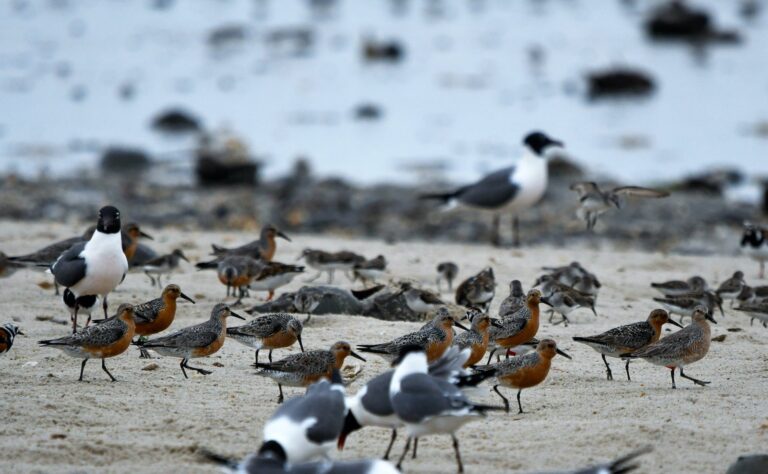
File: Red knots birds are pictured on the beach. (Courtesy of Chris Neff/New Jersey Audubon)
This story is part of the WHYY News Climate Desk, bringing you news and solutions for our changing region.
From the Poconos to the Jersey Shore to the mouth of the Delaware Bay, what do you want to know about climate change? What would you like us to cover? Get in touch.
The federally threatened red knot migrates 9,000 miles each year from South America to the Arctic and back, making a crucial stop along the Delaware Bay to rest and refuel by eating horseshoe crab eggs.
The overharvesting of horseshoe crabs, however, has reduced the shorebirds’ populations by about 75% from the 1980s to the 2000s, according to the U.S. Fish & Wildlife Service.
Biologists in New Jersey and Delaware said they saw a sliver of hope this year, as the official single-day peak count of red knots reached its highest levels since 2019.
Though the sand-pipers continued to favor the New Jersey side of the bay, Delaware recorded slight improvements to its red knot populations and an increase in their body weights.
Still, sightings remain only a fraction of historic times when bird watchers and naturalists flocked to the Delaware Bay to be in awe of the thousands of red knots arriving on its beaches.
“Delaware is just one piece in such a complicated series of movements that these birds make. It’s slightly hard to say we did great or we did poorly,” said Delaware Shorebird Project leader Kat Christie, a coastal waterbird biologist at the Delaware Department of Natural Resources and Environmental Control.
“Compared to historic levels, we’re definitely still lower than what we had been seeing, but there’s also definitely some signs of hope.”
The impact of harvesting horseshoe crabs
Despite efforts to prevent overfishing, horseshoe crabs continue to be harvested and used as bait for eel and whelk. The species’ spawning numbers dropped by 70% between 1990 and the early 2000s.
The Atlantic States Marine Fisheries Commission, which manages fishery resources, recommends a male-only harvest to protect the eggs that shorebirds rely on. However, the crabs haven’t made a significant recovery.
Horseshoe crabs also are increasingly harvested for their bright blue blood, which responds to bacterial toxins by clotting and helps determine the sterility of vaccines and other biomedical materials and devices.
New Jersey has a moratorium on the harvesting of horseshoe crabs for bait, but has an exemption for the biomedical industry.
Delaware allows the commercial harvesting of horseshoe crabs, following a male-only quota limit implemented by the ASMFC. To date, the state has yet to issue any scientific collection permits.
Related Content
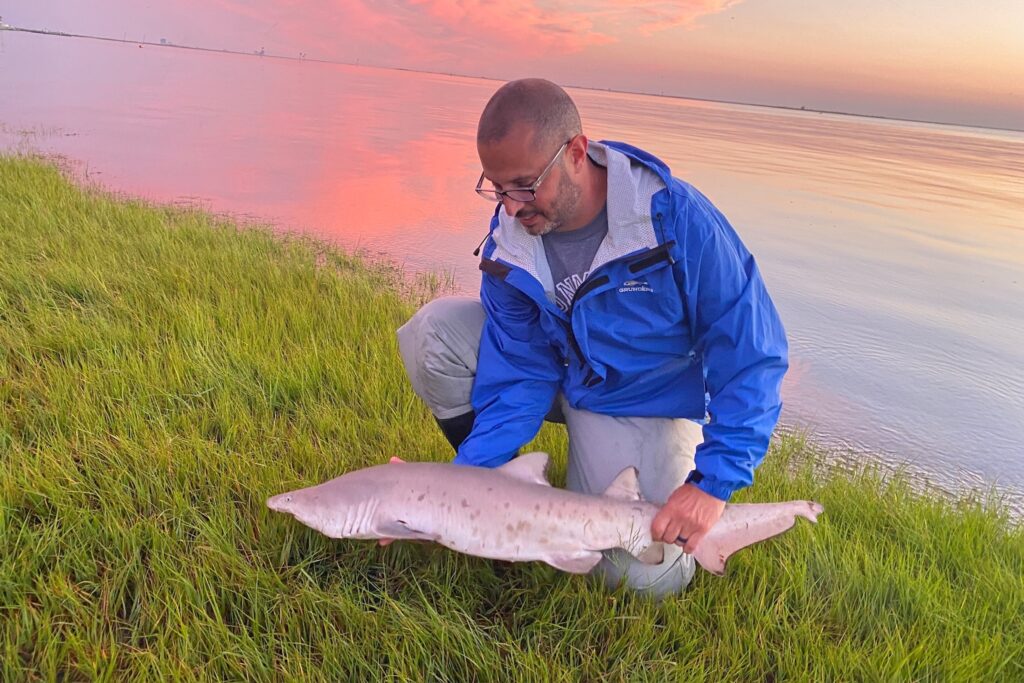
Baby sharks grow up in New Jersey’s back bays. Climate change could threaten the nurseries
Three species of shark use New Jersey’s coastal salt marshes as nurseries — the sandbar shark, the smooth dogfish and the sand tiger shark.
3 months ago
Listen 1:19The fate of red knots and horseshoe crabs
In the spring of 2021, red knot populations on the Delaware Bay reached an all-time low, with biologists finding fewer than 7,000, according to official one-day peak counts. That’s about a third of the population found in 2020, and much lower than the ‘80s, which in some years saw populations as high as 95,000 during peak counts.
The peak counts represent a much lower number than scientific calculations, which tally the total cumulative number of unique birds passing through a site all season. These counts have ranged from 40,000 to 54,000 in recent years for the Delaware Bay, but some critics argue those counts are flawed because they include birds flying overhead looking for food that they may not find, and could mistakenly include re-sightings.
This year, biologists officially tracked more than 30,000 red knots during the peak count — most of which were spotted on the New Jersey side of the Delaware Bay. Biologist Larry Niles, formerly with New Jersey’s Fish and Wildlife division, attributes the improvement to the availability of horseshoe crab eggs.
In Delaware, scientists also recorded some positive trends. On May 11 alone, the state’s Shorebird Project counted nearly 2,000 red knots at Mispillion Harbor — one of the state’s premier horseshoe crab spawning beaches. The birds peaked at 3,000 on May 20, according to state environmental regulators.
“This year we had an exciting resurgence in red knot numbers that we hadn’t seen in a couple of years,” said DNREC’s Christie.
The number of red knot birds counted during the survey in Delaware represents about 2% of the total spotted across the bay. However, in the ‘80s and ‘90s, the counts often rivaled New Jersey’s.
Christie said the cause of the slight improvements might be more complicated than horseshoe crab egg availability alone. Factors like weather, horseshoe crab spawning timing and a more favorable landscape may lure red knots to New Jersey, she said. Issues like sea level rise and development have reduced and degraded roosting marsh habitat in Delaware, while New Jersey’s coastal waters tend to warm quicker and reach the threshold temperatures for horseshoe crab spawning earlier. New Jersey also restored its beaches with sand that’s preferred by horseshoe crabs.
A colder-than-average spring shifted bay-wide spawning timing this year. Mispillion Harbor warmed earlier than many other locations, attracting more red knots to Delaware early in the season.
The birds also hung around Delaware’s beaches longer than in recent years and gained weight at or above expected rates.
Niles said that horseshoe crab egg availability is the most important factor when evaluating the health of the red knots. Today, egg availability is about a fifth of historic highs.
“Yes, there’s been an increase [in birds], but we’re still only about a third of the red knots that we once had,” he said. “We also know that only about half of them are reaching a good weight to get to the Arctic.”
Niles and other environmentalists said that banning the harvesting of horseshoe crab blood would make a significant impact.
“Delaware Bay is an important stopover, but it’s not drawing international tourists anymore,” he said. “All of our local businesses have lost out — and why? For a few [pharmaceutical] companies on the Atlantic coast.”

Get daily updates from WHYY News!
WHYY is your source for fact-based, in-depth journalism and information. As a nonprofit organization, we rely on financial support from readers like you. Please give today.
Part of the series
Watershed
Preserving Our Water: How we use our Delaware Watershed.
The project is funded by The William Penn Foundation.
Part of the series
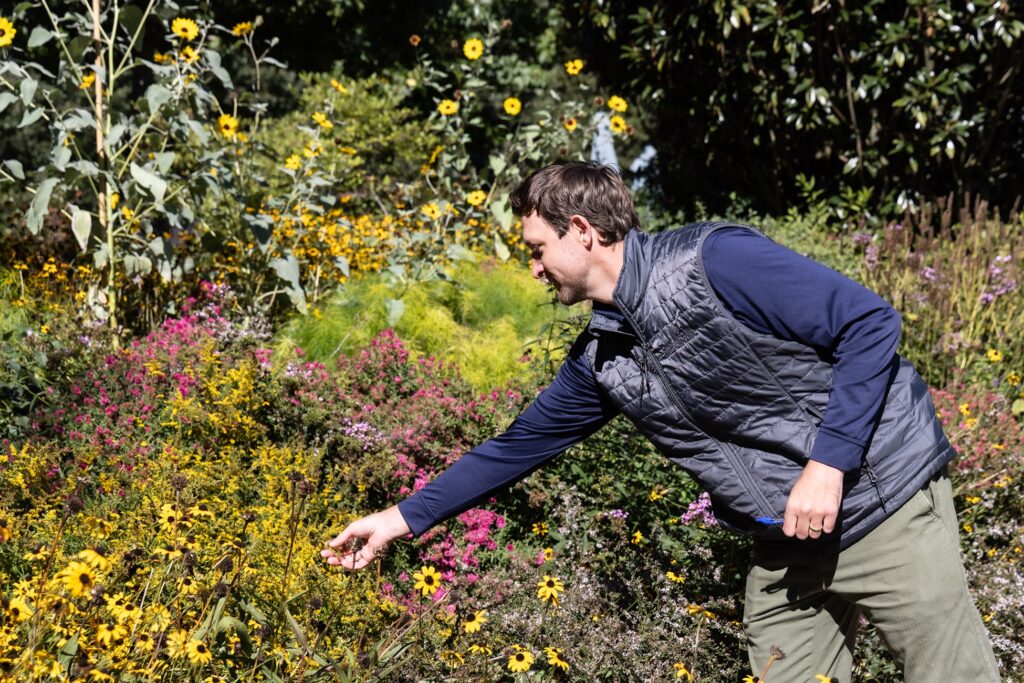
Delaware’s Mt. Cuba Center touts the benefits of native goldenrods
Goldenrods are not to be confused with ragweed. These fall-blooming native plants don’t trigger allergies and insects love them.
2 days ago
Listen 1:23
A network of air quality monitors grows in a formerly redlined area of West Philadelphia
The network will provide residents of formerly redlined areas of West Philly and Harrisburg real-time info about the air they’re breathing.
7 days ago
Listen 1:07
In Philadelphia’s Eastwick neighborhood, plans for a temporary solution to flooding hit a snag
The issue with temporary HESCO-style flood barriers comes after a plan for a levee in Eastwick was deemed not viable.
1 week ago
Listen 1:07