

Baby sharks grow up in New Jersey’s back bays. Climate change could threaten the nurseries
Three species of shark use New Jersey’s coastal salt marshes as nurseries — the sandbar shark, the smooth dogfish and the sand tiger shark.
Listen 1:19
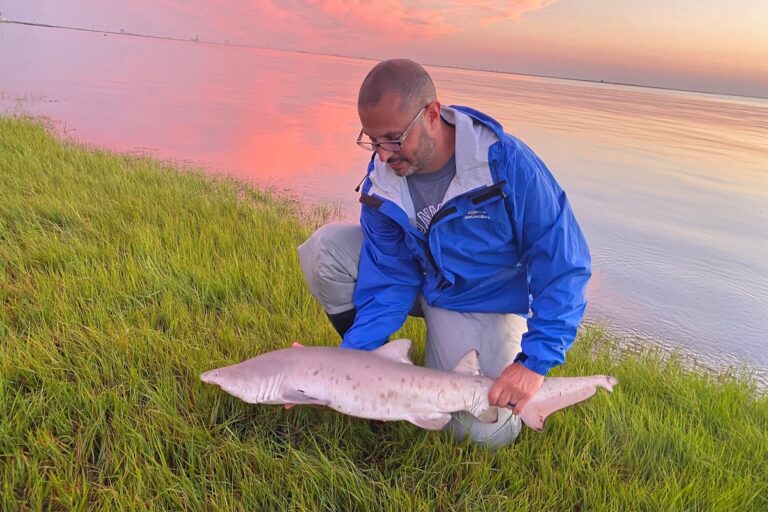
Keith Dunton, professor of biology at Monmouth University, holds a sand tiger shark in a coastal salt marsh. (Courtesy Monmouth University and The Nature Conservancy)
This story is part of the WHYY News Climate Desk, bringing you news and solutions for our changing region.
From the Poconos to the Jersey Shore to the mouth of the Delaware Bay, what do you want to know about climate change? What would you like us to cover? Get in touch.
New Jersey’s back bays, those lush wetlands that sit between the barrier island beach towns and the mainland, are home to unknown numbers of baby sharks that feast on the American eel, crabs and small fish that thrive in the coastal salt marshes. Giving birth to litters in those food-rich shallow waters like Little Egg Harbor is just about all the maternal care given to the shark pups by their mothers, who swim back out to the Atlantic Ocean soon afterwards.
The sand tiger shark, the sandbar shark and the smooth dogfish return each summer to the Jersey coast to give birth between June and July, utilizing the safety of shallow waters that are free from predators that would devour their newborns. Although the smooth dogfish can grow to 3 feet long, the babies are no larger than 12 inches at birth and litters range in size from four to 20 pups. The dogfish are benthic feeders, meaning they forage along the bottom of the marsh.
“We all have our favorite shore towns,” said Adrianna Zito-Livingston, an ecologist who works as the climate adaptation project manager for the New Jersey Nature Conservancy. “We come back year after year. The sharks are doing the same thing.”
The Nature Conservancy is working with Monmouth University to research the health of the salt marshes that have become eroded due to the impacts of climate change. As part of that work, researchers like Zito-Livingston are tagging the sharks with acoustic trackers that are then monitored by listening stations placed along the Jersey coast. She said the sharks provide a good indication of the health of the salt marshes.
“In a lot of ways, sharks are a canary in the coal mine,” she said. “They’re top predators and healthy sharks with a good distribution are indicative of healthy, diverse ecosystems.”
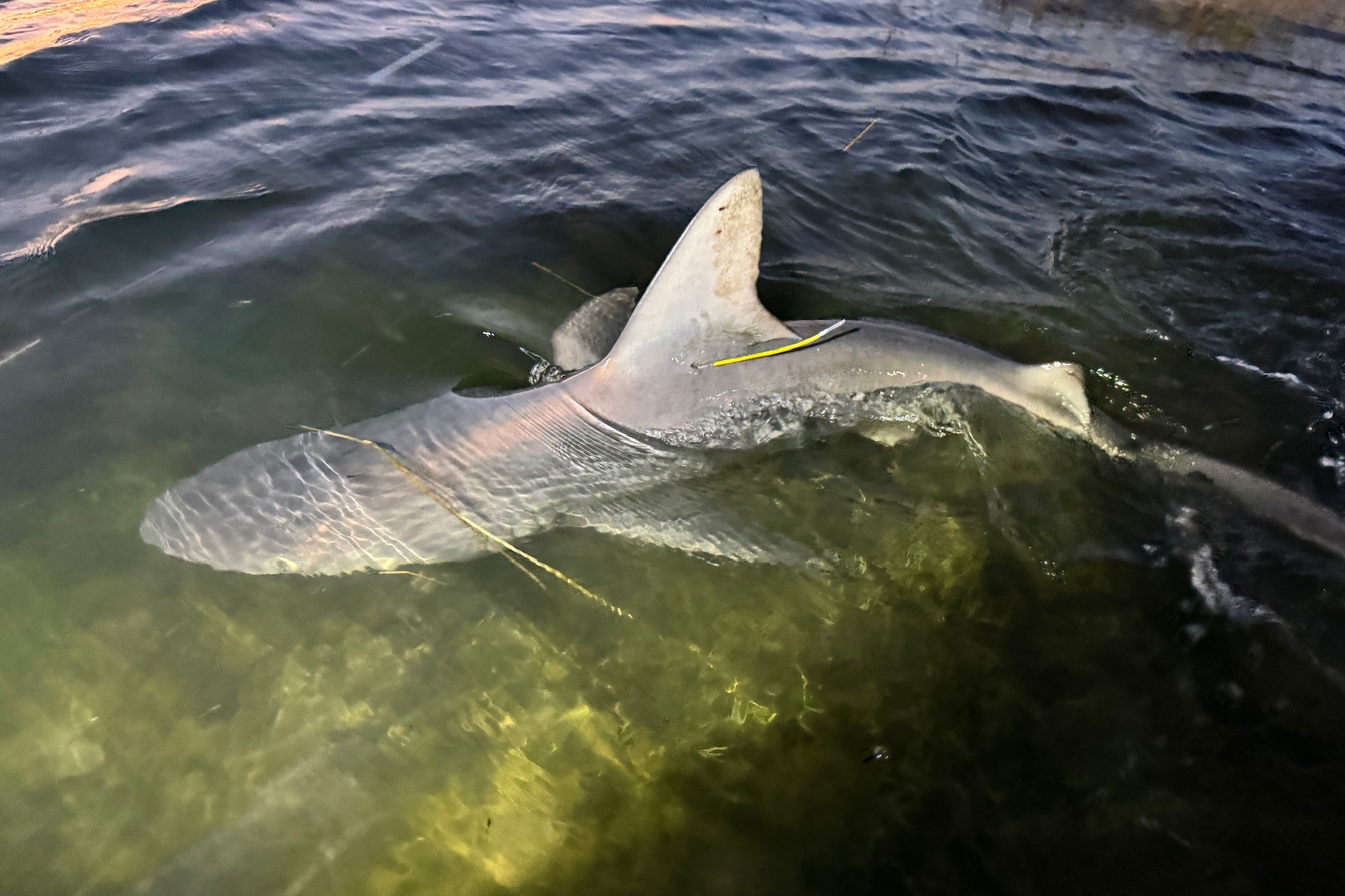
Fishing for many sharks along the shoreline in New Jersey is illegal, but the researchers have a special permit for tagging.
“Standing on a salt marsh edge, we landed a 6-foot sand tiger, in probably 5-6 feet of water, which was mind-blowing to me,” Zito-Livingston said.
There’s no need to worry about running into those sharks in back bays, however, as they are completely harmless to humans, Zito-Livingston said.
“We don’t taste very good,” she said. “We’re not that interesting, and sometimes when we’re in the water, we make a lot of noise, and none of those things are what these sharks are interested in. They’re tracking down fish and eels early in the day, late in the evening.”
Related Content
Earth Day: How climate change is threatening vulnerable species in Pennsylvania
Five decades after the original Earth Day, some Pennsylvania species are still at extreme risk.
6 months ago
How climate change is altering New Jersey’s coastal marshes
Storms are a natural part of life along the Jersey coast. But climate change is bringing more destructive storms, raising sea levels and causing periods of drought that have led to erosion along the edges of the wetlands.
“We’re also seeing the interior parts of our marsh where water doesn’t frequently reach, it’s getting there, it’s staying there and it’s drowning the marsh interior. So, we’re losing a lot of really productive valuable wetland, which is nursery habitat for fish, including sharks, and certainly part of our food chain as well as sharks’ food chains,” Zito-Livingston said.
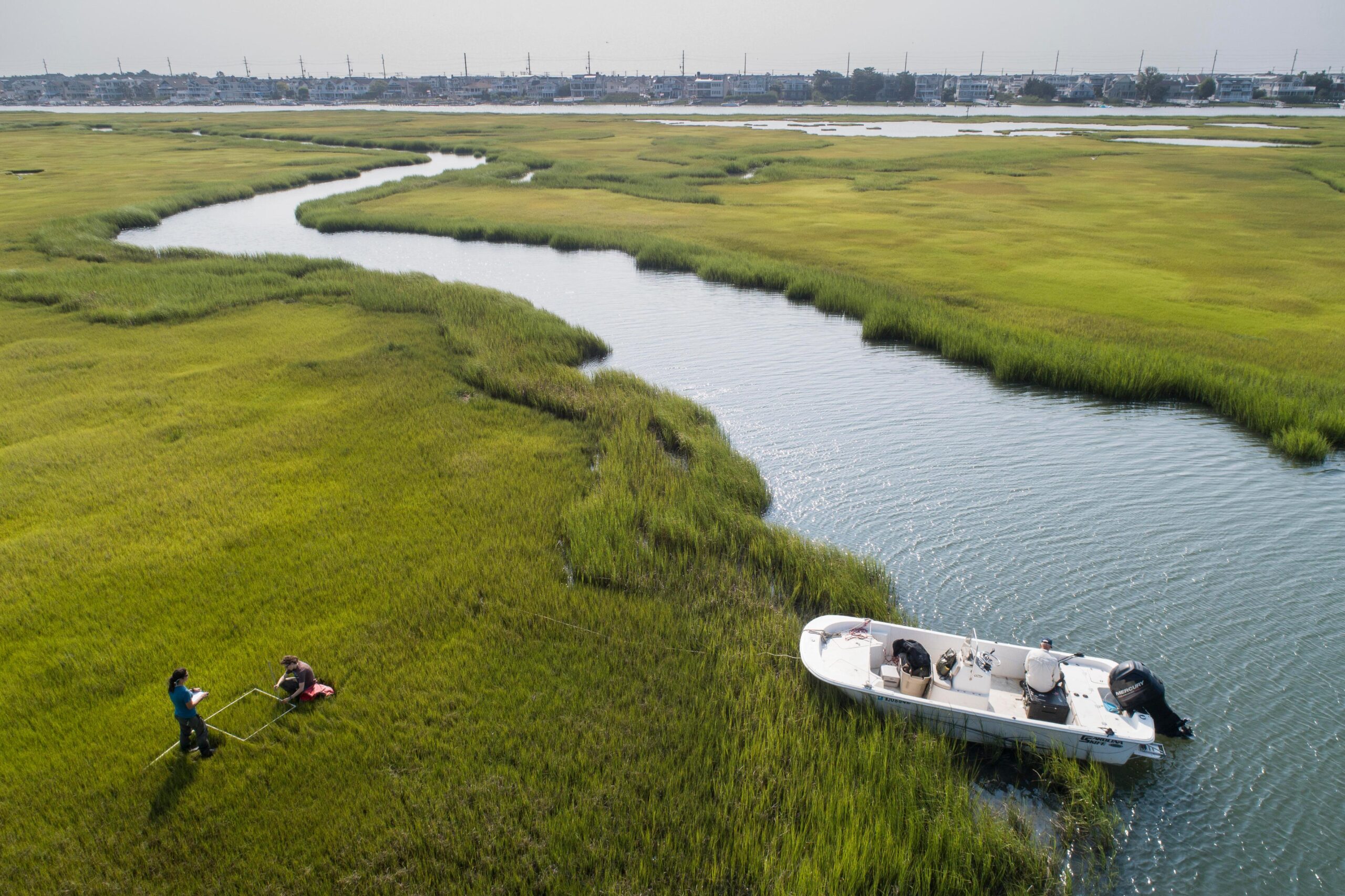
This doesn’t just impact aquatic life; those marshlands serve as a buffer for humans as well, protecting the shoreline and the homes along the coast from severe winds, rain and flooding.
“So, people are feeling those effects [of climate change] more severely in part because of marshes being lost and in part because conditions are getting worse,” Zito-Livinston said.
“That’s why we’re interested in these systems and why sharks are such an interesting and important study case for the health of our marshes.”
She likened the marshes to a shag carpet and storms to a marble ball. If you try to roll a marble along a shag carpet, it will go slow and come to a stop. But remove the carpet, and the marble will roll quickly over a wooden floor.
“That’s the same function that our coastal salt marshes are playing for our human communities,” she said.
The warming ocean also has an impact on the eel grass that is essential for keeping the marsh intact, which acts to keep climate-warming carbon contained in the soil.
“When we start to see salt marshes become stressed through those multiple compounded factors, whether it’s temperature, whether it’s storms, whether it’s being too wet for too long because of sea level rise we start to see a really rapid decline,” Zito-Livingston said. “That’s when the human communities, and businesses along the shore really become much more vulnerable to all of these continuing impacts of climate change.”
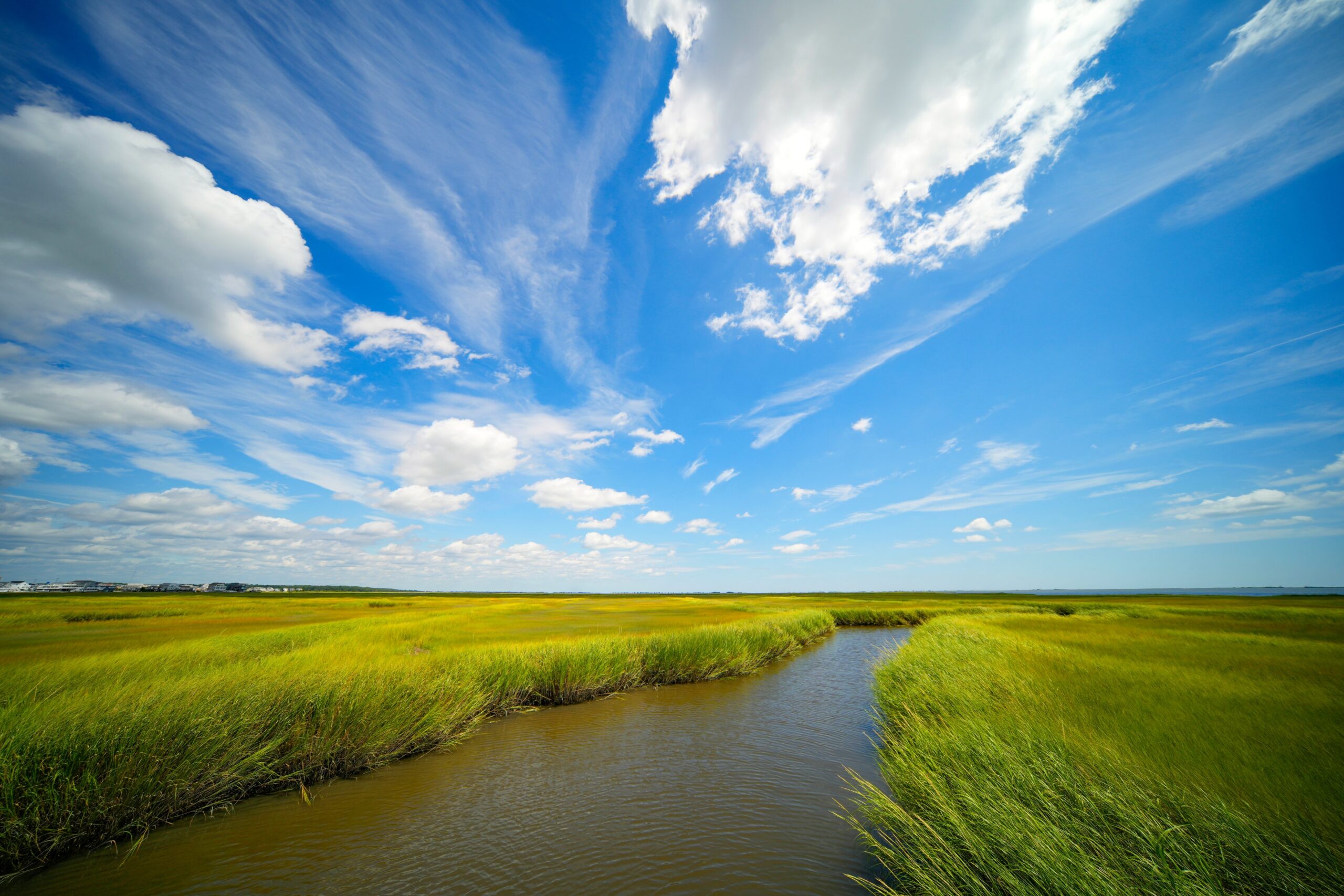
Multiple state, local and federal agencies are working with the conservancy to rebuild damaged salt marshes using dredged soil from the boat channels. Zito-Livingston said it’s a perfect solution, and very simple. The grass seeds are already in the mud vacuumed from the bottom of the channels, and will regenerate the marshlands without much intervention.
“So, it’s kind of a win-win,” she said. “They need to do something with that mud, and we need the coastal restoration.”

Never miss a moment with the WHYY Listen App!


WHYY is your source for fact-based, in-depth journalism and information. As a nonprofit organization, we rely on financial support from readers like you. Please give today.
Part of the series
Anglers warned to not eat PFAS contaminated fish from the Wissahickon watershed
Environmental regulators found high levels of PFAS chemicals in fish tissue sampled from the Wissahickon Creek and its tributaries.
22 hours ago
Listen 1:04
Hydropower parts manufacturer in Northeast Philadelphia lands federal research partnership
Kingsbury plans to test new materials for hydroelectric power equipment that can support the needs of modern-day grids.
4 days ago
Listen 1:09
EPA announces new plan to clean up arsenic contamination at Vineland chemical site
The Vineland Chemical Company produced arsenic-based herbicides and fungicides for 45 years, causing widespread contamination.
4 days ago
Listen 0:53