
Do masks protect me from wildfire smoke? Experts say yes — with some caveats
N95 masks are designed to filter out the particles released during wildfires.


FILE - A product stall filled with free N95 respirator masks, provided by the U.S. Department of Health and Human Services, sits outside the pharmacy at this Jackson, Miss., Kroger grocery store, Wednesday, Feb. 2, 2022. (AP Photo/Rogelio V. Solis)
This story is part of the WHYY News Climate Desk, bringing you news and solutions for our changing region.
From the Poconos to the Jersey Shore to the mouth of the Delaware Bay, what do you want to know about climate change? What would you like us to cover? Get in touch.
Health officials are urging people to limit their time outdoors as smoke from hundreds of wildfires burning in Canada and northern Minnesota continues to blanket the region with dangerous levels of air pollution.
The Philadelphia area was under a Code Purple Air Quality Alert on Friday morning, meaning levels of particulate matter are dangerous to everyone.
People with health conditions, including respiratory and cardiovascular problems, as well as children and the elderly are urged to take extra precautions.
Those who must go outside should wear a mask, health experts say. N95 masks, when fitted properly, are designed to filter the fine, tiny particles that are less than 2.5 microns in diameter known as PM 2.5, that are polluting the air across the region.
“The level of air pollution is bad enough that it’s going to affect people both with and without significant lung issues,” said Dr. David Manoff, chief of pulmonary and critical care medicine at Temple University Hospital – Jeanes Campus.
PM 2.5 are 30 times smaller than the width of human hair, and are easily inhalable. The particles can settle deep in the lungs and enter the bloodstream.
People with cardiovascular and respiratory conditions are more likely to experience worsened symptoms, and are more prone to develop infections like pneumonia. People who are otherwise healthy could be impacted by the smoke, health experts say.
“If you have to go out, the city’s recommendation to wear an N95 if you can, is probably a pretty reasonable one,” Manoff said.
Related Content
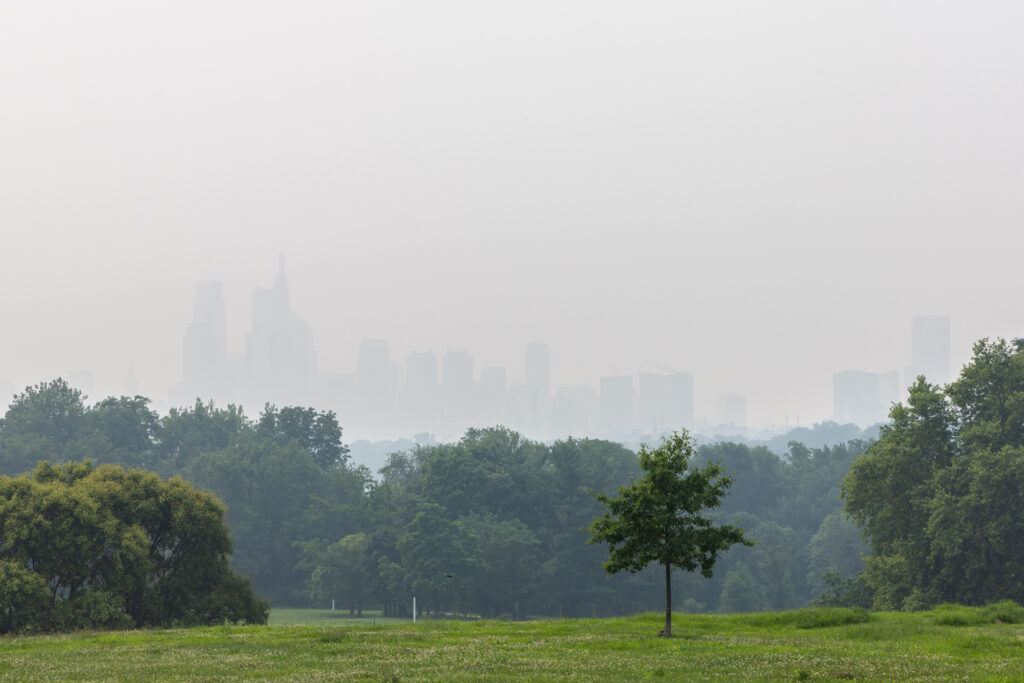
Philly pools closed, trash pickup canceled due to very unhealthy air
Wildfire smoke is bringing very unhealthy air pollution to the Philadelphia region. Officials say everyone should avoid optional outdoor activities.
3 months ago
Listen 0:58Get a mask ‘fit check’
N95 masks are sold in different sizes, and it’s important people choose the size that’s snug. Mask-wearers can twist the strings to get a closer fit, and squeeze the metal band around the nose.
“When you exhale, that mask should pop out a little bit. When you inhale, it should pull back in towards your mouth,” said Jane Clougherty, professor of environmental and occupational health at Drexel University Dornsife School of Public Health.
“That’s just reaffirming that the air you’re breathing is really coming through the mask itself,” she said. “You’ll feel that pressure change inside the mask itself. If that mask isn’t moving with you, you’re just drawing air from around the mask.”
Surgical masks are better than nothing, but they’re not as effective as N95 masks because they’re not designed to filter out PM 2.5, Manoff and Clougherty said.
The experts said there are some caveats — people with beards won’t achieve the same level of protection from N95 masks because facial hair prevents them from being as snug as they should. Still, wearing one is better than having no protection, they said.
When inside, experts advise people to use a HEPA filtration system to remove particles from the home, keep doors and windows closed and avoid outdoor exercise.
At least 17 states have issued air quality alerts, including Pennsylvania, New Jersey and Delaware.
A report by the New Jersey Department of Health found a spike in emergency room visits for new diagnoses of asthma when the 2023 Canadian wildfires led to poor air quality for several days in New Jersey, Pennsylvania and Delaware.
Scientists say climate change could cause an increased number of wildfires, as regions further north like Canada become hotter. High temperatures can also dry out trees and plants, increasing the risk of forest fires. Trapped stagnant air can make these conditions and air pollution worse.

Get daily updates from WHYY News!
WHYY is your source for fact-based, in-depth journalism and information. As a nonprofit organization, we rely on financial support from readers like you. Please give today.
Part of the series
Straight ‘F’s: Philadelphia region’s air quality ranking worsens in annual lung health report
The American Lung Association says the Philly area is among the worst in the country for levels of a pollutant that can cause lung and heart issues.
6 months ago
Listen 1:08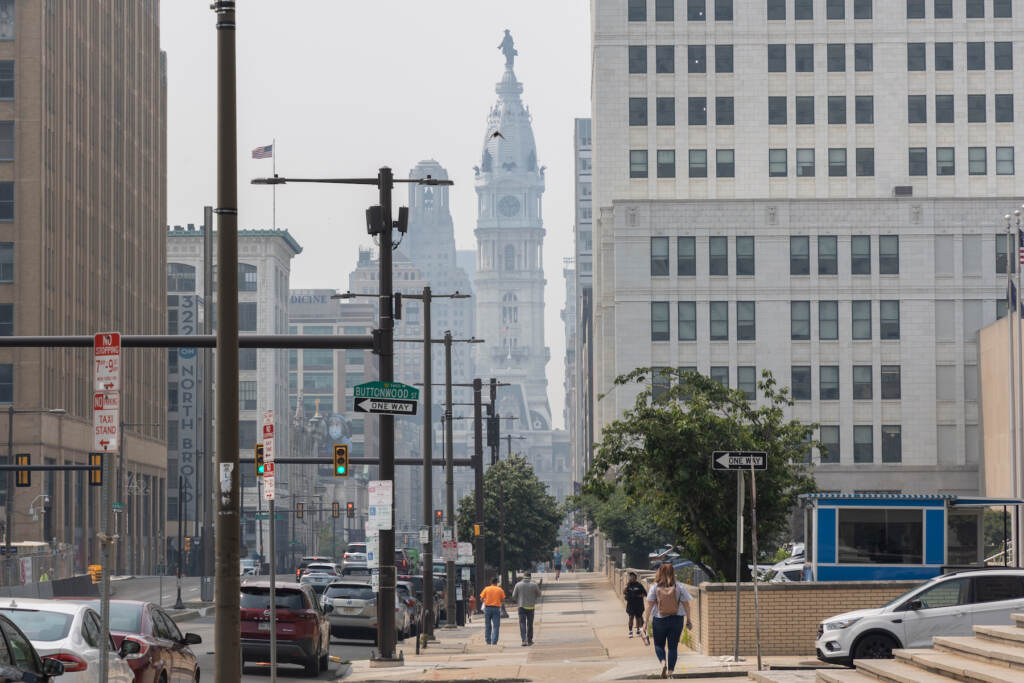
New network of 76 air monitors throughout Philadelphia provides detailed look at air quality
The network will offer hourly air quality index updates posted to a new website, Breathe Philly.
8 months ago
Listen 0:59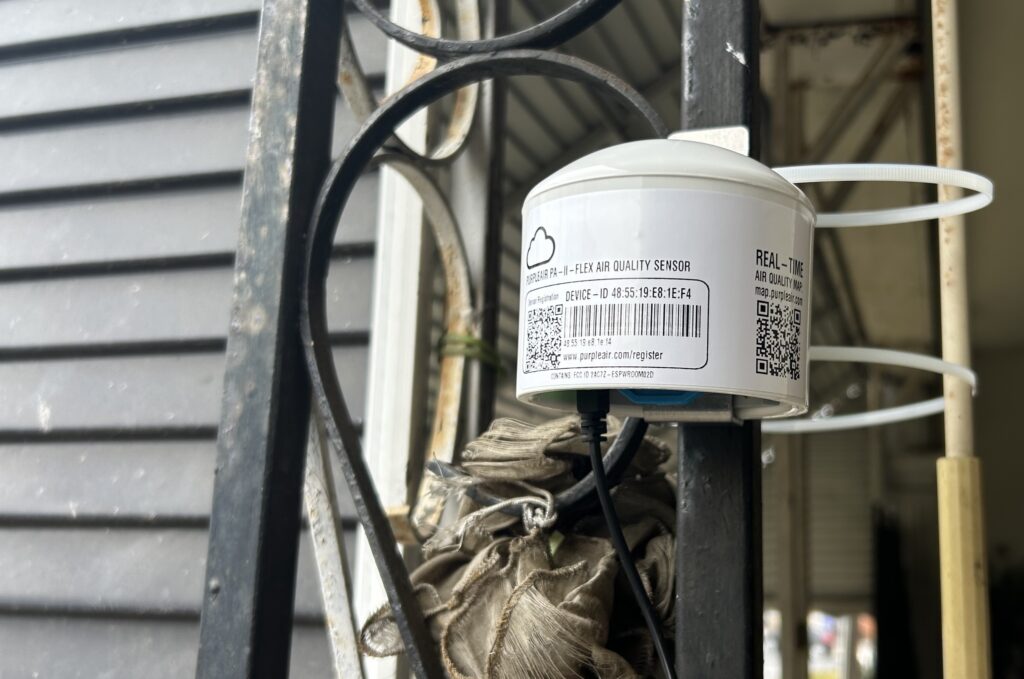
Philadelphia residents are tracking air quality and pollution from their rowhouses in real time
With the fate of EPA regulations uncertain, advocates say local environmental protection efforts, like a community air monitoring network, are increasingly important.
1 year ago
Listen 3:15