
Philadelphia gave America its first major musical oratorio in 1781. Then it got buried in poop
Tempesta di Mare is presenting a fully orchestrated “America Independent, or The Temple of Minerva” as it has never been done before.
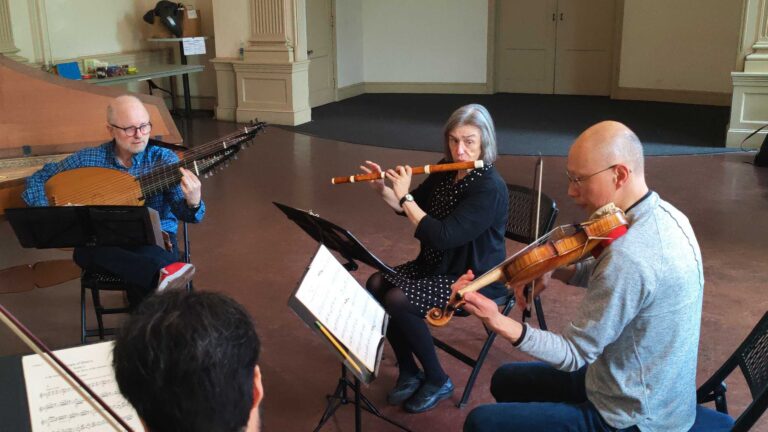
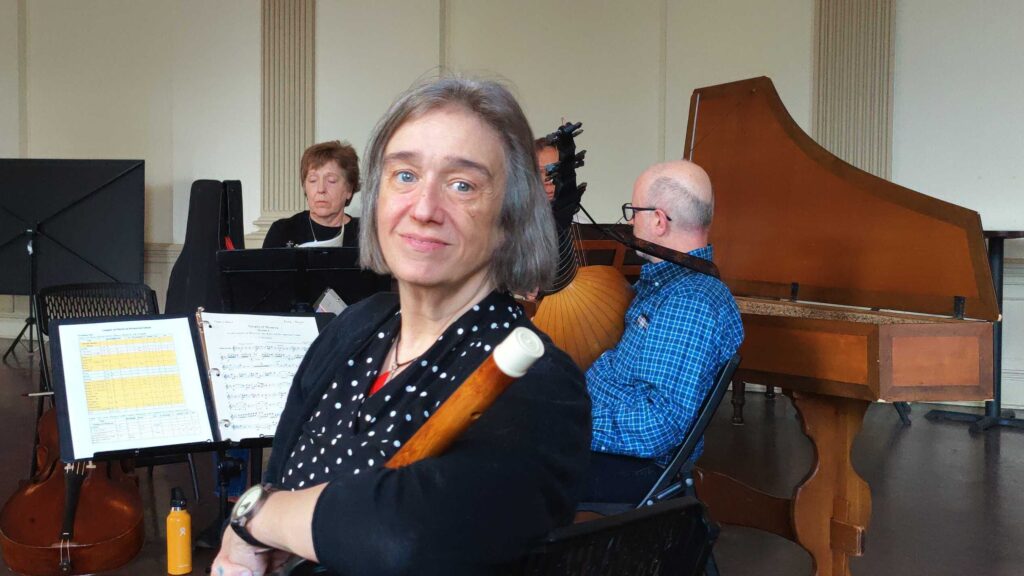
Gwyn Roberts, center, rehearses "The Temple of Minerva" with Tempesta di Mare's principle players Richard Stone on lute (L) and Emlyn Ngai on violin (R) at Christ Church Neighborhood House. (Peter Crimmins/WHYY)
From Philly and the Pa. suburbs to South Jersey and Delaware, what would you like WHYY News to cover? Let us know!
To celebrate the nation’s 250th anniversary, Philadelphia-based early music ensemble Tempesta di Mare is reviving what it calls the first grand musical gesture of American independence: “America Independent, or The Temple of Minerva,” by Francis Hopkinson.
The ensemble will perform the oratorio, written by the Declaration of Independence signer and noted composer, on Thursday, May 14, at Arch Street Meeting house, as part of its “Soundtrack of Independence,” a series of concerts of early American music. Co-director Gwyn Roberts said Hopkinson’s composition is a pastiche of music popular at that time.
“He took music that was written by two of the absolute favorite composers in America at the time, Handel and Arne, from preexisting popular operas and oratorios,” she said. “This was a way of communicating both to a public, but also to some very specific invited guests who were in charge of both the French and the American armies, what his sentiments were.”
On Dec. 11, 1781, Gen. George Washington with his wife Martha, Maj. Gen. Nathanael Greene with his wife Catherine, and selected others were received by the French diplomat in Philadelphia, Maj. Gen. Anne-César de La Luzerne, to hear “The Temple of Minerva.” It was barely two months after Washington’s victory at Yorktown. That night, the Roman goddess Minerva delivered a hopeful prediction to a war whose end was in sight.
“She with France in friendship joined
Shall opposing powers defy
Thus united, thus combined
Heaven will bless this sacred tie.”
The performance at the time was likely modest, a small chamber ensemble with a limited audience. Hopkinson later admitted it was “not very elegant poetry, but the entertainment consisted in the music and went off very well.”
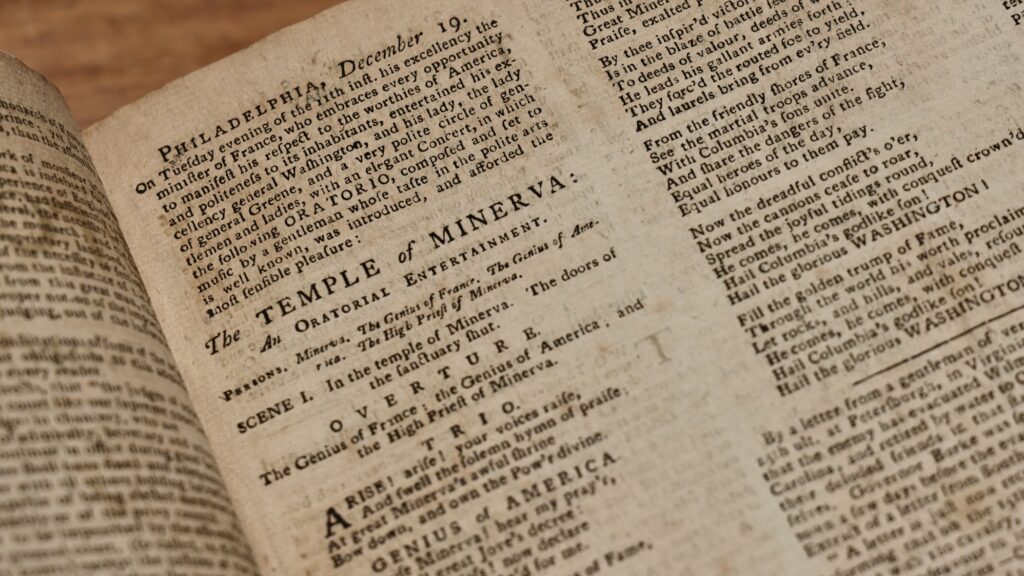
The oratorio then disappeared for almost 200 years. The reasons why are a bit icky.
Related Content
Wild Horizon festival plants a flag for circus performance in Philadelphia
With the loss of Germantown's Circadium school, a new festival is trying to establish Philly as a hub for contemporary circus.
5 months ago
Listen 1:07Lofty sentiments drowned in toilet humor
In the audience was a covert British sympathizer who found the oratorio “full of fulsome flattery and adulation to the French and Washington” and dashed off a parody version, rewriting the libretto as “The Temple of Cloacina,” after the Roman goddess of sewage. The anonymous satirist published the parody in the loyalist New York newspaper The Royal Gazette.
“The libretto is amazingly scatological,” Roberts said. “It is full of the most impressive 8-year-old-boy-style potty humor that I have ever read.”
The parody describes the temple of Cloacina as a “Little-House,” i.e., an outhouse, in which supplicants enter to address the goddess:
“Strain hard! Strain hard! Your voices raise,
And swell your croaking throats with praise,
At Cloacina’s stinking shrine
Squat down, and own you grunt like swine.”
Hopkinson would not let that go. He dashed off his own satire of his satirist, parodying the parody in a local paper. He said the first parody was so filthy it was “not fit to be touched.”
“Let me have it,” Hopkinson wrote. “I will clean it with a stick; I will scrape it with an oyster shell; I will wipe it with a handful of shavings.”
That merited a counter response, parodying a parody of the parody, triggering a mud-slinging match in the pages of newspapers.
“Public culture in early Philadelphia was back-and-forth. You could get in the face of people you disagreed with,” said John Pollack, a curator at the University of Pennsylvania’s Kislak Center for Special Collections, where Hopkinson’s papers are archived. “Hopkinson would have been skilled at what you might call the art of satire.”
Related Content
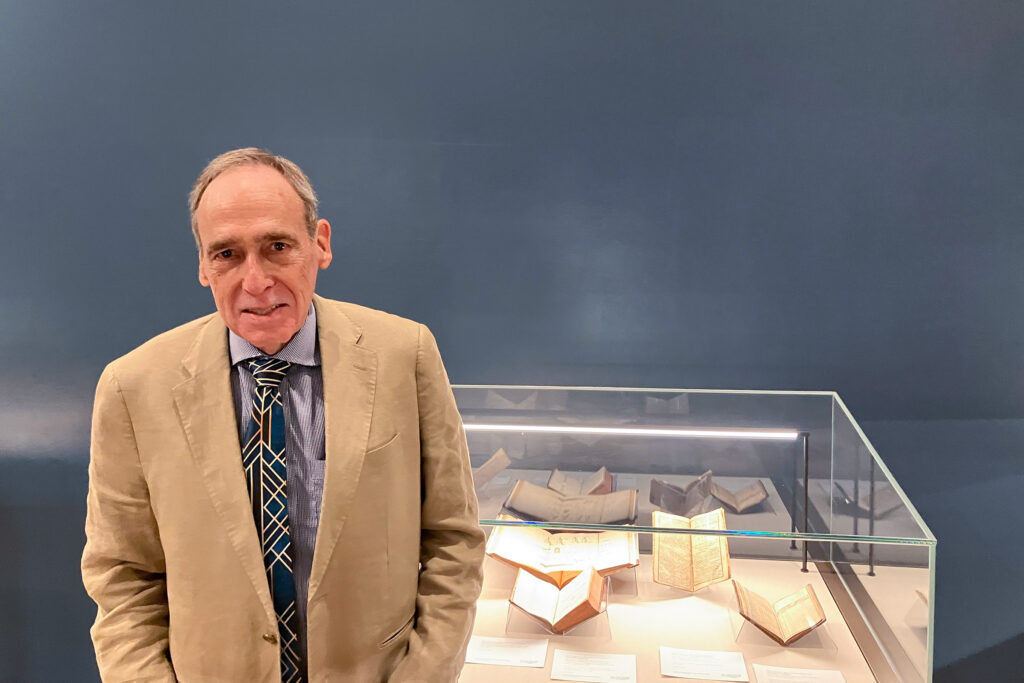
Highlights from the Jay T. Snider collection of Benjamin Franklin are on display at The Library Company of Philadelphia, before heading to auction at Sotheby’s.
5 months ago
Listen 1:14The joke that went too far
Hopkinson was at the center of political and cultural life in Philadelphia, as a respected musician who composed music and avidly collected the music of his contemporaries. Fifteen books of his music collection are archived at the University of Philadelphia, where he was a member of its first graduating class in 1757.
“We often think about artists and politicians in separate fields, whereas Hopkinson demonstrates, basically, that you can be everything,” said Jim Duffin, an assistant archivist at Penn. “He was very much an artist in the sense that he composed music, he wrote plays, he wrote satires and poems. He was also an illustrator. He designed the Great Seal of the United States.”
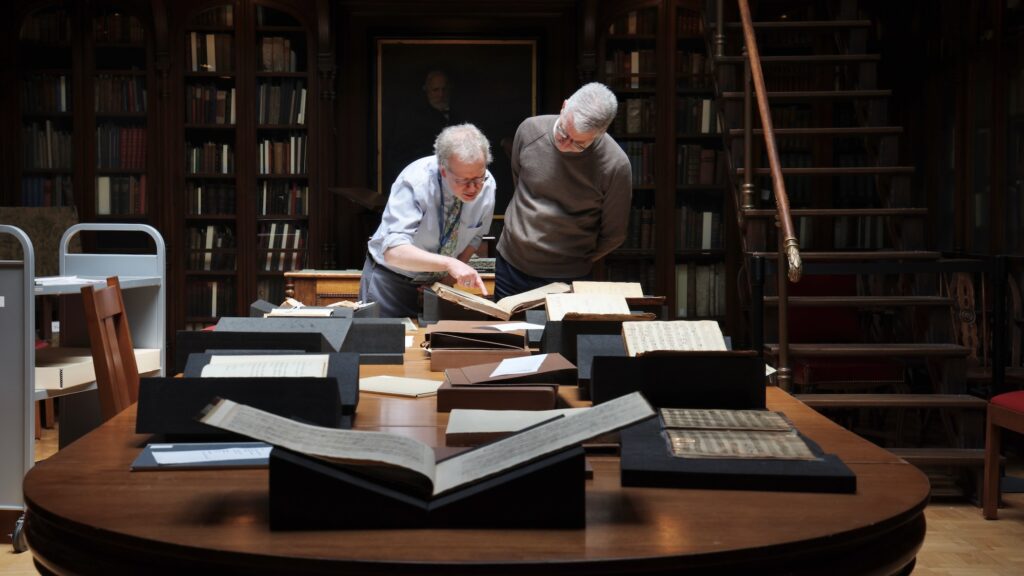
Hopkinson also designed the American flag and wrote poems advocating for the ratification of the U.S. Constitution.
“He could bring in a sensibility as an artist and a creative mind into these discussions about the Declaration of Independence and the Constitution,” he said.
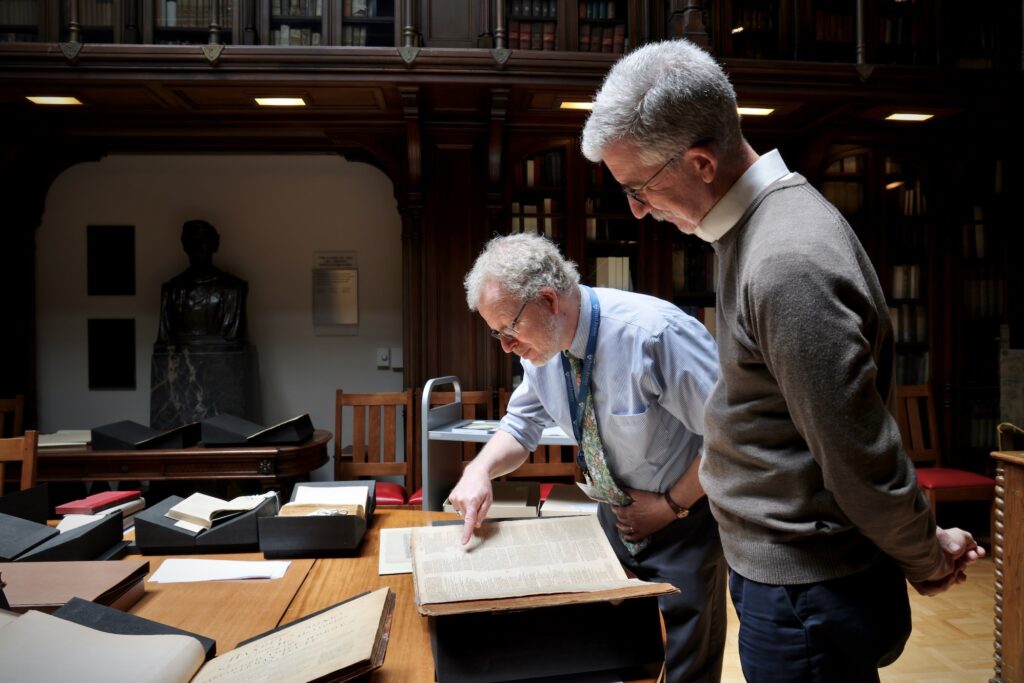
As an elite member of Philadelphia’s upper class, Hopkinson felt his very public and very crass spat in the newspapers over his oratorio had gone too far. The solemnity of his “Temple of Minerva” had been besmirched.
“The back-and-forth got to him,” Roberts said. “He eventually wrote to Benjamin Franklin that he felt that this oratorio he had written was no longer ‘elegant,’ was the word he used, and excluded it from both his poetry collection and his music collection.”
The piece was never performed again in his lifetime and was lost to history for the next 195 years.
Related Content
In Philadelphia, a new exhibit shows American independence was not inevitable
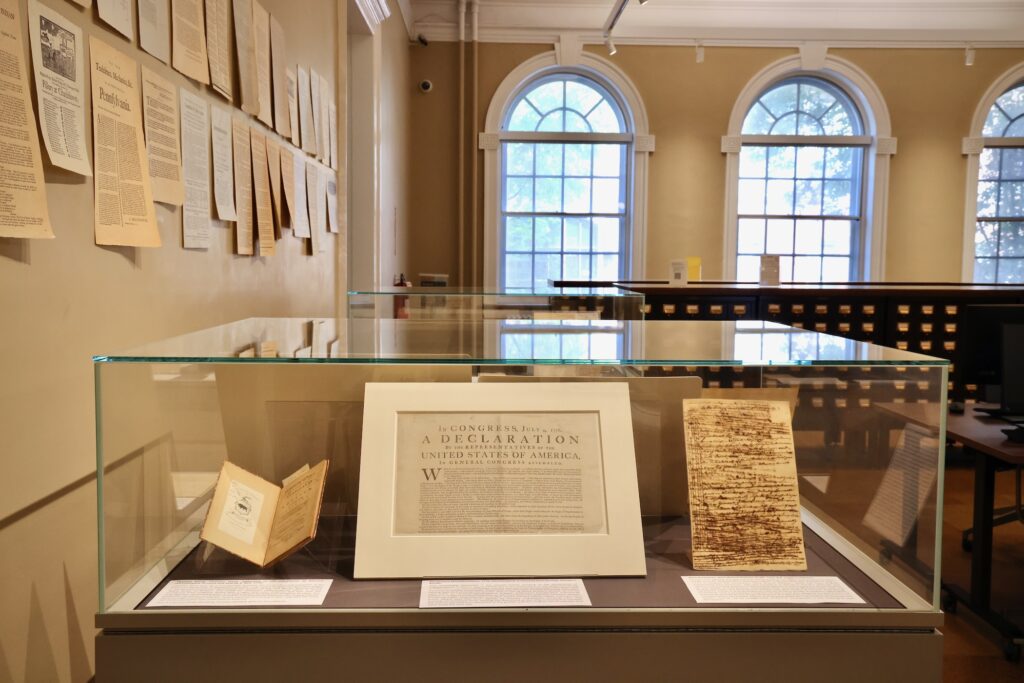
The Historical Society of Pennsylvania traces colonists' fractured, decadeslong shift from loyalty to rebellion.
5 months ago
Listen 1:27A timeless American message
“The Temple of Minerva” was revived in 1976 for America’s bicentennial based on a discovered copy of the libretto with the hand-written notes suggesting the intended music, presumed to be penned by Hopksinson. Historian and musician Gillian B. Anderson performed the piece with singers and instrumental accompaniment for the bicentennial.
The Tempesta di Mare’s concert, with more than 20 musicians, including period-authentic harpsichord and lute and four singers, is likely the largest ensemble to have ever performed “The Temple of Minerva.”
The oratorio was conceived at a time when the new nation was trying to distinguish itself from England politically, economically and culturally. But music complicated that secession, because many former colonists had deep personal connections to European culture, particularly music. Pollack said Hopkinson, himself, continued to collect new English music, even as he fervently called for independence.
“To us that may sound odd: ‘Wait a minute. We’ve just kicked those guys out. How can we still be playing their music?’ We may be separating politically, but that doesn’t mean we have to reject everything that connected us as a people for generations,” Pollack said.
Tempesta di Mare’s revival of “The Temple of Minerva” is a faithful recreation of the past and a call to the present. Although filled with “fulsome flattery,” Minerva’s wisdom for the United States still resonates 250 years later, Roberts said.
“Fate confirms the great decree;
If her sons united stand
Great and prosp’rous shall she be.”
“That is an important message still,” Roberts said. “What we need for our experiment — which I think many of us have concerns about for important reasons even now — what we need is a sense of unity. If that is something that we can come to, then let us hope that Minerva is correct.”
“America Independent, or The Temple of Minerva” will be performed by Tempesta di Mare on Thursday, May 14, at Arch Street Meeting House in Philadelphia, in a program with George Handel’s “Water Music” in F Major. It is part of the “Soundtrack of Independence” series of concerts.

Get daily updates from WHYY News!
WHYY is your source for fact-based, in-depth journalism and information. As a nonprofit organization, we rely on financial support from readers like you. Please give today.
The city’s free July Fourth concert on the Parkway is still on. Organizers say Saturday's star-studded show will happen rain or shine.
3 months ago
5 concerts in the Philadelphia region not to miss in July
With summer concert season in full swing, live music is heating up in July. Here are five acts to catch when they come through the region.
3 months ago
The Philadelphia-based band’s sophomore LP comes after pushing through a period of writer’s block and some restarts in the recording process.
7 months ago
Listen 1:33