

Philadelphia’s Pig Iron Theatre has survived 30 years of critics. We asked its co-founders to respond to some
For 30 years Pig Iron has created original theater that has delighted and disoriented audiences. Critics sometimes didn’t get it.
Listen 3:14
From Philly and the Pa. suburbs to South Jersey and Delaware, what would you like WHYY News to cover? Let us know!
Pig Iron Theatre has turned 30 years old.
As one of Philadelphia’s most prominent experimental theater companies, Pig Iron is celebrating with a full season of performances in Philadelphia, starting at the Wilma Theater with a reprise of “Poor Judge,” a play that premiered last fall based on the song of Aimee Mann.
“Poor Judge” is co-created by Dito van Reigersberg, who also plays a central role. But due to a medical issue, he will not be starring in this production at the Wilma Theater. Instead, Pax Ressler will be playing the part for the run of the show.
Pig Iron typically does not plan a season of shows, preferring to stage one show, usually during September’s Philly Fringe Festival, and touring other shows as the traffic will bear.
Thirty years of originally devised theater means 30 years of plays that could leave audiences sometimes delighted, sometimes scratching their heads. Oftentimes both.
Over the last three decades theater critics have described Pig Iron shows as “banal,” “stunning,” “grotesque,” “gleefully mindless,” “antiverbal,” “spot-on perfection” and “One Big Goof.”
We asked two of the company’s co-founders, Quinn Bauriedel and Dan Rothenberg, to respond to selected published reviews of their shows over the last 30 years.
Related Content

Philadelphia’s Pig Iron Theatre will revive a Rube Goldberg machine contest this spring
The Philadelphia Contraption Contest went dormant during the pandemic. It took an experimental theater company to bring it back.
3 months ago
Listen 1:21‘Poet in New York’ 2000
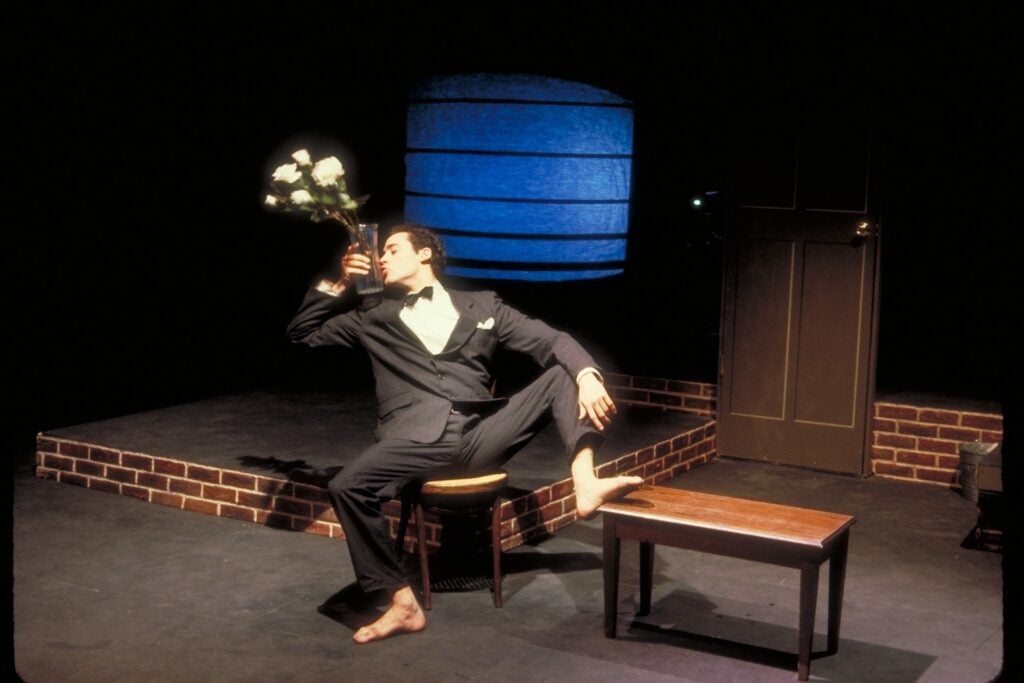
“Dito Van Reigersberg…playing 11 characters…truly shines. Highly stylized movement, effective and atmospheric sound/lighting, and an inventive set dull in comparison with the stunning performance. The performer’s evident interest/obsession with the young gay poet makes Poet in New York very special.” – The Herald (Scotland)
Bauriedel: “That play had one of the longest lives. Dito performed it for 10, if not 15 years.”
Rothenberg: “It was a beautiful piece, a real showcase for Dito playing these characters. There’s almost no monologue. It’s a one-person show that’s almost entirely dialogue. Dido would switch character and talk to himself. That was part of the virtuosity that people responded to.”
Bauriedel: “Each character is inspired by an animal.”
Rothenberg: “That’s true.”
Bauriedel: “It was his way of distinguishing which character he is in. [Salvador] Dali is a big ape. [Federico Garcia] Lorca is a horse. This woman who has a huge crush on Lorca is a bird. What is Hart Crane?”
Rothenberg: “Hart Crane is a snake.”
‘Shut Eye’ 2002
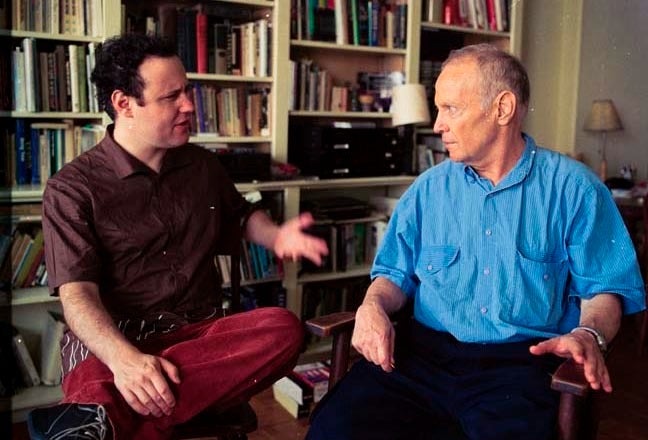
“The piece looks good, and has a touch of Alice in Wonderland absurdity, but it is a case of style over substance. It is banal and bizarre at the same time. … It is as if the company were so excited by what they could do that they forgot about the need to say something interesting.” – Lyn Gardner, The Guardian
Rothenberg: “I feel you could leave any of our shows and give that review.”
Bauriedel: “This one stings.”
Rothenberg: “It was a collaboration with a hero of ours, Joe Chaikin, who was a lion of the downtown New York experimental theater scene and one of the inspirations for us starting the company. Joe came out of retirement and made this piece with us, which mostly got really good reviews.
“But I remember in Edinburgh we got really bit in the butt because I was unprepared for the tech time at that theater. We were not teched with the show. The later reviews from 2002 were positive but the early reviews were all bad because the show was not teched, and because there were no fringe audiences at the early shows. It was, like, old and angry Scottish people. They were not happy with our upstart American hijinks.”
‘Chekhov Lizardbrain’ 2008
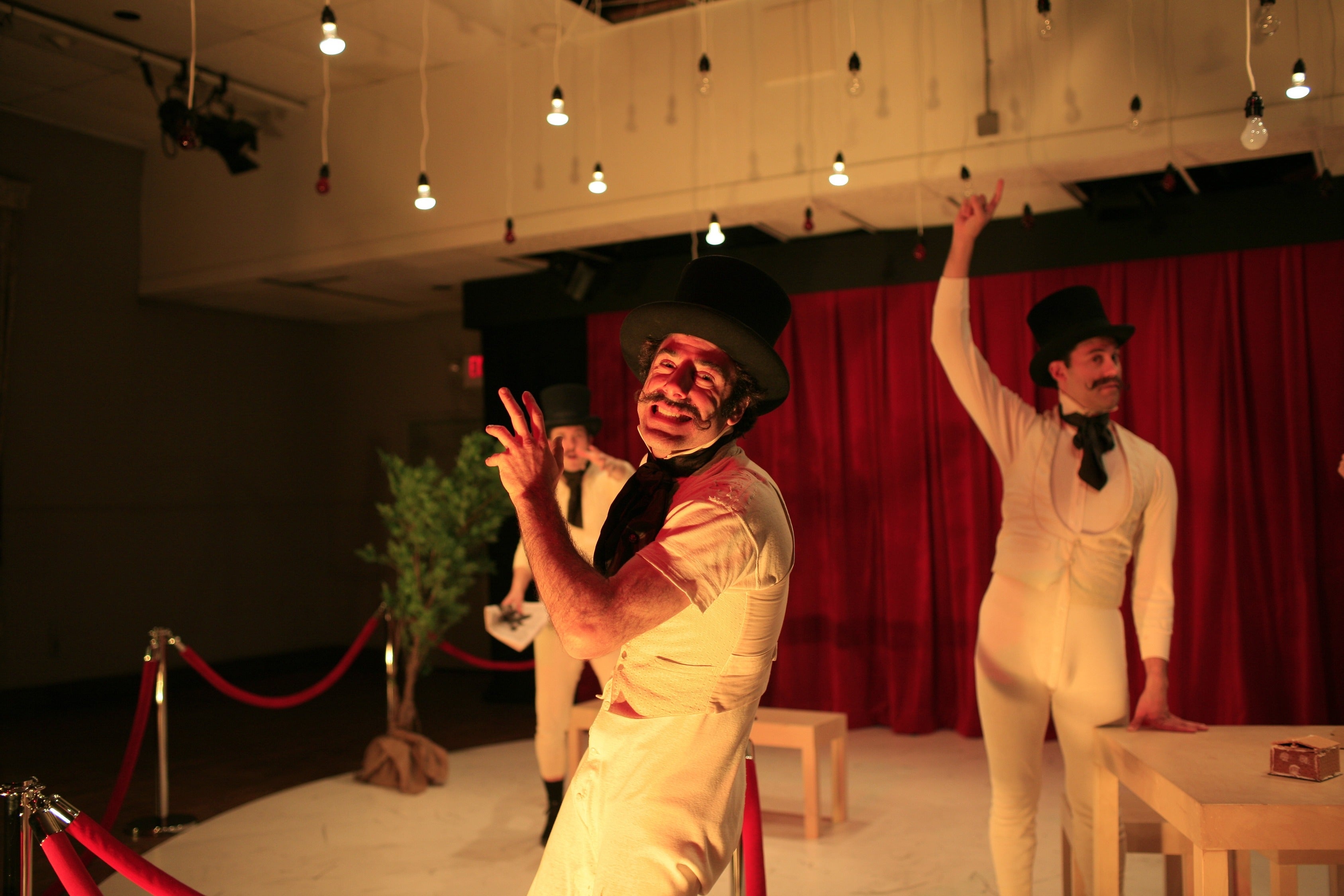
“The members of Pig Iron are masters of the egghead deadpan. Their work has vaudevillian theatricality – slamming doors, bowler hats, and broad physical comedy – with a fertile intellectual subtext.
Is this funny ha-ha? The pliable expressions and expostulation of the cast … draw loud laughter. But this comedy has more to do with Schaden than Freude.” – Liesl Schillinger, New York Magazine
“Nothing’s insisted on and little is stated overtly; the show is almost aggressively undidactic. …The result is a kind of exhilarating despair: Everything in life is hopelessly weird.” – Michael Feingold, Village Voice
Rothenberg: “A word that doesn’t come up in the reviews but that came up a lot in those years is ‘preposterous.’ To explain what the play is, is ridiculous: There’s a guy. He lives in upstate New York. He’s got a Russian name and he has a complete misunderstanding of what Chekhov is.
“In his mind Chekhov is fancy voice, wearing top hats, and using complicated Russian names. That’s his whole understanding of it. He’s imagining Chekhov plays to make himself feel better.
“God, I can’t even explain it.”
‘Hell Meets Henry Halfway’ 2009
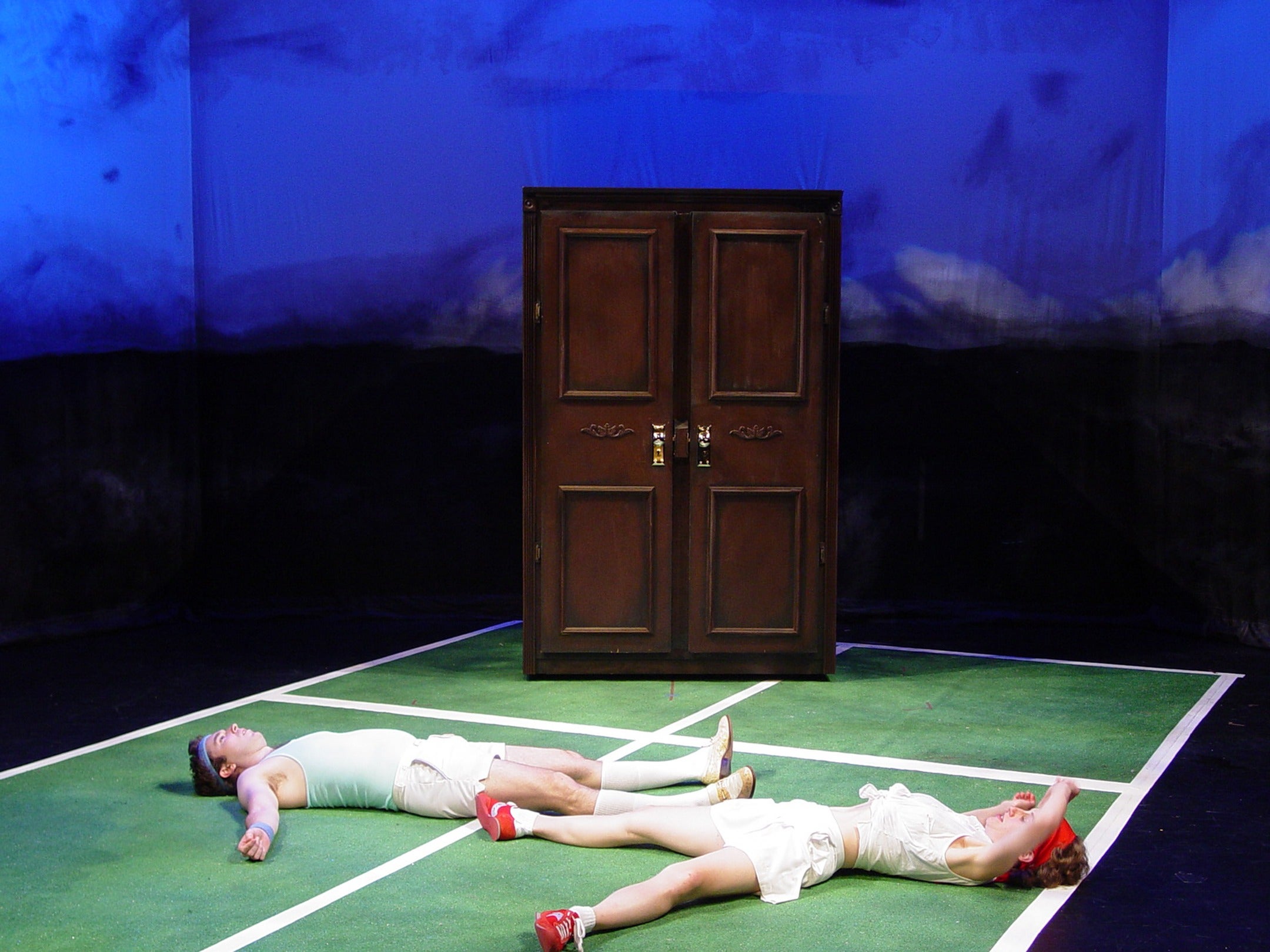
“Not a great deal happens in this play, but I was nonetheless grateful that Hell was willing to make the trip. …This play is as delightful as sin. As pleasing as a self-righteous politician caught in a sex scandal. As wonderful as seeing your high school disciplinarian in a drunken brawl.” – Tim Treanor, D.C. Theater Scene
Rothenberg: “I can’t believe that this person would say not a lot happens.”
Bauriedel: “It’s filled with stuff happening.”
Rothenberg: “The end of the play has the two protagonists spearing themselves on a javelin. They pull a javelin into themselves and they’re still angry with each other and they’re still fighting.”
Bauriedel: “It has everything. There’s sex.”
Rothenberg: “It has tennis. A squirrel gets murdered. I would say this is more full of events than many Pig Iron plays.”
Bauriedel: “Well, Tim Treanor from the D.C. Theater Scene apparently thought that not a lot happens.”
‘Zero Cost House’ 2012
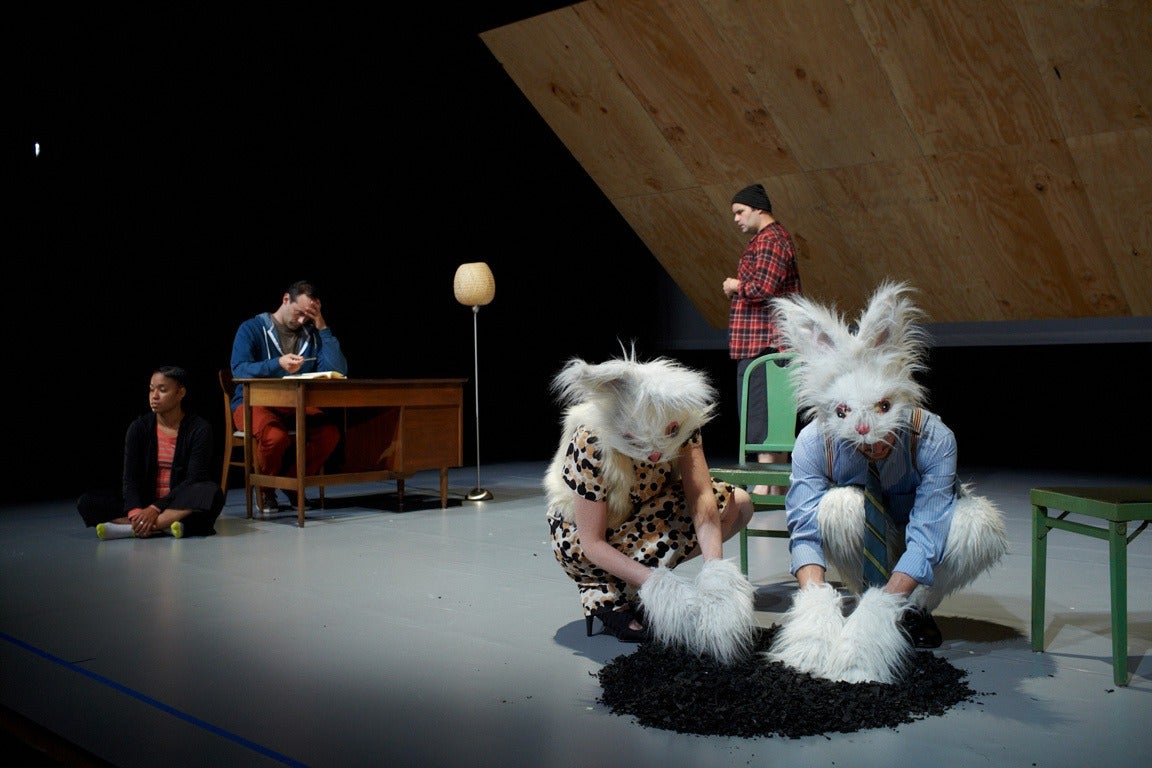
“Dappled with quirky diversions, like a domestic drama within the drama featuring two actors dressed in white bunny costumes, the play is so repetitive and dramatically sluggish that its ideas seem to be written in cement that is slowly drying before your eyes.” – Charles Isherwood, New York Times
Rothenberg: “That is our collaboration with Toshiki Okada, a Japanese playwright who is kind of like the bad boy of Tokyo.”
Bauriedel: “You always said that in one year he won, basically, the Pulitzer Prize and was called the worst playwright Japan has ever created.”
Rothenberg: “Yeah, the critics circle said ‘This is the worst play of the year,’ and then he also got the Kenzaburō Ōe prize.
“Instead of us running around, [this play] was all description spoken to the audience. Never quite becoming drama, just describing what’s going on. I think people were not prepared for that much of a Pig Iron vibe shift.”
Bauriedel: “In context, the year before we had premiered ‘Twelfth Night,’ which was a runaway success. It was gargantuan, beautiful. Everything is fireworks. Everything is dazzling. The music is lush.”
Rothenberg: “We got a lot more, like, normal fans. People who hadn’t come to Fringe shows were, like, ‘I’ll do Shakespeare.’”
Bauriedel: “[Zero Cost House] was the complete opposite register, which I thought was one of the boldest risks.”
‘99 Breakups’ 2014
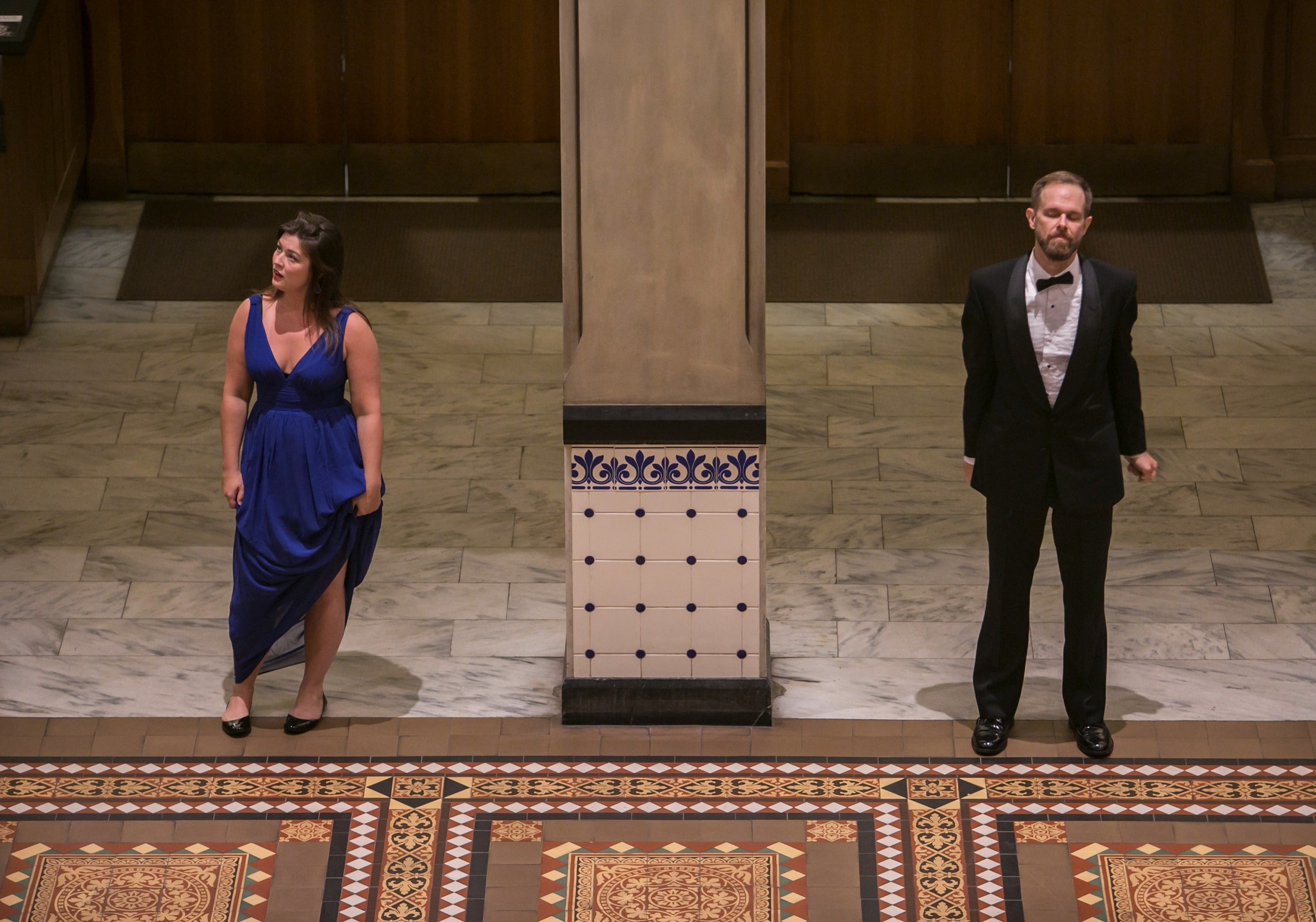
“As we come up the stairs into the main gallery space, a line of sobbing actors … hand every ticket-holder a bedraggled-looking item out of a box.”
“I already tend to feel like Pig Iron asks a lot of us — just getting a ticket to one of their Fringe shows means subscribing to a weeks-long slew of emails instructing you on how to attend the performance, including how you should get there, what to wear, and what you shouldn’t bring. Do I really have to follow the actors around for 75 minutes and carry this darn CD?” – Alaina Johns, Broad Street Review
Bauriedel: “That had a hoax at the beginning which I thought was really fun. Always made me laugh. We started it on the street, on Broad Street. I didn’t realize this at the time, but now I know Broad Street on one half is in one police district and Broad Street on the other half is in another police district. We staged a breakup happening in public out of a car: Car drives up, a couple is having a breakup and she throws all of his equipment out of the car, like papers and stuff, his life goes out onto the street.”
“We told the police district on our side of the street that it was for a performance and that they didn’t need to be fearing it. But we didn’t tell the other side. So the other side watched this and like thought, ‘Oh my goodness, there’s a domestic situation!’”
Rothenberg: “Having done several plays which start with chaos and cars outside the theater, the couple of times that someone actually pulled the fire alarm a lot of audience members are like, ‘You guys with your fake fire alarm.’ And I’m, like, ‘No, this time somebody really pulled the fire alarm. Those are real fire people coming.’”
‘I Promised Myself to Live Faster’ 2015
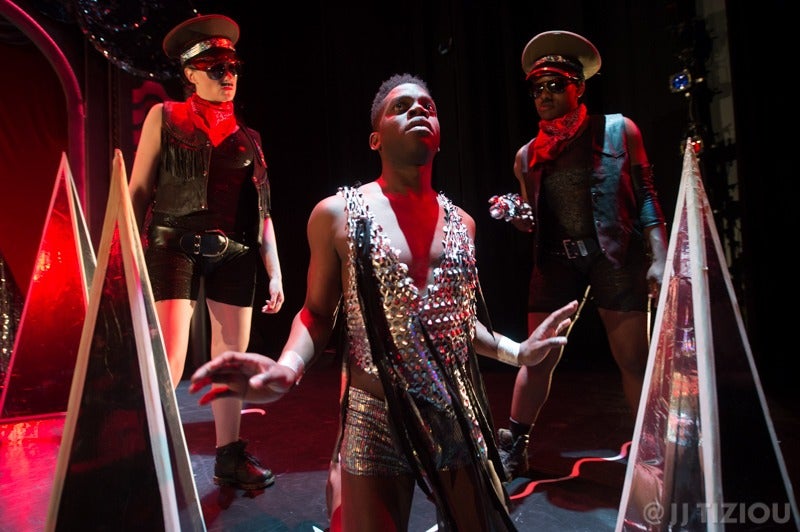
“It is One Big Goof. An absurd sci-fi adventure that says something – according to Pig Iron’s own description – about being gay in 2015. Just what that is, don’t ask me. I couldn’t find a serious bone in the body of the work, and that’s a good thing. Funnybones are at its very foundation.” – Howard Shapiro, WHYY
Bauriedel: “You can read it as just a total romp, but at the core it’s about the gay flame and maintaining the gay flame and what you owe your ancestors. It maybe is hidden to some and overt to others.”
Rothenberg: “Peter [Crimmins] has collected quite a number of reviews that say, ‘Not didactic,’ ‘I like it but don’t understand,’ ‘It definitely says something, but I don’t know what.’ ‘It doesn’t say anything.’ I think that’s a goal.”
Bauriedel: “Sure. We’ll take it.”
Rothenberg: “I don’t think we wanted to make plays that someone would go out and say, ‘I know the message.’ The goal has always been to make theater where it’s, like: ‘I didn’t think I would like something like that,’ or ‘I even didn’t think I was interested in that. But now I do care. Even though I don’t know if I do yet.’”

Saturdays just got more interesting.
WHYY is your source for fact-based, in-depth journalism and information. As a nonprofit organization, we rely on financial support from readers like you. Please give today.
After the fall: Philly arts programs search for a way out of the collapse of UArts
UArts was home to a handful of organizations with various levels of independence. After the dramatic closure, who will survive?
2 years ago
Listen 1:37
After New Year’s, Times Square will become part of a sound art opera
The Prototype opera festival will debut ‘Times3’ by Geoff Sobelle and Pamela Z, a sound art composition about the past, present, and future of Times Square.
5 years ago
Fringe’s ‘Superterranean’ considers the awe and terror of urban infrastructure
“Superterranean” features a forbidding set by Mimi Lien, evoking the awe and mystery of the systems that support urban life.
7 years ago