Philadelphia unions, labor activists use May Day rally to outline a vision for the future: ‘workers over billionaires’
While May Day grew out of the 19th century labor movement, its influence has waned along with union membership. Some Philadelphia leaders see signs of a resurgence.

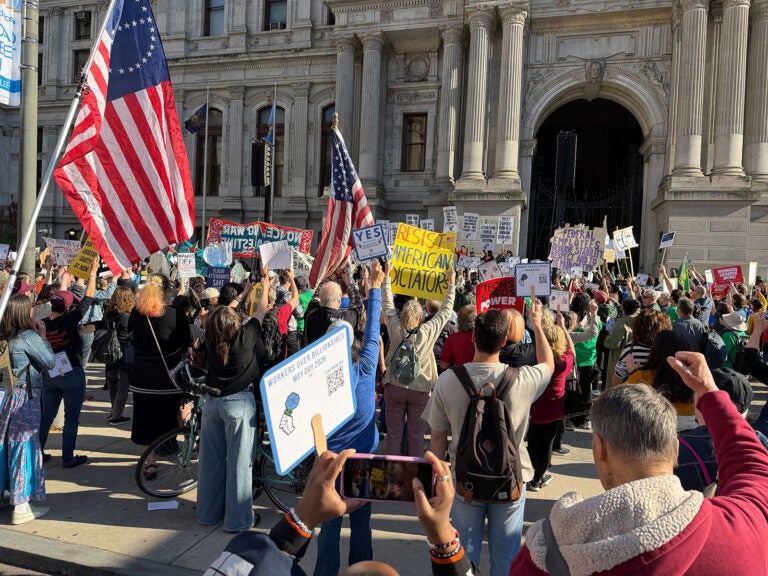
Unions and labor activists rally at City Hall to commemorate May Day, an annual international commemoration of labor struggles, and achievements. (Carmen Russell-Sluchansky/WHYY)
From Philly and the Pa. suburbs to South Jersey and Delaware, what would you like WHYY News to cover? Let us know!
Hundreds of union members, activists and area residents assembled at Philadelphia City Hall shortly before marching west down John F. Kennedy Boulevard to mark May Day, an annual international commemoration of labor and the struggles and gains of the working class.
The rally adopted the theme “Workers Over Billionaires,” a reflection of concerns about recent policies participants say are hurting average Americans. While unions gather for May Day every year, this year drew a broader protest against the Trump administration.
“I’m very distraught about what’s happening in our country and that people with a lot of money are making decisions that impact greatly the rest of our lives,” said Denise Dowell, a retired health care organizer. “I’m distraught that we no longer have a democracy, in my opinion. And I’m a longtime community and union organizer, so I’m motivated to step up and show up.”
A series of speakers from different industries and areas of labor took the stage at City Hall and rallied the crowd, leading chants and a series of votes on a “working people’s vision” of labor goals.
“To truly win the world that we deserve, we need to have a shared vision of what that world looks like,” Susie Person of Glaziers Local 252 told the group. “And now we want all of you to be part of this process by voting to ratify that vision.”
By the end, the platform included 10 planks including demands for a tax on billionaires, a statement that “healthcare is a human right” and a call to preserve public education.
‘Fascismo’ deja vu
The first May Day, also known as International Workers’ Day, was established in the late 19th Century. In 1886, labor activists in the U.S. organized a nationwide push for an eight-hour workday, culminating in protests during which an explosion killed a police officer and wounded others. Eight protestors were charged with inciting violence, seven of whom were executed.
The event, known as the Haymarket Affair, became a powerful symbol of the labor movement and, by 1889, international socialist groups designated May 1 as a day to honor workers and continue the fight for fair conditions. In an effort to subdue the impact of May Day while still honoring workers, the U.S. government established Labor Day in 1894. Unlike May Day, which often carries a more political or protest-oriented tone in many countries, Labor Day in the U.S. has evolved into a more moderate celebration, marked by parades and community events.
“May Day is a historically very important day,” said Julia Orthy, a graphic designer and member of the Democratic Socialists Association, who joined the march. “Currently workers all around the world internationally celebrate May Day. It has its history in the United States [but] it’s not as much celebrated in the United States, and we’re trying to bring it back.”
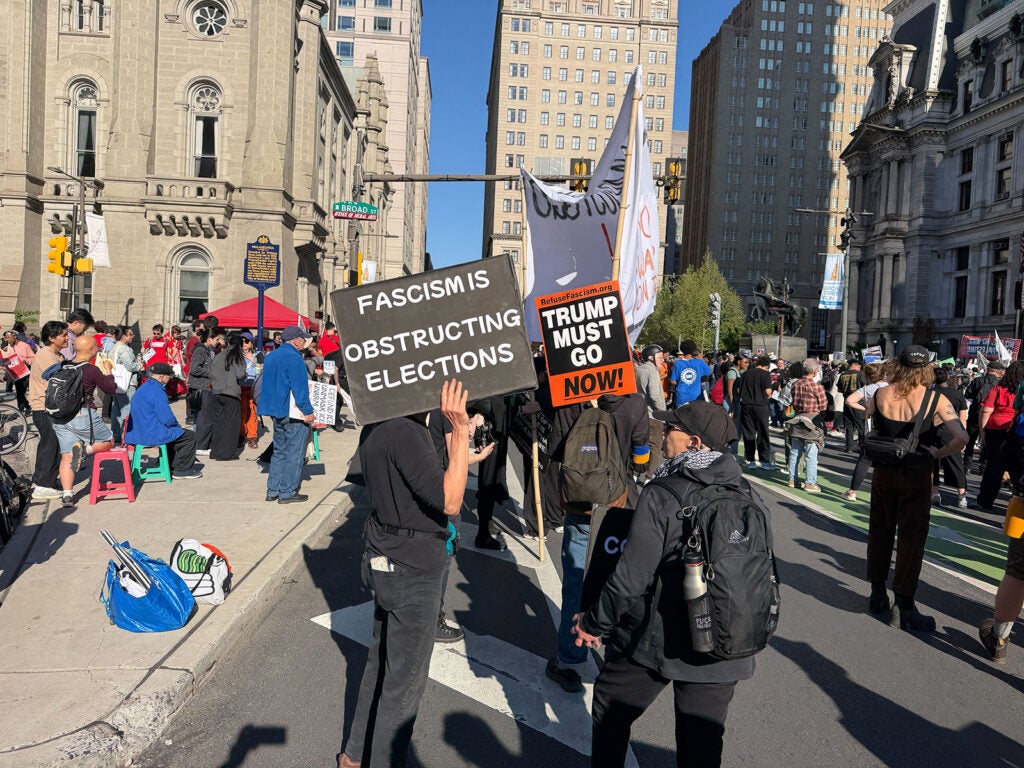
Participants carried signs showing a range of messages. Some included the hammer and sickle, a communist symbol representing the unity of workers and common citizens, and declaring, “Workers of the world unite.” Others railed against “fascism” as an obstruction to fair elections and called for a resistance to “American dictators.” Others called for another impeachment of President Donald Trump, and one referenced “86 47,” a social media meme that former FBI Director James Comey once posted, which led to his recent indictment by the Justice Department.
Miriam Avila, who moved to Philadelphia 30 years ago, joined the rally carrying the flag of her homeland, Peru, to criticize the treatment of immigrants.
“I really wanted to protest against the misery immigrants live in right now. It’s a lot of unjust sins. It’s like to fascismo and abuse of power,” she said, using the Spanish word for fascism. “How many people are dying? Even our Americans in this country. We cannot live like this.”
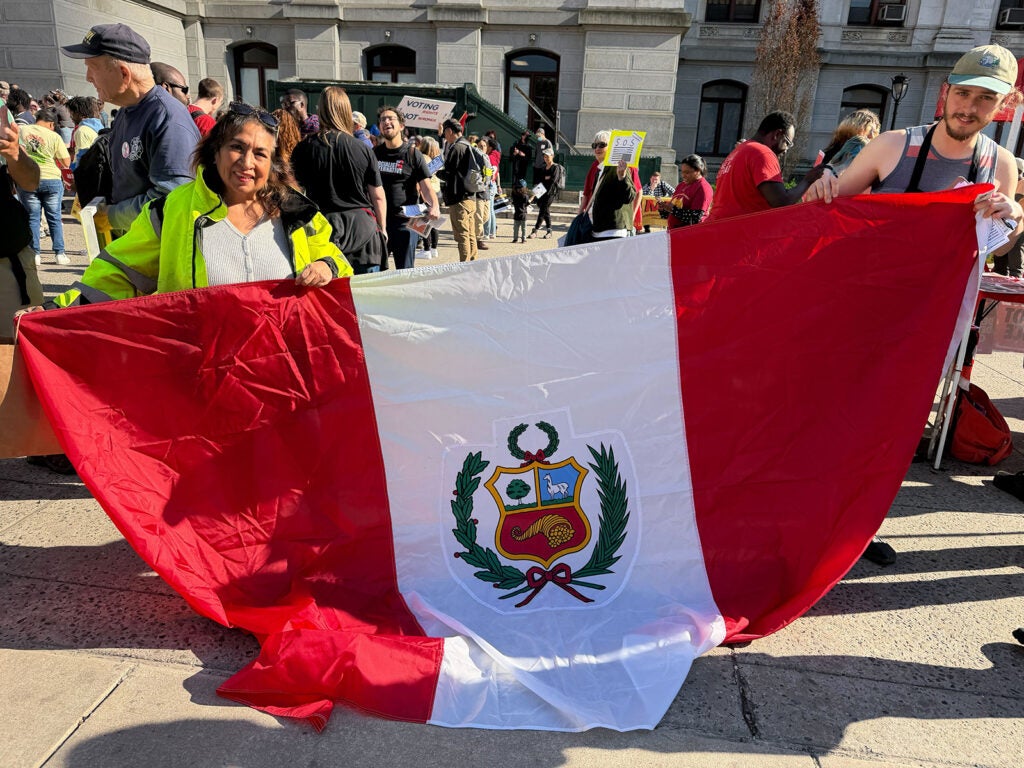
Avila, a retired psychotherapist, said she fears for the U.S. because it is becoming reminiscent of the challenges she faced in Peru.
“I came here because the people don’t respect the life in my country with the terrorism and money,” she said. “But here it’s almost the same right now. I can’t believe it … It’s very sad.”
Related Content
‘Devastated’: Lankenau slated for closure after tense Philadelphia school board vote
A sophomore at Lankenau said she’d rather graduate early or take a GED test than transfer to a different school for her senior year.
4 months ago
Listen 1:10A Philly tradition
Many participants were there to represent their own unions and to show solidarity with the labor movement. This included members of the new University of Pennsylvania graduate student union, formed under the United Auto Workers, who recently reached a “historic” agreement with the university over benefits and worker protections.
Isabel Navarro, a seventh-year graduate student studying bioengineering, said that the contract has already reduced incidents of discrimination and harassment.
“It was amazing to see so many things resolved within a month, basically, of us getting our first contract,” she said. “Suddenly these grievances are dropping, because we have a way to protect ourselves, which we didn’t have before.”
Her colleague, Will Yu, who is originally from China, said the contract also came with practical benefits, such as the university paying for 50% of the cost of medical insurance for dependent spouses.
“Which is a really big issue for international students, because oftentimes, when international students have a spouse or a partner, because of the basic regulations, their spouse could not work in the United States,” Yu said.
Related Content
The judge paused his own order, writing that while the university is unlikely to win its appeal, the delay will not harm a federal investigation.
5 months ago
Listen 0:57Union membership in the U.S. has experienced a long-term decline, falling from a peak of nearly 35% of American workers in 1954 to 9.9% in 2024, with roughly 14.3 million to 14.7 million members. Public-sector workers remain more heavily unionized than their private counterparts.
However, Greg Boulware, president of American Federation of State, County and Municipal Employees District Council 33, said he believes that is changing.
“When you look at what’s going on with the corporations everywhere and what’s going on in the workplaces, where people are being devalued everywhere and jobs are being outsourced, people are now starting to see the value in unions, and they’re growing,” he told WHYY News. “Membership is growing. Organizing opportunities are expanding on a daily basis.”
Boulware added that Philadelphia plays a prominent role in the movement, given its history.
“This is a union city,” he said. “The birthplace of America is here, right? … So we have a responsibility here in Philadelphia to make sure we live up to that standard and… advocate for working people and workers all across this country. And there’s no greater place to do that than here in Philadelphia.”

Get daily updates from WHYY News!
WHYY is your source for fact-based, in-depth journalism and information. As a nonprofit organization, we rely on financial support from readers like you. Please give today.
Strikes begin at 2 Center City Philadelphia hotels
Union contracts have expired at eight Center City hotels, with picket lines forming over the weekend outside the Sheraton and the Hampton Inn.
11 months ago
Listen 0:53
Mayor Parker says white-collar workers’ union deal keeps the city ‘living within its means’
The tentative deal between the city and AFSCME District Council 47 still needs to be approved by union members.
1 year ago
Listen 1:08
The union represents 9,000 blue-collar city employees ranging from sanitation workers to crossing guards.
1 year ago