

‘Devastated’: Lankenau slated for closure after tense Philadelphia school board vote
A sophomore at Lankenau said she’d rather graduate early or take a GED test than transfer to a different school for her senior year.
Listen 1:10
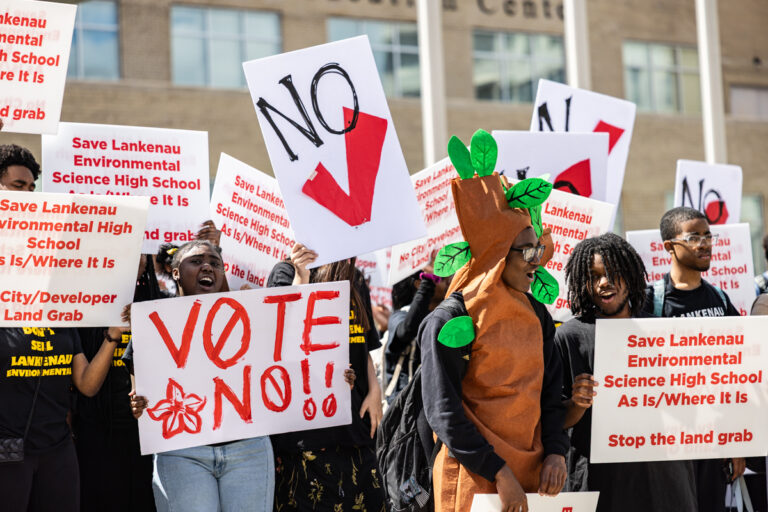
Protesters from Lankenau Environmental High School urged Philadelphia School District Board Members to vote against closing 17 schools in the city. (Kimberly Paynter/WHYY)
This story is part of the WHYY News Climate Desk, bringing you news and solutions for our changing region.
From the Poconos to the Jersey Shore to the mouth of the Delaware Bay, what do you want to know about climate change? What would you like us to cover? Get in touch.
Lankenau Environmental Science Magnet High School in Northwest Philadelphia is slated to close as early as 2027 under the facilities plan approved Thursday by the Philadelphia Board of Education.
Despite pressure from City Council members, students, parents and teachers to preserve the school, the board voted 6-3 to approve the School District of Philadelphia’s $3 billion facilities plan. Protests from City Council members and others forced the board to pause its meeting twice and abruptly move proceedings online.
Alana Rothman, a sophomore at Lankenau who had hoped to graduate from the school in 2028, said she is considering trying to graduate early or earning a GED rather than transferring to a different school for her senior year.
“I’m devastated,” Rothman said. “I’ll miss the people most, I think.”
Lankenau is among 17 schools that will close under the district’s plan to right-size and modernize its building stock to deal with underenrollment and aging facilities. The 10-year facilities plan also includes modernizing 169 school campuses and colocating school programs in six facilities. District officials say it will improve opportunities for students and reduce the number of buildings rated as ‘unsatisfactory’ or ‘poor’ to zero.
Members of City Council promised to reject any future reappointments of school board members who voted in favor of the plan and to do “everything in our legal power” to sue the board over its approval during a Council meeting earlier Thursday. City Council confirms the mayor’s appointments of members to the school board and controls roughly half of the district’s funding.
Related Content

Philadelphia school board approves facility plan, district to close 17 schools
The facilities plan had gone through multiple revisions after backlash from the community.
5 months ago
Listen 1:22‘Sacrificing Lankenau students for the greater good’
District officials say that with around 225 students, Lankenau is enrolled at less than half its capacity, and its remote location in Upper Roxborough makes it expensive to transport students to attend.
But students and teachers say the school has a unique, hands-on environmental science curriculum that depends upon the roughly 400 acres of natural land surrounding the school’s 17-acre campus beside the Schuylkill Center for Environmental Education. The school also boasts a 100% graduation rate, well above the district’s average.
“Lankenau is a good school,” said Dan Rothman, Alana Rothman’s father. “It’s successful. They’re doing well.”
Rothman said he worries Alana’s junior year at Lankenau could also be disrupted if teachers and staff begin to leave for other jobs ahead of the closure.
“I feel like they’re sacrificing Lankenau students for the greater good,” he said.
Board members who criticized the plan Thursday said it lacks a “clear path forward”, would not be financially viable and would not lead to improved academic outcomes for students, but conceded that some school closures are necessary.
“Let me be clear, we do need to close schools,” said school board member Crystal Cubbage, who voted against the plan. “We do need to make hard decisions, and people are going to be upset. But those decisions need to be grounded in a coherent vision that gets us somewhere better.”
The school district plans to fund one-third of the plan’s cost itself through capital bonds, and seek money from state government and philanthropic organizations to cover the remaining two-thirds.
In the face of pushback after the plan was first unveiled in January, the district revised its original plan to merge Lankenau with Roxborough High School and convey the Lankenau property to the city for affordable workforce housing or job creation. The district now plans to convert Lankenau into an honors program within the nearby Walter B. Saul High School of Agricultural Sciences and retain ownership of the property to create an environmental education center for students across the district.
City Councilmember Nina Ahmad said during Thursday’s meeting that Council had not received a “cost-benefit analysis” backing up the decision to close Lankenau and the other 16 schools.
“We’re going to make an environmental center when there’s one right next door, who are begging for the school district to use them,” Ahmad said, referring to the Schuylkill Center for Environmental Education. “What are we doing?”
Erin Mooney, executive director of the Schuylkill Center for Environmental Education, testified during the school board meeting after it was moved online that the district’s plan to turn Lankenau into an environmental education center lacked transparency and would duplicate her own organization’s services.
“It’s like building a Sheetz next to a Wawa,” Mooney said. “It makes no sense.”
After Thursday’s vote, Jonathan Hoffmeier, who teaches algebra and agriculture business at Lankenau, said he felt “extremely frustrated” that school board members did not listen to students who spoke out against the planned school closures.
“They can’t say they support children if they voted ‘yes’ to this plan,” Hoffmeier said.
Lankenau offers a three-year Agriculture, Food and Natural Resources Career and Technical Education Program, which the district has said would transition seamlessly to Saul. District spokesperson Monique Braxton said last month that preserving the school’s signature hands-on curriculum, partnerships, dual enrollment and internship opportunities is a “priority” for the district.
District Superintendent Tony Watlington defended the plan to close Lankenau last week, saying former Lankenau students will get access to the new environmental education center “as often as they need it.”
“We cannot drive faster improvement and at the same time support really small high schools,” Watlington said. “It is just inevitable that we’ve got to reallocate some of our resources.”
The facilities plan could evolve over time. The resolution the board passed Thursday specifies that the board will retain authority to require changes to the plan’s “sequencing, timing, scope, and prioritization of recommendations.”
Last week, Board President Reginald Streater framed the plan as mere “guidelines of where we’re trying to head,” and said more board votes will be necessary to approve specific school closures and capital projects.

Get daily updates from WHYY News!
WHYY is your source for fact-based, in-depth journalism and information. As a nonprofit organization, we rely on financial support from readers like you. Please give today.
Part of the series
Part of the series
In 2025, international student enrollment declined for the first time in years, leading to an estimated $50 million loss for Pennsylvania.
6 days ago
Listen 1:50
Parents sue Central Bucks School District, allege ‘concerted cover-up’ of abuse
A former school board member and his wife say that their 10-year-old son endured “horrific abuses” at the hands of instructors in an autistic support classroom.
1 week ago
Pennsylvania Gov. Shapiro signs legislation guaranteeing 30 minutes of recess to elementary students
The governor signed a bill Wednesday that was approved by the state legislature as part of the 2026-27 budget.
1 month ago