Philly’s COVID-era resource hubs are closing as services move to new centers. Some residents are fighting to keep them
COVID-19 supplies and other public health services at four resource hubs will move to new community action centers at different city locations.
Listen 1:17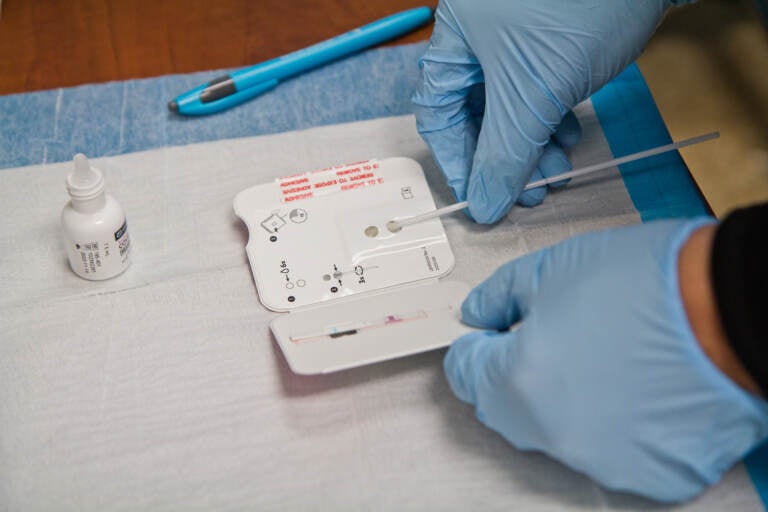
A woman administers a rapid COVID-19 test. (Kimberly Paynter/WHYY)
From Philly and the Pa. suburbs to South Jersey and Delaware, what would you like WHYY News to cover? Let us know!
Philadelphia’s neighborhood resource hubs, which opened as a COVID-19 pandemic measure to increase access to free masks, test kits and hand sanitizer, will close June 17. Some locations also offer food distributions, naloxone, wellness screenings and other public health services.
Federal emergency pandemic relief funding that supported the four centers is expiring, but public health officials say the goal is to maintain services by moving hub operations to the city’s newer neighborhood community action centers.
However, some residents are fighting to keep the hubs, which are located within nearby wellness centers, health organizations and churches, where they are now.
The resource sites have supported people who continue to take precautions against COVID and other health threats, said Remy Campbell, who is an emergency room nurse and has a heart condition.
As a nurse who is frequently exposed to the virus and someone who is at a higher risk of COVID complications due to health issues, Campbell said they continue to mask and test frequently, “and it’s not totally unaffordable, but it’s also not free.”
Campbell discovered the resource hub at Bethany Baptist Church a couple years ago.
“They were giving out free tests and I was like, ‘Wait, what?’ It changed my life so much,” they said.
Dismantling and moving these hubs could create a disruption in services for people who depend on them, Campbell said. Advocates are calling on the city to fund the current locations with other city dollars.
An online petition has garnered about 500 signatures as of June 5 in support of that action.
“What we’re trying to sell to the city on is the idea that, yes, this still matters even though now it’s going to come out of your pocket,” Campbell said. “And that’s what makes it hard. It was a magical service that fell from the sky, and the magic is going away. So, do we have the interest as a city to preserve it?”
If the hubs and services do need to move to the community action centers, which include 10 sites throughout Philly, Campbell said people want to see more communication and transparency from the city on how that will happen.
“What is the plan? We need to see a plan,” they said.
Related Content

Lancaster-based Sun Point Foundation has taken over operations of Council for Relationships. The Philly nonprofit was set to close in May.
4 months ago
Listen 1:11Community demand at neighborhood resource hubs
The resource hubs first started providing in-person COVID-19 testing in underserved communities in November 2021. By January 2022, they began distributing at-home test kits and other supplies. The hubs were designed to bring free services closer to residents and address cost, transportation and other barriers to accessing preventative tools.
In addition to offering free COVID-19 resources, many of the hubs grew their services to include free testing for sexually transmitted infections, fentanyl testing strips and overdose reversal medication, diabetes screenings, pregnancy tests, nicotine replacement therapies like patches and gum, infant cribs, children’s books and more.
They are staffed by the health department and currently located within Bethany Baptist Church in Southwest Philly, Mi Salud Wellness Center in North Philly, Puentes de Salud in Center City and St. Barnabas Community Resource Center in West Philly.
Community members said they worry that people who consistently visit these sites will struggle to access services at new locations.
They’re also concerned the move will bring services out of trusted community organizations like Puentes de Salud, which serves a large population of Spanish-speaking residents.
The city can use its real-time language interpretation program to help non-English visitors, said James Garrow, spokesperson for the city health department. There are also Spanish-speaking staff who can assist in person at certain community action centers.
Health Commissioner Palak Raval-Nelson said she is personally working with Puentes to reassure residents that they will have access to services in one form or another.
“As a non-English speaker, English being my second language, I’m very mindful of those issues,” said Raval-Nelson during a May 4 city budget hearing. “So, I want to make sure that at the end of the day, we have the best solution for the community that needs the Department of Public Health to be there for them.”
Transitioning and growing services at new action centers
The specific types of hub services and resources that will be offered at community action centers will depend on each site’s capacity, as some locations are smaller in scope and size than others, Garrow told WHYY.
“So we’re working to right-size the operations at each of the [action centers] to make sure we can offer the appropriate resources and support based on community needs,” he said. “We acknowledge that not all 10 sites will have as many resources as the current four resource hubs do, but now we’ll be offering resources in neighborhoods throughout the city, as opposed to the current handful.”
The hope is that the action centers will grow and eventually offer a range of public health programs and assistance, starting with resource hub services, Garrow said.
Some health department staff members who’ve been working at the current resource hubs are being moved to other city programs, he said. The department is working to place other hub workers in new roles through internal job fairs and city human resources.
At the end of the day, Campbell said it’s important that people have places they can depend on for free COVID-19 supplies and other public health services to the same or even greater degree they’ve had in the past.
Supporters and visitors of these resource hubs want to be part of the solution, they said.
“The want is there. The organizational drive is there. Just be clear with us about what the options are,” Campbell said.
Get daily updates from WHYY News!
WHYY is your source for fact-based, in-depth journalism and information. As a nonprofit organization, we rely on financial support from readers like you. Please give today.
Part of the series
As they prepare to dole out newly updated booster shots, local health workers are trying to incorporate lessons learned from three years’ worth of vaccine campaigns.
3 years ago
Listen 4:03
Philly officials are trying to spread the word that city health centers have the COVID-19 vaccine available for children under 5.
4 years ago
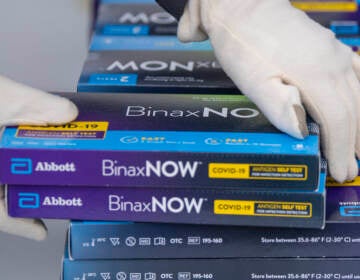
Philly Health Dept. offers free COVID tests to event organizers for distribution
The effort is designed to concentrate on those in areas suffering disproportionately from COVID or people at high risk of transmitting COVID.
4 years ago