

Daughters of the American Revolution honors hospital at Historic Yellow Springs — but can’t officially name any nurses
For decades, descendants of Abigail Hartman Rice have hunted for evidence of their ancestor’s patriotic contribution to enshrine her in the nonprofit.
Listen 1:11
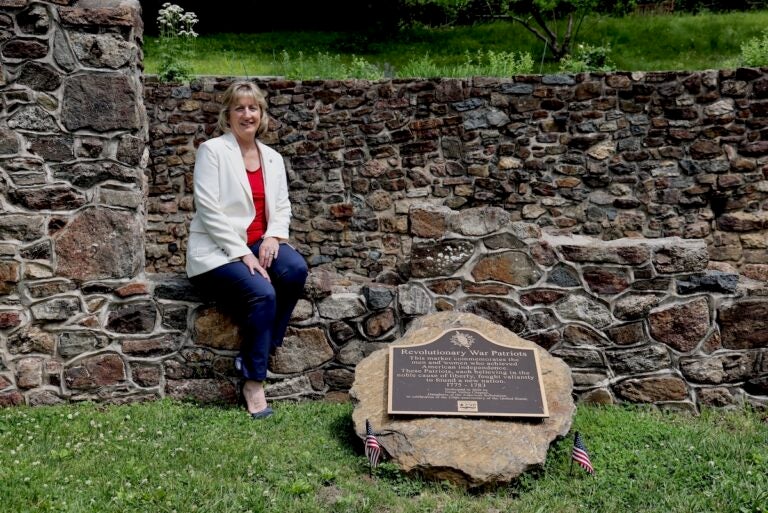
Karen Christen, regent of the Great Valley Chapter of the Daughters of the American Revolution, sits in the ruins of an American Revolutionary War military hospital at Historic Yellow Springs. (Emma Lee/WHYY)
From Philly and the Pa. suburbs to South Jersey and Delaware, what would you like WHYY News to cover? Let us know!
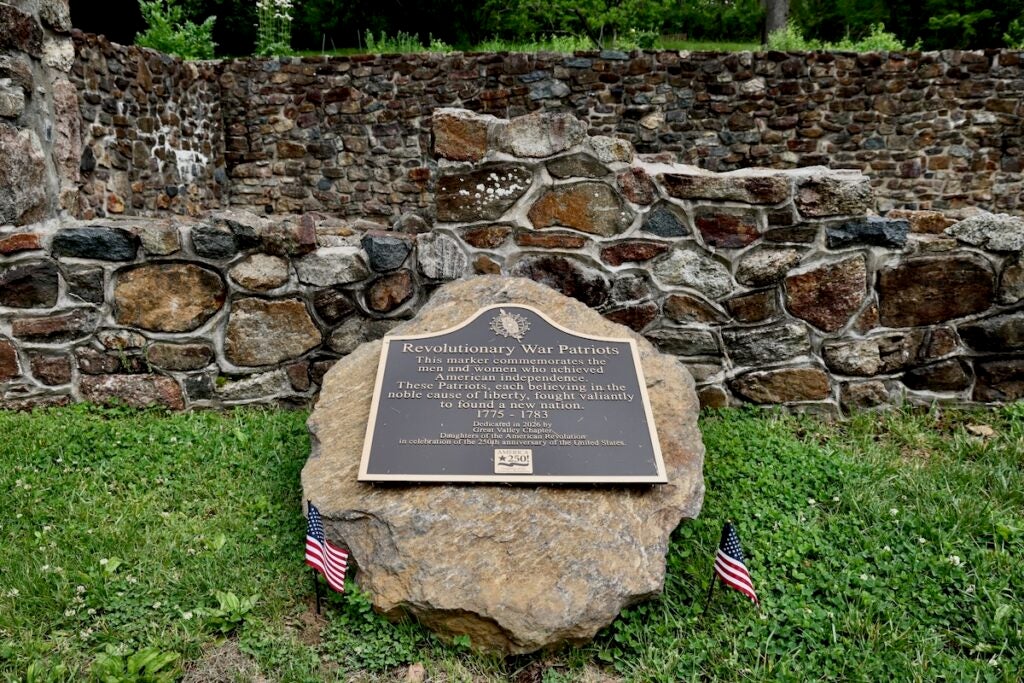
The Daughters of the American Revolution has installed a permanent plaque in Yellow Springs in Chester County, Pennsylvania, to commemorate heroic acts of the Revolutionary War.
But not on the battlefield.
“All the time we have had people asking us if we’re going to do battle scene reenactments at Yellow Springs,” said Historic Yellow Springs Executive Director Tom Compton. “That’s not historically relevant in any way to this site.”
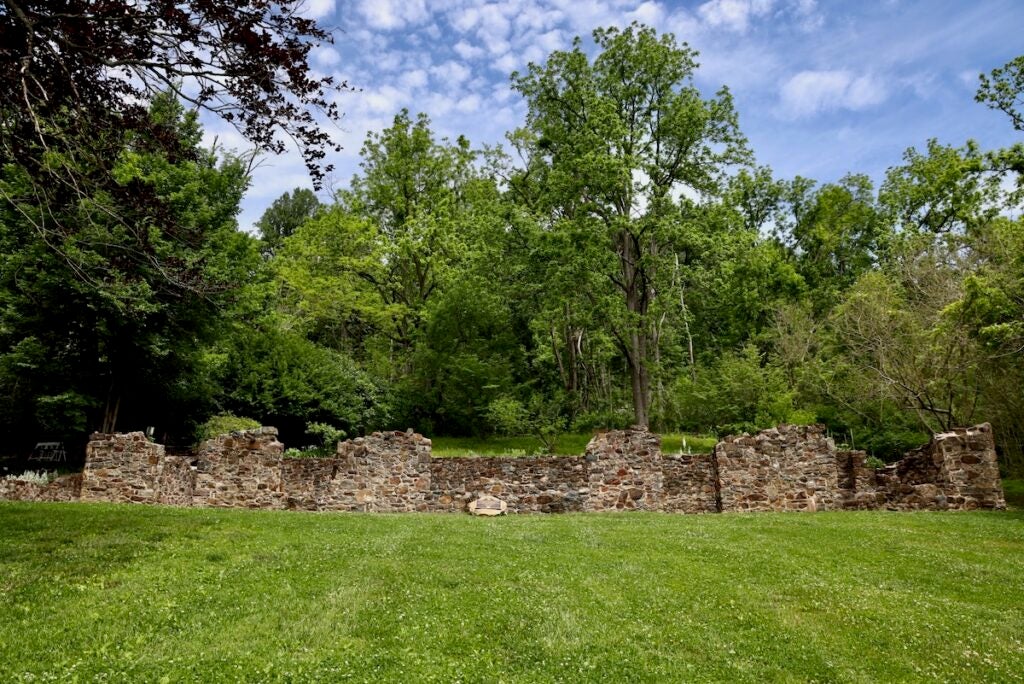
Yellow Springs was the site of a hospital during the Revolutionary War, the only purpose-built hospital of the war, a fact that was lost on Karen Christen when she was growing up in Berwyn, not far from Valley Forge.
“The focus was mostly on Valley Forge, that I recall. We never really heard about a hospital,” Christen said. “We heard about the men and how ill they were and how many deaths there were, but I don’t recall ever hearing where they were treated.”
Christen is the regent of the Great Valley chapter of the Daughters of the American Revolution, or DAR, which installed the bronze plaque at the stone ruins of the Yellow Springs hospital. It is part of a push by DAR chapters across the country to sprinkle plaques among significant sites to mark the 250th anniversary of the signing of the Declaration of Independence.
Other plaques are installed at locations including Paoli Battlefield Historical Park in Malvern, Washington Crossing Historic Park in Upper Makefield Township and the Old Eagle School in Tredyffrin, where many Revolutionary soldiers are buried.
At Historic Yellow Springs, there are plenty of existing signs that explain its historic significance, but Compton says the DAR plaque, gleaming in the sun at the top of a hill, is a standout.
“What I’m so excited about with the DAR signage is its prominence and the appearance of it,” he said. “It really gives the monumental presence that that place deserves.”
Saving the memory of Abigail Hartman Rice
The hundreds of plaques being installed around the country all use the same words to commemorate “the men and women who achieved American independence.” They do not name specific people or places.
Many amateur and professional historians have been asking the DAR to officially recognize one woman in particular who is believed to have done her patriotic duty at Yellow Springs: Abigail Hartman Rice.
Rice was a nurse at the hospital, according to Sandra Momyer, the former director of Yellow Springs.
“She started bringing over hot food for the patients, thinking that would help them. But when she saw the conditions here and saw how ill and in dire need of support, she started coming over more often,” Momyer said. “She bathed the men, she changed the bedding, she changed their clothing. It became a regular thing.”
Rice tended to soldiers suffering from disease, which was far more deadly than combat wounds during the war. Through her work, she contracted typhus, which ultimately killed her at 47 years old, leaving behind 21 children.
During the war, she was believed to have received into her home Gen. George Washington, fresh from his defeat at Brandywine. The tired general stopped at the Rice home where, according to published family lore, Abigail gave him a refreshing rum flip cocktail.
“We have no titles here, we are all brothers,” a defeated Washington is believed to have told her. “My heart is with my poor men who lie in the battlefield at Brandywine.”
During that visit, the general was believed to have held Rice’s young daughter, Susan, which caused subsequent generations to name their children Susan.
“There are a lot of Susans in the descendants,” said Holly Trostle Brigham, a Philadelphia-based artist and one of Rice’s fourth-great-grandchildren. “It comes down from that story, whether or not it was true.”
The DAR once recognized Abigail Rice as a patriot. In 1915, the Washington, D.C., chapter was named after her, and a plaque with her name was installed in the Washington Memorial Chapel at Valley Forge.
But after the 1976 bicentennial flooded membership to historically high levels, the DAR began to adopt more exclusive historical requirements to declare someone a Revolutionary War patriot. Family lore was no longer accepted, only explicit historical documents could prove an ancestor offered “material aid” to the war of independence.
By the 1990s, Rice’s name was stripped from the DAR chapter and from its official registry of patriots. The DAR database now lists Abigail, under her full name Maria Appolonia Abigail Hartman Rice, with the caveat “Future Applicants Must Prove Correct Service.“
“We don’t have that definitive piece of information that says she was 100% here,” Christen said. “We got a lot of — for lack of a better word — hearsay, stories that are handed down through families, which oddly enough are not always true.”
“I certainly am not saying that about Abigail, because I personally believe she was here. I think she was here. I think she was probably integral in what was going on here,” she said. “We just haven’t been able to find the piece of documentation to say ’yes’ for a fact.”

Related Content
Chester Springs preserves the site of the only military hospital built during the Revolutionary War
While George Washington’s army waged war against Britain, Yellow Springs Hospital fought a deadlier enemy: contagious disease.
8 months ago
Listen 3:39The Abigail army marches on
Rice left behind a jaw-dropping 21 children. Now, two and a half centuries later, the descendants pushing for her recognition are legion.
While most descendants, like Brigham, occasionally poke around archives in their spare time to look for the document that will prove Rice’s service, Lynn Elliott of Abingdon, Virginia, says an online group of about two dozen descendants are actively sharing tips and resources to find the holy grail.
“We’ve never met in person, but we’re trying to piece together information we have, sources we’ve each come across, to find some concrete, written evidence of Abigail’s service,” Elliott said.
One of the main hurdles in doing historical research on women of the Revolutionary War is that so few records were kept. There are muster rolls and pension records that kept track of men who served, but most service by women was never noted down anywhere.
In the 18th century, nursing was not a profession even as women performed that role, but that kind of work could carry a social stigma, according to historian Meg Roberts, who is working toward a doctorate degree at the University of Edinburgh.
“Outside the walls of the hospital, in the general urban and rural communities, women had a lot more medical authority over the treatment of family and friends,” Roberts said. “But as soon as you’re in the hospital, it’s often working women, poor women, women that don’t have other options. It’s below the status of a domestic servant, in terms of stigma, because you’re working with a stranger’s bodily fluids.”
Roberts said 18th century documentation is notoriously sparse for female medical practitioners.
“They’re extremely absent,” Roberts said. “There’s no contemporary evidence for their work as nurses at all.”
A drink of rum may save the day
Elliott said she had believed she was onto a breakthrough when she discovered one of Rice’s children may have kept a journal, which might have documented her work at the hospital — but the trail went cold when she learned the journal had likely been destroyed.
Another possible route to official recognition may be that rum cocktail Rice supposedly made for Washington when he came to her house after the Battle of Brandywine.
“We know Washington was in the area because of the battle of Brandywine. He was sending missives. It’s documented from other sources that he was out and about interacting with people,” Elliott said. “It really stands to reason that he could have come across the Rice farm and had this exchange.”
“One of the standards for approving patriotic service is providing material aid. To hand George Washington a drink is providing material service to the cause,” she said. “So that may ultimately — whoever’s got two years to wait it out — end up being the way we can reinstate Abigail.”
Elliott said Rice likely has many supporters owing to her copious family line, but she is hardly the only Revolutionary-era woman to go officially unrecognized as a patriot: Rice’s neighbor, Christina Hench, also likely served as a nurse and also contracted typhus from it.
Margaretta Werkiser of Tredyffrin is believed to have walked to Philadelphia when it was occupied by the British Army in 1778 and slipped back out past the army guards smuggling medicine for American soldiers under her dress.
Her patriotic act of running contraband is not officially documented, but appears in a published family history.
Werkiser is not officially recognized by the DAR, but she is buried in the Old Eagle School cemetery with a marker carrying these words:
“Verses on tombstones are but idly spent, the living character is the monument.”

Get daily updates from WHYY News!
WHYY is your source for fact-based, in-depth journalism and information. As a nonprofit organization, we rely on financial support from readers like you. Please give today.
Part of the series
Philadelphia 250
The United States is marking its semiquincentennial — or its 250th anniversary — in and around the City of Brotherly Love.

After days of oppressive heat, thunderstorms cut Philly’s July 4th concert short
After storms forced attendees to evacuate, the concert resumed around midnight with a shortened performance by The Roots, followed by fireworks.
2 months ago
Listen 0:55
Patriotic Pet Parade at Betsy Ross House in Old City celebrates America’s 250th birthday
The competition boasted 22 pets donning a range of red, white and blue attire.
2 months ago
Chester Springs preserves the site of the only military hospital built during the Revolutionary War
While George Washington’s army waged war against Britain, Yellow Springs Hospital fought a deadlier enemy: contagious disease.
8 months ago
Listen 3:39