
Gen Z college graduates in Philadelphia are facing tough odds in the job market
With a historically bad job market, phantom job listings and a loss of entry-level positions due to AI, young Philadelphians are sounding the alarm.
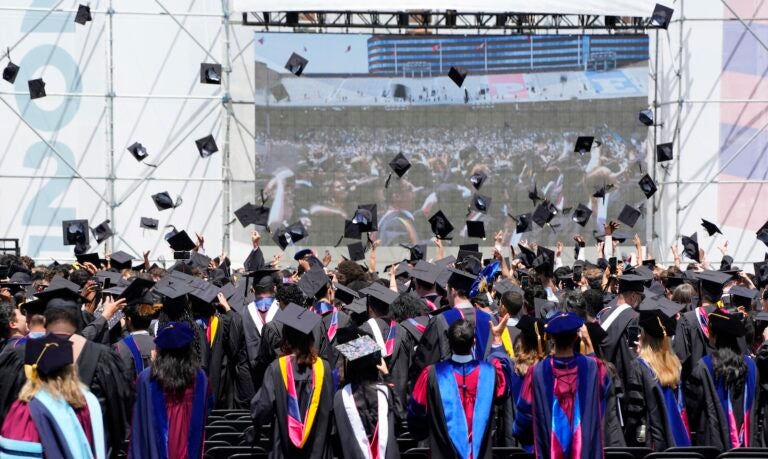
The class of 2025 celebrates their graduation at the University of Pennsylvania's 269th commencement on Monday, May 19, 2025, in Philadelphia. (Charles Sykes/Invision/AP)
From Philly and the Pa. suburbs to South Jersey and Delaware, what would you like WHYY News to cover? Let us know!
Ary Marrow says that people often come into the cafe where she works to do their remote job or work on a school assignment. If you look around the room, everyone’s head is buried in their laptop.
The recent Temple University graduate says it is demoralizing.
“You’re sweeping the floor or something, and it’s like I have qualifications too,” Marrow said. “I just can’t find a job.”
Recent Gen Z graduates in Philadelphia are struggling to break into the fields they studied. The generation is broadly defined as those born roughly between 1996 and 2010.
Entering one of the most challenging job markets in years, as the young adults face a growing number of “ghost jobs” and a loss of entry-level positions due to artificial intelligence, for some the job-seeking process has become a never-ending nightmare.
Marrow graduated from Temple in 2024 with a degree in psychology. While looking for a position in her field, she’s been working at Good Karma Cafe, a coffee shop in Center City. Before moving in with her boyfriend, she had two jobs to support herself.
Since graduating, the 24-year-old has had interviews and a few follow-ups from employers, but nothing has led to anything permanent. Even with the relevant qualifications positions are asking for — a four-year degree, internship experience — she says job prospects are “looking kind of grim.”
“My experience has been kind of throwing job applications into the void and hoping you hear something back,” Marrow said.
Related Content

Ban it or use it? How teachers are grappling with generative AI in the classroom
Generative AI tools have transformed classrooms. But local teachers and school districts are still deciding on whether, and how, to use them.
7 months ago
Listen 12:29Ghost jobs and AI are creating issues for applicants
In addition to a historically difficult hiring market, not seen since the aftermath of the great recession, recent graduates face two novel challenges: an increase in “ghost jobs” and the rise of artificial intelligence.
Ghost jobs describe openings companies list that don’t actually exist or have already been filled, but remain posted. Marrow says that when she sees a position online, she’s not sure whether the listing is real or not.
With these ghost jobs making up 30% of openings listed, according to a MyPerfectResume analysis of Bureau of Labor Statistics data, spending time differentiating between legitimate and fake postings adds another layer of difficulty to the job hunt.
Once an applicant is able to discern real positions from the fake ones and submit their resume, cover letter and references, there is no guarantee that their application will be seen by a human being. The advent of artificial intelligence has led to roughly 90% of companies using AI to review resumes, according to the World Economic Forum.
Marrow wondered if her resume was the reason she wasn’t getting hired, so she got it reviewed.
“They said it was fine,” Marrow said. “But then they were like, ‘Just use AI, it’ll tell you what to put on there.’”
With AI use becoming a day-to-day fixture in many people’s lives, and recruiters even giving advice on how to use the technology for your resume, job applications are heading towards a process where there is less of a human element, instead replaced by a conversation between AI-generated resumes evaluated by AI reviewers.
This technology is not only changing the hiring process — it is actively eliminating jobs.
When choosing what to study at college, Fiona Gaugush says she picked computer science for the same reason as many others: the promise of job security. Once hailed as the surefire way to find work after college, recent computer science graduates are now struggling to find jobs.
Unemployment rates are sitting at 6.1% for the major, more than double the percentage of stereotypically riskier degrees like art history, which has a 3% unemployment rate, according to a Federal Reserve Bank of New York study.
Gaugush works with Marrow at the Center City coffee shop and graduated from Barnard College, a private liberal arts college in New York City, this past May. Her plan was to move back to Philly and live with her mom, while applying to jobs and working in the service industry.
So far, she has not been able to break into the tech industry and said that a recent conversation with a software engineer confirmed fears of AI replacing entry-level workers.
“He was telling me that it’s true, they’re developing AI to do these menial, sort of developmental tasks,” Gaugush said.
There are two ways that AI can affect job duties, according to Samuel Solomon, an assistant professor of economics at Temple. The first is that the technology has the capability to perform the main task of the occupation. The second is AI replaces only supplementary duties, allowing the worker to focus on the most important matters at hand.
“The idea there is that it’s going to have a lot more implications for employment because now AI is actually doing the main task of what you had to do.” Solomon said. “Versus in the latter case, it’s really refocusing your time on the main tasks and making you more productive.”
Solomon said that computer science jobs fall into the former category. Since AI has shown that it can do a lot of these main tasks, the demand for entry-level workers is slowing down.
Pointing to data from Revelio Labs, Solomon explained that entry-level job postings are down in general. In these types of roles that are highly exposed to AI, the number of listings have dropped almost 41% from January 2023, according to Revelio Labs.
Related Content
At the University of Delaware, a writing professor teaches students to use AI responsibly, exploring its capabilities and fact-checking tools.
3 months ago
Listen 1:45A mental toll and switching strategies
Unable to find work in the city after graduating from the University of Pittsburgh in 2024, Ryan Walukonis moved back home to the Philly suburbs. The 24-year-old Delaware County resident says a year and a half of rejection has taken a lot out of him.
He says he has read the phrase “sorry we’re looking for someone with a different set of qualifications” in an email hundreds of times.
Walukonis made it to the final round of interviews at GoPuff, the Philly-based food delivery platform. He was told it was between him and one other candidate, but he didn’t make the cut — the other person had a company connection.
“I thought I was a great candidate and just being told ‘no,’ it really makes me doubt my own abilities, doubt what I’m worth, doubt what I can do,” Walukonis said. “So that’s been a really tough mental aspect of it.”
He describes feeling a loss of autonomy moving back home, from the city to the suburbs. “I’m not living my own life anymore,” he said.
Now, Walukonis is asking for outside help. He’s looking to find a career coach that can assist him and land a permanent role. He said that someone with more connections could be the key to finding a job.
After six months of technical interviews, talking with recruiters and not getting a lot of feedback, Gaugush also decided to take a more mindful approach to applications.
“I just felt like I was putting all my applications in a pit,” Gaugush said. “I did that basically until October or November, I was just applying, applying, applying.”
Recently, the computer science graduate took a step back from constant job applications and focused on making human connections. Gaugush has been taking the time to speak with people running their own startups and networking with more experienced professionals.
Even though she’s slowing down the active job hunt, these conversations have been beneficial in the application process. She said that a recent connection led to an interview for a coding job.
Taking a step back has also helped Gaugush’s mental state. The constant stress of endless applications combined with work in the service industry can be draining.
“I feel like that’s been fruitful, mentally,” Gaugush said. “It feels like I’m not, you know, hopeless.”

Get daily updates from WHYY News!
WHYY is your source for fact-based, in-depth journalism and information. As a nonprofit organization, we rely on financial support from readers like you. Please give today.

Center City Whole Foods workers vote in favor of unionizing
Philadelphia union organizers say the vote is about more than just higher wages and better benefits. The store is on track to become the first in the U.S. to unionize.
1 year ago

Are return-to-office mandates helpful or harmful?
Mayor Parker is ordering city workers back to the office five days a week. Who is winning the battle between remote and office work?
Air Date: May 22, 2024 12:00 pm
Listen 50:04
Philadelphia businesses say they struggle with labor, access to money
Economists forecast that the Philly region will see a “soft landing” instead of an abrupt halt to business in the new year.
2 years ago
Listen 1:19