
Philly’s next budget includes funding for proactive rental inspections, modular home factories
The $7.1 billion plan contains many of Mayor Cherelle Parker’s housing priorities, but none of the staffing requests made by elected officials.
Listen 0:50
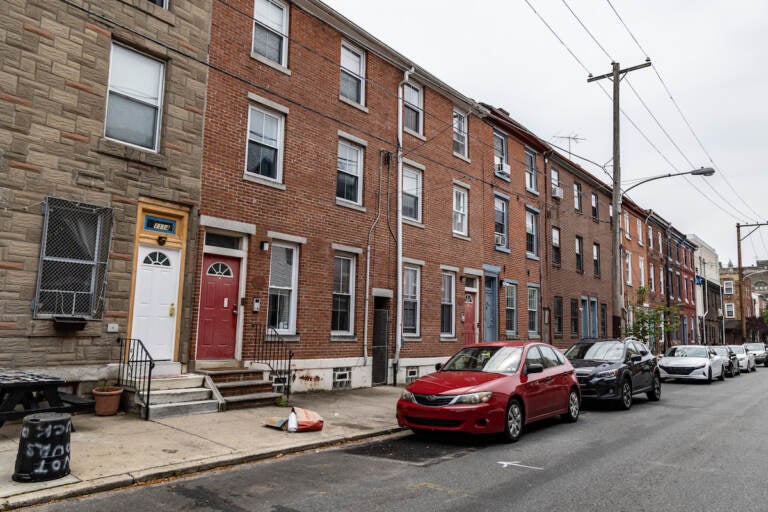
Rowhouses in Philadelphia’s Spring Garden neighborhood. (Kimberly Paynter/WHYY)
Have a question about Philly’s neighborhoods or the systems that shape them? PlanPhilly reporters want to hear from you! Ask us a question or send us a story idea you think we should cover.
Philadelphia’s next city budget contains millions aimed at easing an ongoing affordable housing crisis — but leaves some housing priorities on the cutting room floor.
The $7.1 billion plan, which was passed and signed last week, includes $7.5 million to expand Philadelphia’s proactive rental inspections program and $10 million to support building a modular home factory at a still-to-be-determined location.
The deal also includes a modest increase in operating dollars for the Philadelphia Land Bank, the quasi-governmental agency charged with putting vacant city land into productive use. The majority of the land is used for affordable housing.
The investments were all part of Mayor Cherelle Parker’s budget proposal. Each is tied to the administration’s Housing Opportunities Made Easy, or H.O.M.E. initiative, the mayor’s plan to preserve and build 30,000 homes.
“We see housing as a gateway to economic mobility — and I know City Council does too,” Parker said during her budget address in March.
Lawmakers pushed to add staff to Philadelphia’s Fair Housing Commission, the agency responsible for enforcing many of the city’s renter protections. But funding for those positions was not included in the final agreement.
Similarly, a request from the Sheriff’s Office to expand its eviction unit went unfulfilled.
Here’s what else to know:
Proactive rental inspections
The city’s Department of Licenses and Inspections quietly launched a proactive rental inspections program earlier this year, bringing Philadelphia in line with other major cities.
In April, Council passed legislation backing the initiative. The measure was not needed for L&I to create the program, but proponents say having political support could help make the case for a more permanent program down the line.
For now, the initiative will operate as a citywide pilot.
The new funding will be used to expand the initiative. That includes increasing capacity. Currently, the program has five dedicated inspectors. Department officials hope to add as many as 13 to that total.
They have said the goal of the program is to inspect all licensed rental properties in the city on a rotating five-year cycle. Properties are expected to be prioritized based on their history of code violations and risk to the public.
It’s unclear when that work will start.
“The Department of Licenses and Inspections Quality of Life Division (L&I QOL) is committed to being a part of a city government that renters can see, touch, and feel and intends to expand this program (via hiring, obtaining equipment, etc.) after the fiscal year begins on July 1st,” a spokesperson said in a statement.
Fair housing advocates have pushed for a proactive rental inspections program for years. They say many tenants fear they’ll be evicted if they speak up about dangerous living conditions, and that having such a program would help reduce the possibility of that kind of retaliation.
Until recently, city inspectors only investigated a property if a formal complaint was filed with the department.
Related Content
Philadelphia Mayor Cherelle Parker signs $7.1B budget into law following City Council approval
After weeks of debate, City Council approved the budget without Mayor Parker's proposed taxes on ride-share and short-term rentals.
2 months ago
Listen 1:12A modular home factory in Philly?
On a frigid January day, Parker huddled outdoors with residents and union leaders in North Philadelphia to announce that her administration was working to bring a modular home factory — potentially a handful of them — to the city.
A day earlier, the city had begun soliciting information from industry experts with the goal of releasing a request for proposals, or RFP, at a later date.
“We are all moving in a unified way to attempt to do what has never been done in the city of Philadelphia before. And that is to create a manufacturing hub for housing,” Parker said from a portable stage in Logan.
Now, six months later, Parker has $10 million to put toward that goal.
The funding will help with site preparation, utilities and infrastructure improvements that “support the development of underutilized assets that could be candidates for this type of facility,” according to a spokesperson for the Department of Planning and Development.
The mayor has floated the idea of bringing factories to locations where “persistently” vacant schools now stand, as well as to the infamous Logan Triangle in North Philadelphia.
Nearly 1,000 homes once stood at the site, a 35-acre parcel near Roosevelt Boulevard. The city demolished them after the discovery that they were hopelessly sinking into the unstable soil beneath them. It’s been vacant ever since.
It’s unclear when the city might release an RFP.
Unfulfilled staffing requests
The Fair Housing Commission has a long history of being understaffed.
Lawmakers sought to remedy that problem by requesting funding for three additional investigators. They also backed the mayor’s proposal to bring on a deputy director.
Proponents argued the commission needed to increase capacity to handle a growing caseload. The agency is projected to process more than 700 cases next fiscal year, in part because of newly passed renter protections. Officials handled more than 600 during the current fiscal year.
If approved, the commission’s budget would have jumped more than 50% to roughly $1.2 million.
In the end, only the deputy director position made it into the budget.
The result is considered to be a casualty of Council’s decision to oppose most of the tax proposals Parker sought in her spending plan. That included a controversial $1-per-ride tax on ride-hailing companies the administration had hoped would generate recurring revenue for the Philadelphia School District, which is facing a budget deficit.
Parker also wanted to tax Airbnb and other short-term rental companies, as well as retail delivery services like Door Dash. Those dollars were to have gone toward homelessness prevention services and filling potholes.
“There was no chance at all because of the deal that was reached,” said Jordan Levy, spokesperson for Councilmember Nicolas O’Rourke, who pushed for the additional staffing.
It’s unclear why the Sheriff’s Office didn’t get the additional staffers it was seeking. A spokesperson declined to comment.
Sheriff Rochelle Bilal wanted to more than double the size of her office’s eviction unit, a budget request aimed at clearing a sizable backlog of cases and keeping pace with new ones.
The office currently has eight to 12 detectives assigned to perform eviction operations each day, including lockouts. To meet the demand, Bilal hoped to hire another 14 detectives as part of a broader push to increase headcount across the office.
Landlords supported the request, saying it is taking too long to get tenants evicted, costing them rent while putting their businesses at risk.

Get daily updates from WHYY News!
WHYY is your source for fact-based, in-depth journalism and information. As a nonprofit organization, we rely on financial support from readers like you. Please give today.
Brought to you by PlanPhilly

PlanPhilly
In-depth, original reporting on housing, transportation, and development.
Backyard homes and basement apartments could become easier to build in Pa. Here’s why
Accessory dwelling units would help close the gap of affordable rentals, supporters say.
1 month ago
Listen 1:19
Trump budget proposal threatens Philly’s effort to increase supply of deeply affordable units
Amid an affordable housing crisis, the Philadelphia Housing Authority is spending billions to expand its portfolio of subsidized units.
2 months ago
Listen 1:11
Philly homeownership program launches first project in 8th District
Elected officials and residents gathered Monday for a groundbreaking ceremony on the 1600 block of West Venango Street.
2 months ago
Listen 1:00